Kinnetly is a private personal CRM built around a visual graph. Kinnetly maps your relationships, introductions, meeting context and follow-ups, so you can remember who you know, how you met and what to do next. Get started free (no credit card required, no time limit). Upgrade to Standard or Pro plans if you need more included (see pricing page on the Kinnetly website).
What became possible in your product with Astra that was not practical before?
Maker
This launch became possible only after I ran security audits and fixing security vulnerabilities using Astra.
Report
Maker
📌
Hey Product Hunter 👋
I’m Eyal, the builder of Kinnetly.
I built Kinnetly because I kept getting frustrated with the same problem: I could remember that I knew someone, but not the story around the relationship.
Who introduced us? Was it through an intro by a mutual contact, at an event, through a company, or in a group conversation? What did we talk about? Was there something I promised to send? Who else were they connected to?
Most tools in this category treat relationships like a list.
Contacts are rows. Notes are buried inside profiles. Reminders sit somewhere else. Introductions are hard to trace. And after a while, the story of how people connect disappears.
That never felt right to me.
After all, visual representations are easier and more intuitive because the human brain is evolutionarily hard-wired to process images 60,000 times faster than text, allowing for nearly instantaneous comprehension of patterns and trends.
So I built Kinnetly around a visual graph from the start.
Here’s what makes it different:
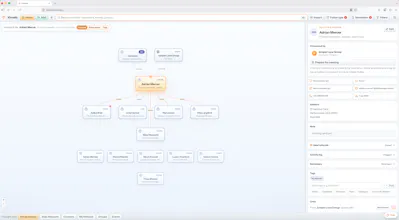
- Visual graph UX: Your network is shown as connected people, companies, groups, events and introductions, not a flat contact database.
- Relationship context first: Kinnetly helps you remember how you met, who introduced whom and why the relationship exists.
- Introductions have provenance: You can see the path behind a warm introduction instead of losing it in a note field.
- Built for individuals: This is a private personal CRM, not a sales CRM, team pipeline tool, or outreach machine.
- Follow-ups with context: The point is not just “message this person”. It’s remembering what matters before you do.
- Private by default: Your relationship map is yours. It’s not a social network and it doesn’t auto-log your inbox or calendar.
The core idea is simple: when you can see your relationships, you remember them better.
I’m launching Kinnetly for people whose work depends on long-term trust: founders, consultants, recruiters, investors, advisors, community builders, networkers and anyone who relies on warm introductions.
I’d love for you to try it and tell me what feels missing.
When you think about your own network, does it feel like a contact list, or a relationship map?
Report
I’ve made an account and it’s so easy to get started I loved the user experience. Actually a simple, easy to use CRM-like software for once. Great work, love the concept!




Hey Product Hunter 👋
I’m Eyal, the builder of Kinnetly.
I built Kinnetly because I kept getting frustrated with the same problem: I could remember that I knew someone, but not the story around the relationship.
Who introduced us?
Was it through an intro by a mutual contact, at an event, through a company, or in a group conversation?
What did we talk about?
Was there something I promised to send?
Who else were they connected to?
Most tools in this category treat relationships like a list.
Contacts are rows.
Notes are buried inside profiles.
Reminders sit somewhere else.
Introductions are hard to trace.
And after a while, the story of how people connect disappears.
That never felt right to me.
After all, visual representations are easier and more intuitive because the human brain is evolutionarily hard-wired to process images 60,000 times faster than text, allowing for nearly instantaneous comprehension of patterns and trends.
So I built Kinnetly around a visual graph from the start.
Here’s what makes it different:
- Visual graph UX: Your network is shown as connected people, companies, groups, events and introductions, not a flat contact database.
- Relationship context first: Kinnetly helps you remember how you met, who introduced whom and why the relationship exists.
- Introductions have provenance: You can see the path behind a warm introduction instead of losing it in a note field.
- Built for individuals: This is a private personal CRM, not a sales CRM, team pipeline tool, or outreach machine.
- Follow-ups with context: The point is not just “message this person”. It’s remembering what matters before you do.
- Private by default: Your relationship map is yours. It’s not a social network and it doesn’t auto-log your inbox or calendar.
The core idea is simple: when you can see your relationships, you remember them better.
I’m launching Kinnetly for people whose work depends on long-term trust: founders, consultants, recruiters, investors, advisors, community builders, networkers and anyone who relies on warm introductions.
I’d love for you to try it and tell me what feels missing.
When you think about your own network, does it feel like a contact list, or a relationship map?
I’ve made an account and it’s so easy to get started I loved the user experience. Actually a simple, easy to use CRM-like software for once. Great work, love the concept!