
JobCubby
Run your job search like it's your job
61 followers
Run your job search like it's your job
61 followers
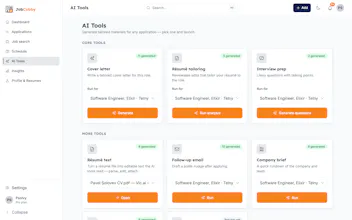
JobCubby is a job-search command center: track every application from saved to offer, with AI that assists but never impersonates you — tailored cover letters, screening-answer prep, résumé feedback and interview practice. Unlike generic trackers, it has a built-in job feed and ships its own MCP server, so you can run your entire search from Claude or any AI assistant. Autopilot watches new postings and preps applications for you. Free to start.




Hi Product Hunt!
I built JobCubby after watching my own job searches dissolve into chaos - applications scattered across tabs, spreadsheets and email threads, follow-ups forgotten, and every cover letter written from scratch at 1am.
The idea: run your job search like it's your job. One place to track every application from saved → applied → interview → offer, with AI doing the heavy lifting - cover letters tailored to the posting, screening-question prep, résumé feedback and interview practice. There's also a built-in job feed with about 100k new positions monthly, so you can go from "found it" to "applied" without leaving the app.
The approach evolved a lot along the way. The biggest shift: I stopped trying to make the AI do everything for you and made it assist-only - it prepares drafts, scores matches and drafts screening answers, but you always hit submit. Job hunting is personal; the tool should amplify you, not impersonate you.
The second shift was opening it up to AI assistants: JobCubby ships an MCP server, so you can manage your whole search from Claude or any MCP-capable assistant - "log this application, schedule the interview, prep my answers." absolutely free.
For the technically curious: it's written in Elixir + Phoenix LiveView end to end, so every screen is real-time server-rendered, and the same OTP machinery runs the job feed sync and the AI pipelines.
Launch treat: code PRODUCTHUNT gets you 20% off, live all July. Happy to answer anything!
@solopa Interesting idea but you're asking people to hand an AI agent write access to literally their entire job search, salary expectations, work history, who they know at which company. That's some of the most sensitive data a person has, especially if they're searching while still employed. Where is this data stored, who can see it, do you train models on it, and what happens to it if JobCubby shuts down? Job search tools come and go fast so I'd want to know there's an export and delete story before putting anything real in there.
@suyash_kr Hello!
Postgres encrypted at rest, TLS everywhere. Nobody sees your data except you, there's no team browsing dashboards.
Never training. Your data doesn't train anything, mine or anyone else's. The AI only touches your data when YOU connect an assistant, and even then it goes through OAuth scopes you approve, read / write / destructive are separate, so you can give an agent read-only and it physically can't destroy anything. Every call is logged for 60 days and you can revoke any agent in one click.
Full JSON export anytime in the settings (already implemented), your data is yours.
Delete account is actually deletes, not "deactivates". Gone from backups also within 30 days.
if JobCubby ever dies, everyone already gets exports and i guaranty a 90 days notice. But it's not my plan!
Thanks for the detailed answers in the comments, Pavel, especially the breakdown on scoped OAuth permissions for connected agents. Splitting read/write/destructive access so a connected assistant can be given read-only is the right default for something holding someone's whole job search.
A concrete case where the MCP server helps: someone actively interviewing who wants Claude to log a new application and draft screening answers between meetings, without switching to a separate tab to update a tracker by hand afterward.
I noticed the exchange with Manjeet about self-hosting and AGPL. We work on Heym, which is self-hosted and source-available in a similar automation and MCP space, so I get why that request comes up for anything holding salary history and employer contacts. If the tracker core does eventually get open sourced, would that be something people could realistically self-host against their own Postgres, or more of a reference implementation without a full deployment story behind it?
The assist-only stance, drafts prepared but a person always hits submit, seems like the right line to hold as more of this becomes agent-driven on both sides of the hiring process.
@mbakgun Hello!
Thanks, and nice to see Heym here, more source-available tooling in this space is good for everyone honestly.
Your interview-week case is exactly the loop I built this around: log the application, draft the screening answers, keep prepping, and the tracker just stays current in the background.
On the self-hosting question, honest answer with the same caveat as above: nothing planned right now. But hypothetically it wouldn't be a reference-implementation situation. It's a Phoenix app, and Elixir releases compile to a single artifact, so the realistic shape is one container plus your own Postgres, migrations included. The deployment story is kind of the free lunch of the stack. What wouldn't come along is the shared layer (postings index, market stats, matching), that only exists because it aggregates across users.
And yes, assist-only is a hill I'll die on. Drafts from the agent, submit from the human. The moment tools start submitting on people's behalf, recruiters stop trusting applications entirely and everyone loses.
@solopa Congrats on the launch! Looks clean. Honest question though, I've been tracking my job search in a Notion template for years and before that a spreadsheet, and tools like Teal and Huntr already do the tracker plus AI resume thing. What actually made you build another one? Is the MCP stuff the whole pitch or is there something in the core tracker that made you switch from whatever you used before?
@abhiranjan_mehta Thanks!
Fair question! Teal and Huntr are genuinely good, no hate.
The honest answer: I built this during my own job search. I was already doing everything with an AI assistant anyway, cover letters, interview prep, digging through Gmail, and then copying it all into a tracker by hand like a clerk. That copy-paste tax is what JobCubby kills.
So yeah, MCP is the pitch, but the framing matters: it's agent-native, not a tracker with a chatbot bolted on. Your assistant (Claude, Cursor, whatever) gets the whole thing as tools and keeps it current while you just... talk to it.
If Notion works for you and already configured, honestly, stay there. This is for people who already live in an AI assistant daily.
Coming at this from the other side of the table. Slightly terrifying to imagine candidates showing up with an AI that logged every interaction with me, follow-up timing optimized, my name saved as a contact with notes. The power balance in hiring has been tilted toward companies with ATSs for decades, so honestly, fair play. Just funny to watch the tooling arms race arrive at our doorstep.
@himanshi_kum563 Hello! Your comment made my day!
You're right, it's an arms race, except your side has had CRMs with notes about us for twenty years, so welcome to the mirror :)
Honestly though, I think you win from this too. A candidate with organized notes follows up once at the right moment instead of three anxious pings, shows up remembering what you actually discussed, and doesn't double-apply to your company because their spreadsheet fell apart. Organized counterparties are just... nicer to work with, on both sides of the table IMO.
And if it ever gets truly terrifying, remember you can always tell candidates the timeline upfront. Nothing disarms follow-up optimization like an actual answer ;)
The MCP server angle is genuinely useful, I ran my whole search from Claude last week and it felt like having a personal assistant without the awkwardness of copy pasting. Cover letter drafts are solid, just need to tweak the tone a bit.
@emeltanaslan Thank you for the feedback!
Yes, i totally agree with it
Honestly the MCP server angle is kind of brilliant, I would love to see a salary negotiation prep mode built in. Like, have the AI help you benchmark offers, draft counter emails, and prep you for compensation conversations using data from the role and your tracked experience.
@hasanmutl9pxx Thanks a lot for the kind words, really appreciate it!
You basically described what's already there. Salary benchmarking, counter offer emails, comp conversation prep, all of it runs on prompts I've been testing and tuning for a while. The prompt chains already pull in everything relevant on their own: the attached application, your profile and the resume tied to it, your search statistics, and most importantly your rejection reasons, so the prep is grounded in your actual track record, not a generic template. You can also add your own comment to any generation before it runs, so the output stays in your voice.
For the benchmarking part specifically, there's a public hiring stats page at https://jobcubby.com/jobs/stats with weekly numbers per technology: posting counts, disclosed salary medians, remote share and top hiring companies (charts are coming in a few weeks once there's enough data). And it's not just UI, the same stats are already exposed over MCP too.
All of this works on the free tier, you get 15 AI calls a month, enough to cover a handful of active applications.
And here's where the MCP part gets fun. If you already have your own agent, Claude or anything MCP capable, you can skip the built in AI entirely and use JobCubby as the backbone. The agent can do literally everything you could do by hand in the app: read your tracked experience, pull role data and hiring stats, update statuses, log events. The only thing it can't call is the internal AI tools, because you're bringing your own brain to the party. So if 15 applications a month fits your pace, you don't even need a paid plan to run a fully agent driven search.
Would love to hear how it works for you if you give it a try!
PS: I've been running my own job search through JobCubby for the last month and a half, driving the whole tracker via MCP, and for the writing side the app's AI tools already have my tuned prompts ready to go, so I never had to build any of that into my agent.
Take a look at my live progress if interested: https://jobcubby.com/s/psolvy