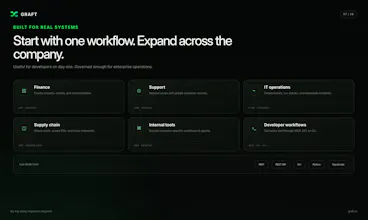
Most agent tools assume clean APIs. Graft starts where companies actually work: legacy apps, internal tools, and workflows trapped behind screens. It learns how the work gets done, turns it into a living operational map, and gives agents stable tools with permissions, approvals, audit trails, and verification built in. When the underlying UI changes, Graft detects the drift and repairs the workflow without breaking the agent interface.
No reviews yetBe the first to leave a review for Graft AI
Operations as a map agents can walk is close to what I do per-client, structured facts an AI can't step outside of. Mine is one brand, yours is a whole company, and I suspect the hard part scales badly. How do you keep the map current when the operations change weekly?
@vladimir_iudin That is the hard part, so we treat the operational map like a versioned codebase, not a static knowledge graph. Every execution, exception, and employee correction is compared against the current map; changes are proposed as reviewable updates, tested in shadow mode, and only promoted after they pass verification. The map stays current because the company continuously contributes to it through normal work, instead of relying on a quarterly process-document rewrite. We're building knowledge graphs, real time data flow mechanisms, more info soon.
Report
@ychampion Shadow mode promotion is the part I want to steal. I do a much smaller version of this, per-client fact bases with a gate that refuses to generate anything not backed by a stored fact, but updates to the facts themselves are still manual and that's where staleness creeps in. One thing I don't get yet: what counts as a failed verification for a process change? Bad code fails a test. A bad "how we handle refunds" update can look fine until a customer hits it.
@vladimir_iudin this is the knowledge we have to extract, it can be possible by recording situations, creating twins of it, asking for approval when not sure, there are many ways. Even we're exploring new architectures.
Report
The problem is definitely a very real one. But how well will your AI understand legacy systems? Have you considered adding a training mechanism?
For example, you could build a browser extension where the user logs into all their systems and shows the AI where everything is located and how each system works. The AI would learn from that, remember it, and then be able to reproduce those workflows later. Something like that would be ideal in my opinion.
@natalia_iankovych Yes, that is very close to the onboarding model we are building. A user demonstrates a workflow through a browser extension or desktop recorder, and Graft learns the inputs, decisions, exceptions, and success conditions, not just the sequence of clicks. It then runs in shadow mode, learns from corrections, and only becomes autonomous once it can reproduce the outcome reliably within the company’s approved rules
Report
spend months trying to get an agent to reliably click though our old internal ticketing system before giving up, this is the exact problem.
@kyle_bennett6 Exactly. The problem is not getting an agent through the UI once, it is making the 500th run as reliable as the first. Graft learns the workflow, turns it into a stable tool like create_ticket or update_case, and verifies the result in the source system so the agent never has to rediscover that interface again.
Report
@Yashas Gunderia thanks for the correction and the detail, that's a clearer picture than I had. the auto-repair-within-minutes plus human approval gate for business-logic changes is the part that actually addresses my original worry, will read the workflow access gap post
@omri_ben_shoham1 sure, if you're interested you can join the waitlist
Report
Really interesting direction.
As companies adopt more AI tools, do you think the biggest challenge becomes connecting knowledge, or getting teams to trust the outputs enough to change how they work?
Graft will be helping f500's transform their legacy applications into operational knowledge basis for agents to use. Agents can interact with their legacy software and help them transition into agent native software, this is a shift we're seeing but companies fail because the data is in people's head as domain knowledge so we're building the infra to make it operational by agents.
Operations as a map agents can walk is close to what I do per-client, structured facts an AI can't step outside of. Mine is one brand, yours is a whole company, and I suspect the hard part scales badly. How do you keep the map current when the operations change weekly?
Graft AI
@vladimir_iudin That is the hard part, so we treat the operational map like a versioned codebase, not a static knowledge graph. Every execution, exception, and employee correction is compared against the current map; changes are proposed as reviewable updates, tested in shadow mode, and only promoted after they pass verification. The map stays current because the company continuously contributes to it through normal work, instead of relying on a quarterly process-document rewrite. We're building knowledge graphs, real time data flow mechanisms, more info soon.
@ychampion Shadow mode promotion is the part I want to steal. I do a much smaller version of this, per-client fact bases with a gate that refuses to generate anything not backed by a stored fact, but updates to the facts themselves are still manual and that's where staleness creeps in. One thing I don't get yet: what counts as a failed verification for a process change? Bad code fails a test. A bad "how we handle refunds" update can look fine until a customer hits it.
Graft AI
@vladimir_iudin this is the knowledge we have to extract, it can be possible by recording situations, creating twins of it, asking for approval when not sure, there are many ways. Even we're exploring new architectures.
The problem is definitely a very real one. But how well will your AI understand legacy systems? Have you considered adding a training mechanism?
For example, you could build a browser extension where the user logs into all their systems and shows the AI where everything is located and how each system works. The AI would learn from that, remember it, and then be able to reproduce those workflows later. Something like that would be ideal in my opinion.
Graft AI
@natalia_iankovych Yes, that is very close to the onboarding model we are building. A user demonstrates a workflow through a browser extension or desktop recorder, and Graft learns the inputs, decisions, exceptions, and success conditions, not just the sequence of clicks. It then runs in shadow mode, learns from corrections, and only becomes autonomous once it can reproduce the outcome reliably within the company’s approved rules
spend months trying to get an agent to reliably click though our old internal ticketing system before giving up, this is the exact problem.
Graft AI
@kyle_bennett6 Exactly. The problem is not getting an agent through the UI once, it is making the 500th run as reliable as the first. Graft learns the workflow, turns it into a stable tool like create_ticket or update_case, and verifies the result in the source system so the agent never has to rediscover that interface again.
@Yashas Gunderia thanks for the correction and the detail, that's a clearer picture than I had. the auto-repair-within-minutes plus human approval gate for business-logic changes is the part that actually addresses my original worry, will read the workflow access gap post
Graft AI
@omri_ben_shoham1 sure, if you're interested you can join the waitlist
Really interesting direction.
As companies adopt more AI tools, do you think the biggest challenge becomes connecting knowledge, or getting teams to trust the outputs enough to change how they work?
Graft AI
Graft will be helping f500's transform their legacy applications into operational knowledge basis for agents to use. Agents can interact with their legacy software and help them transition into agent native software, this is a shift we're seeing but companies fail because the data is in people's head as domain knowledge so we're building the infra to make it operational by agents.
Graft AI
hello everyone, just a quick update. I've updated graft's social media, the old one was the wrong one. Thank you.