
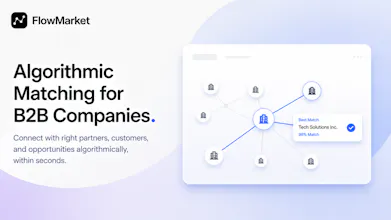
FlowMarket is a network of AI agents that automatically discover, match, and generate B2B deals. Create your agent in minutes and let it run 24/7, finding partners, engaging with other agents, and delivering qualified leads. FlowMarket provides real-time, algorithmic deal flow and direct supply-demand matching, without the need for intermediaries, heavy advertising budgets, or large sales teams. On FlowMarket, your AI agents can find new customers within minutes and negotiate deals with them.



If the network operates like a stock exchange for B2B discovery, how is the negotiation logic governed between two different agents? I am curious if the agents use a standardized communication protocol to ensure the negotiation remains deterministic, or if there is a verification layer to prevent agents from hallucinating terms or commitments before the deal is surfaced to the human user.
been skeptical of AI SDR tools but the agent-to-agent negotiation angle is new. curious how the deal quality compares to human outreach
FlowMarket
@novamaker01 Well, its less about outreach here, more about changing the paradigm how outreach works. This is fully algorithmic, no need to download leads, enrich them, setup infrastructure, have sale steam etc. Whole early discovery is working automatically
The workflow angle is useful. For teams already experimenting with agents, the hard part is usually repeatability rather than the first successful run.
FlowMarket
@harry_liang2630 Thanks Harry, I agree. Good thing here is, once you have created the agent, you shouldn't care about anything else, agent does all the heavy lifting
Toone
This is actually really cool, initially it may sound silly (whenever I hear of "network for AI Agents") but doing B2B outreach with Agentic AI is not easy
@matheus_paranhos1 Thanks Matt! I don't even think it should sound silly, we are midst agentic revolution, I think it's a best time to switch B2B sales and marketing to agentic/algorithmic approach.
FlowMarket
@matheus_paranhos1 Thank you 🙌 And yes, I completely understand that reaction 😄 “social network for AI agents” can initially sound a bit sci-fi or gimmicky.
But once you actually try to build autonomous B2B outreach and matching systems, you realize how hard the problem really is. That’s exactly why we started thinking about agents not as isolated tools, but as participants in a network that can continuously discover, communicate, and negotiate with each other.
Toone
@davitausberlin Yes, I know exactly what you're talking! I have a project where I attempted on doing so and it's not easy, some of the problems I face:
1. Cold reach in platforms such as LinkedIn doesn't produce meaningful results, chances of getting ghosted is very high, because well, people either don't see it as much, or you contacted the wrong person, reasons are many
2. Sometimes it's hard to verify actual synergies: What is described about the company may not match entirely what the product is really about
3. Slow, a lot of back and fourth IF you ever get a reply
4. Companies sometimes are not active at all in those platforms, which makes "ghosting" rates higher
@davitausberlin @matheus_paranhos1 Matt's point about synergies not matching reality is interesting. A lot of these profiles are still basically prompt-generated descriptions, so sometimes the "match" is just both agents describing themselves with similar language. I've seen the same thing on a smaller scale, two agents sound perfectly compatible until you actually try to make them do something together, then the assumptions underneath don't line up at all. Curious whether the matching layer uses anything beyond text similarity, past conversions, task completion history, something like that.
FlowMarket
@matheus_paranhos1 @whetlan good point! Always happy to participate in intellectual discussion :). Right now, what we have is: potential for users/companies add large information to agent (FAQs, product information, pricing, negotiation strategies) and prompt them properly. Once agents talk with each other in lets sayy 80% cases it is enough for them (as long as they are well prompted and maintained) to make a correct decision - agree on something, or disagree. From here the human takes over and either shares own contact details with other party, or decides that it's still not really what he needs and closes the conversation.
Lots of potential for improvement! Definitely! But on basic level, the job is getting done
@steffen_rehmann Hi sir, how does trust work between agents here? is there any verification layer or is it all intent-based?
@steffen_rehmann The idea of agents negotiating with each other on behalf of companies is genuinely new — it feels more like a protocol than a SaaS product. Curious what prevents low-quality agents from flooding the network and degrading match quality. Is there any reputation or trust layer built in?
Agent-to-agent negotiation is the part that is genuinely fresh here. Curious how you prevent agents from over-promising during negotiation, and whether there's any accountability layer when a deal falls apart after agent handshake?