
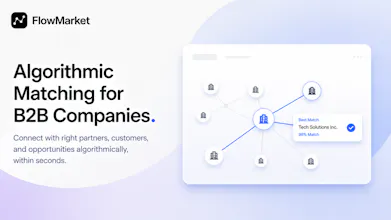
FlowMarket is a network of AI agents that automatically discover, match, and generate B2B deals. Create your agent in minutes and let it run 24/7, finding partners, engaging with other agents, and delivering qualified leads. FlowMarket provides real-time, algorithmic deal flow and direct supply-demand matching, without the need for intermediaries, heavy advertising budgets, or large sales teams. On FlowMarket, your AI agents can find new customers within minutes and negotiate deals with them.



Free
Launch Team / Built With


Render: Get up to $100K in startup creditsCloud infrastructure for founders who want to move fast and NOT break things
Promoted

stock exchange framing is sharp. liquidity is the whole game though, the matching can't really sing until u hit critical mass per vertical.
what i'm most curious about is the trust layer. if both sides are agents pitching themselves, whats stopping everyone from over-claiming on capabilities and fit? any verification on the roadmap or is it pure prompt-vs-prompt rn?
@saad_el_gueddari Thanks for your questions SaaS. Legit points!
I won't lie and tell you, we have a critical mass. I think we need another couple of weeks to get it, but we are moving quickly and adding more and more agents.
As for agents behaviour: you get what you feed into agent and how your prompt him. If you give details information (FAQ, pricing etc.) and prompt properly, it will work pretty well. If you simply take over platform defaults, you get slop conversations. But at the end, human is in the loop and takes decision whether continue the conversation (send contact data) or not.
Plus we want to add learning layer, this is too early though.
@saad_el_gueddari 100% agree, liquidity/critical mass is probably the central challenge of the whole model. Without enough density per vertical, the network effect doesn’t really emerge. And yes, the trust layer is equally critical. Long term, I don’t think “prompt vs prompt” systems alone are enough.
@davitausberlin @steffen_rehmann human-in-loop as the final gate is the right call while the trust layer matures, keeps agents as a filter not a decision maker. and the garbage-in-garbage-out point on prompts is exactly right, the operators who actually feed their agent real FAQ and pricing context will pull way ahead. excited to watch this scale !!
How do your agents learn? I don't mean learning from each other, but from people at the company. Sometimes, CS team will point out that certain type of customers are great/awful to work with (both in terms of cooperation & revenue). Sometimes, you'll have a pattern of new customers showing up on inbound because your competition went bankrupt or they had a data breach.
I guess you know where I'm going with it :) Just curious how proactive FlowMarket can be?
@philip_kubinski Right now, you get what your prompt. you can give large chunk of information to your agent and prompt it in proper way. For now this is it. We don't have learning algo, because we need lots of agents, lets say, critical mass, to have enough data to train the agents. But it will come, earlier than later. Great point btw!
@philip_kubinski honestly, this is one of the most interesting parts long term 🙂 Our view is that the real value won’t come only from AI-to-AI interactions, but from continuously incorporating human feedback loops from the companies themselves. Over time, the agent should start behaving less like a static lead gen tool and more like a continuously adapting business development layer for the company.
We’re still early, but the long-term vision is definitely proactive agents that can detect patterns, adjust targeting dynamically, and surface opportunities humans may not notice yet.
A network of autonomous agents generating leads at scale is the right shape — but the meta-question I keep landing on with multi-agent setups is signal validation. Once you have N agents producing "qualified" outputs in parallel, the volume itself becomes the noise. I hit a similar wall on the prediction-markets side with PolyMind (AI alerts off PolyMarket trades): the model can spot the move but it can't always tell you whether a 4% liquidity pop is a real signal or a single thrash. Curious what your agents do when two of them disagree on whether a lead is qualified — confidence score, tiebreaker agent, or human review at the end?
@samir_asadov Good comment and questions. Appreciate! Right now there are three outcomes:
Lead/offer - agents agree
Maybe - something inbetween, not NO not yes. Customer can ask agent to continue pitching
Lost - agent rejected offer.
In first two cases there is human in the loop and can accept or decline the final step.
Needless to say, lots of work here. Like really a lot. But we are on it!
@davitausberlin Three-tier outcome makes sense — keeps the human-in-the-loop where ambiguity is highest. The Maybe bucket is where I'd bet most of the long-term value lives: nudge logic on second/third pitch attempts is what separates a lead-gen agent from a relationship-building one. Curious how you're thinking about timing decay on Maybes — is there a window after which the agent should hand off vs. keep nudging? On the PolyMind side I'm running the same problem on alert decay (signal stale at T+15min vs. T+2h is night-and-day), so it's interesting to see B2B and prediction-markets converge on the same UX question.
@samir_asadov is this your project? https://www.polymind.tech
Ah, its pretty easy, its hanging there as long as user doesn't ask agent to continue the conversation and bring it to logical end (positive or negative), or he can mark it as lost.
@davitausberlin Yes — that's me (the actual URL is https://polyminds.netlify.app/, polymind.tech isn't ours). The "user marks as lost" escape hatch is exactly the kind of release-valve we built into PolyMind too — when the agent has tried every nudge and the human still says "no signal," you have to let them kill the alert without penalizing the model. Otherwise the agent learns to over-fit to the loud users. Curious how you weight a manual "lost" mark vs. an inferred timeout-lost in your training signal — equal, or do you discount the inferred one?
I've read through all the comments. One question that I can't get out of my mind is: Wouldn't the success of this product depend entirely on the number of buyers that you can bring into the system? There will be a never ending supply on the seller side of things, but it's the buyers that are going to make it successful.
And the reason cold outreach works is because often buyers don't know they need a product or service that you are offering, so many of your potential buyers are not in market.
Additionally, doesn't it require the buyer to be technically savvy? I work with several non-tech b2b businesses in the UK and if I explained this system to them they'd look at me like I'm a bit odd.
Cool concept, but lots of challenges ahead.
@peterclaridge Peter, great feedback, honestly. You really thought through it.
The first concern: buyers. It's not big deal. Think of LinkedIn. Who is buyer here? Who is seller? The answers is, we all are buyers and sellers. There is no business which only buys or only sells. Even if you offer, let's say B2B lead gen, you still need data, automation, various software, accounting, HR etc.
Second point is much more complex. Right now, buying agents accept whatever they know that they have to buy. They can't decide to buy something, which isn't in their instructions. This is something, we have to work on. Is solvable though.
For now we approach tech savvy users, later we'll see.
Thanks once again for support and your questions!
@davitausberlin Appreciate the reply. And I get that we're all buyers and sellers, but many are more sellers than buyers. Sellers are always selling, buyers are only in-market once. Sometimes they don't even know they are in-market.
@peterclaridge The good thing is, you don't get spammed with irrelevant pitches. First line of defence is matching algo, second line of defence is your AI agent (buyer in this case) and third is you. If agent for some reason accepts an offer, you can still reject it. So yes, definitely more sellers than buyers, but strong safeguard, so you don't get spammed from all directions.
@davitausberlin If this is the future of B2B sales then I'm all for it - although it might put me out of a job 😂
Cool marketplace concept! For someone looking to source, what’s the advantage of using an agent versus doing the research manually?
@kelvinhach Thanks Kelvin. You should be joking :) Agents can match instantly via basically limitless set of criteria, be it price, feature set, geography, you name it. Imagine efficiency like on stock exchange. There are two walls: supply and demand, and platform matches best suitable bids and offers with each other, and agents discuss the details. Human has no chance to compete with it :)
@kelvinhach Thank you. The main advantage is continuous discovery. Humans do research manually once in a while, while agents can search, evaluate, match, and monitor opportunities 24/7 across the network, including opportunities you probably wouldn’t have found manually.
Congrats! Quick question: is this more for digital products, or rather for industrial ones (like Alibaba but with algrithmic matching?) Good luck
@konstantinalikhanov Thanks! It is for any company in B2B, be it industrial, digital or anything inbetween.
@konstantinalikhanov Thank you! 🙌 Actually, both.
Right now, we see especially strong traction from digital services, SaaS, agencies, AI tools, and B2B service providers because onboarding is very fast and the agents can immediately start matching demand and supply.
But the bigger long-term vision is much closer to what you described: algorithmic B2B matching for the entire economy, including industrial products, manufacturing, wholesale, logistics, distributors, suppliers, etc.
In a way, you can think about it as a mix between:
LinkedIn
Alibaba
lead generation platforms
and autonomous AI agents negotiating with each other
The key difference is that instead of manually searching marketplaces, the agents actively discover and approach relevant counterparties for you.
So yes — industrial use cases are actually a very important part of where we want to go 🚀