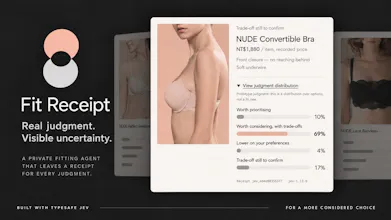
Fit Receipt keeps the person in control:
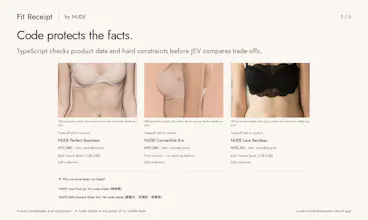
code protects product facts and pricing, while JEV weighs bounded trade-offs and shows uncertainty when the evidence is weak.
Where should an AI fitting agent explain its reasoning, and where should it leave room for personal preference?






Second Eyes
Hi Product Hunt! I'm Crystal, founder of NUDE, a Taiwanese intimate apparel brand.
To buy or not to buy — that is always the question for a shopaholic. 🛍️
After years in our fitting rooms, I've learned there is rarely a 100% "right" bra. Preference and habit matter, but so do things no algorithm sees: the mood in the room, the light, how the person helping you makes you feel. A good store follows a quiet order: you see the piece, we learn how you'll wear it, you try it on, and only then do we talk about the cost.
Fit Receipt brings that order online, along with the part of good service that's about honesty.
The agent understands the person. JEV, a judgment model, weighs the trade-offs between styles. Code protects the facts: product data, prices, promotions. The person owns the decision.
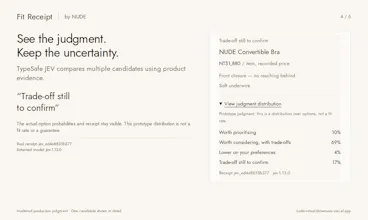
Every judgment leaves a receipt, uncertainty included. When the top option sits at 69%, it still says "trade-off still to confirm."
We don't cure choice paralysis. We show you when it's justified.
I'd love to know: where should AI explain its reasoning and where should it make room for irrational human shopping behavior?