Launched this week

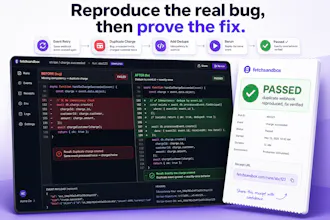
Most API tests stop at 200 OK. FetchSandbox lets developers and AI agents verify what happens next—webhooks, retries, state changes, async workflows, and failure scenarios. It reproduces the real bug, proves the fix, and remembers what breaks—so your agent catches it before production. Connect via MCP to Cursor, Claude Code, Windsurf, VS Code, and Codex. Explore 60+ APIs—Stripe, GitHub, Clerk, Resend, Twilio, Descope, OpenAI—without burning real API quota or waiting on staging.




@rnagulapalle I get the outline of what it does, but I'd love to understand this better: how can a non-coder like me who builds web-apps just by prompting with Claude Code actually make use of this? I saw it helps avoid burning through API tokens,hitting limits and fix bugs.
FetchSandbox
@thejus_ph honestly youre the exact person i want using it, let me put it in plain terms.
when you build an app by prompting, claude code quietly wires up things like payments (stripe), login, or email behind the scenes. that code usually looks done and even works when you test it once. the problem is those connections tend to break later in ways you cant catch by clicking around once, a customer getting charged twice, a signup making two accounts, a payment coming through before the order was even saved. you only find out after real users hit it.
what fetchsandbox does is let claude code test that connection against a realistic fake version of stripe (or auth, email etc) that throws those nasty real-world situations on purpose, so the bug shows up now instead of after launch.
and for you it stays as simple as you already work. you connect it to claude code once, then you just prompt in plain english like "test my stripe integration", and it runs it and hands back a result plus a link showing it either survived or exactly where it broke. no code from you, same prompting you already do.
one small correction, its less about saving api tokens and more about catching the bugs that only show up after youve shipped, thats the real value. happy to walk you through the setup if you wanna try it.
Macaly
stopping at 200 OK is exactly the trap 👏 remembering what broke is the smart bit. solo devs or teams mostly?
FetchSandbox
@petrkovacik right now mostly solo devs and small teams, the kind of person wiring an api or an agent themselves in cursor or claude code. thats who installs an mcp and just tries it same day.
but the stuff people keep asking for, gating a merge, dropping a receipt in a PR, thats really a team workflow, so i think it grows into teams as it matures. today its mostly the solo builder though. thanks man.
We do something similar on a smaller scale in our own Stripe integration — coupon/pause mutations carry session-scoped idempotency keys so a double-click can't create two coupons, and webhook processing claims-then-deletes on failure so LS/Stripe can safely retry. The proof-gated regression capture here (reproduce → fix → rerun) is the piece we've been doing manually — would've saved some debugging early on. Following for the async/retry simulation angle, that's usually the first thing testing tools skip.
FetchSandbox
@cancelkithq this is a genuinely solid setup.... session-scoped idempotency keys on the mutations plus claims-then-deletes-on-failure is exactly what survives a retry storm, most people don't get that far until after they have already been burned once.
and yeah, the reproduce-fix-rerun loop being manual is the exact gap... you clearly already know the pattern, its just painful to do by hand every time and easy to skip under pressure, the whole point is making that part automatic so its not on you to remember.
appreciate you following. if you ever point it at your coupon/pause flows i'd love to hear whether it catches the stuff you already handle or misses something you do, that feedback is worth more to me than any upvote....tbh
the webhook replay feature is genuinely useful, finally a way to test retry logic without stubbing out half my codebase
FetchSandbox
@tuncaypamurqnk thanks, and honestly thats the whole reason it exists. stubbing webhooks to test retry logic is miserable, you end up writing more mock than real code and it still doesnt behave like prod anyway. glad its clicking for you.
the most-tests-stop-at-200 framing is exactly right. the bugs never live in the happy path, they live in the retry that fires twice and the webhook that lands out of order. good to see a tool pointed at that part specifically.
FetchSandbox
@alex_watson2110 thanks, yeah that retry-that-fires-twice and the out-of-order webhook are exactly the two i kept getting burned by, thats the whole reason this exists. appreciate you getting it.
I have spent time debugging APIs where the request worked perfectly but the webhook created unexpected issues later. A tool that can consistently recreate those situations would have saved a lot of time. Nice work on tackling such a common challenge.
FetchSandbox
@nitesh_kumar98 thanks man.., request worked, webhook bit me later is the one that gets everyone. you don't see it until a customer emails you about it. being able to recreate that on demand, duplicate delivery, late event, dropped, without waiting for prod to bite you, that's the whole point. give it a spin and
Hey bro
The website icon is showing of Next.js default icon . It would be great if that shows your website's logo .
FetchSandbox
@vansh36 ahh good catch man.. thank u.. will fix it