Launched this week

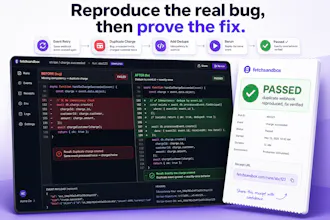
Most API tests stop at 200 OK. FetchSandbox lets developers and AI agents verify what happens next—webhooks, retries, state changes, async workflows, and failure scenarios. It reproduces the real bug, proves the fix, and remembers what breaks—so your agent catches it before production. Connect via MCP to Cursor, Claude Code, Windsurf, VS Code, and Codex. Explore 60+ APIs—Stripe, GitHub, Clerk, Resend, Twilio, Descope, OpenAI—without burning real API quota or waiting on staging.




the webhook/retry/async testing angle is the part that's actually missing from most API sandbox tools, everyone nails the happy path 200 OK case but real integration bugs live in the retry logic and race conditions. does it let you simulate out-of-order webhook delivery, or just delayed/duplicate events?
FetchSandbox
@omri_ben_shoham1 yeah the async/retry layer is where the real bugs live and most sandboxes just skip it entirely.
three scenarios shipped today: delayed delivery, duplicate/redelivery (same event id fired again so you can actually test idempotency), and dropped. covers most of the retry + race surface.
out-of-order specifically: not a dedicated knob yet. variable delays can surface ordering races but a controlled "deliver B before A" isn't in yet. that's the next one i want.
API integration testing is becoming critical as AI agents rely on more external tools. Curious if you’ve seen AI-generated requests expose edge cases that traditional integration tests usually miss?
FetchSandbox
@amjad_shaik thanks for the question.... honestly its less that agents expose brand new edge cases and more that they confidently miss the same ones humans do, just faster and at way more volume.
the pattern i keep seeing is the agent nails the common shape, types check, mock passes, looks perfect, then it breaks on the exact edge nobody exercised, retry with the same idempotency key, a payment intent thats requires_capture not actually paid, a session jwt it decodes but never verifies. same edges we always missed, but now the code is generated so its harder to catch in review because it reads so plausible.
so the shift isnt really new bugs, its the same bugs shipping faster and with more confidence. thats basically why this exists, the happy path looking perfect is exactly when i stopped trusting green.
Congrats on the launch. I integrate several AI provider APIs in my product, and the painful breakages are never the loud ones. It's when the same endpoint quietly starts returning a slightly different shape, or a model name stops resolving one day. Does FetchSandbox catch that kind of quiet drift, or is it focused on hard failures?
FetchSandbox
@henry_s_jung right now its focused on the hard and lifecycle failures, not the quiet drift you mean.
the shape thing, within a run we validate responses against the contract, so if your handler assumes a field thats missing or wrongly typed, that shows up. but that only catches it if our model of the api is current.
the case you actually care about, the real provider silently changing shape or a model name that stops resolving one day, we dont auto-detect that yet. we test against a sandbox, so we catch the mismatch only if the sandbox already knows the api moved. noticing the live api drifted on its own is the piece im still building, and honestly its the one im most focused on next.
Love that it covers async edge cases most testing tools miss, the MCP integration with Cursor is super smooth. One thing that would make this a no-brainer for me: built-in support for replaying recorded webhook sequences against different environments, so I can validate that a staging deploy handles the exact same payload ordering as production without re-running the whole test suite.
FetchSandbox
@mirahmlk thanks Miraç, glad the cursor integration felt smooth, that was a big focus for us.
on the replay idea, part of it is there and part isnt, being honest. the sequences today are deterministic so you can rerun the exact same webhook/retry ordering against a change and confirm your handler still behaves the same, thats basically the staging-regression check you're describing. what isnt there yet is capturing a real production sequence and replaying that exact recorded payload ordering against your own staging or prod, right now it runs against our sandbox not your environments. thats a genuinely good ask though, record-from-prod and point the replay at your own env is the thing that turns it from a pre-merge check into a real regression tool. putting it on the list, appreciate you spelling it out...
the dedup/idempotency scenarios are the ones I'd actually use. when two CI runs hit the same sandboxed Stripe API concurrently, is state isolated per run, or can one job's retry storm bleed into another's results?
FetchSandbox
@sabber_ahamed good question, and its the right one for CI. isolation is per sandbox, each one has its own state, its own event log, and its own active scenario. so if each run spins up its own sandbox (one call) theyre fully isolated, one jobs retry storm cant bleed into anothers results at all.
honest caveat, a sandbox is a stateful environment, so if two runs deliberately point at the same sandbox id they share state, thats by design not a bug. the pattern for concurrent CI is one sandbox per job, then you get clean isolation even under a retry storm.
short version, own sandbox per run = isolated, shared sandbox = they see each other.
@rnagulapalle good, one-sandbox-per-job as the default answers the retry-storm question cleanly. is spinning up and tearing down that sandbox a single API call from CI, or a couple round trips?
FetchSandbox
@sabber_ahamed its light. spin up is one call, you import the spec and get back a sandbox id thats yours for that job. then its one call to run, run-all, or per-workflow if you want to scope it tighter.
teardown you basically dont have to do, the sandbox is isolated by its id so you can just let it go at the end of the job, theres no cleanup youre forced to run. theres a reset if you want a clean slate mid-run, but CI doesnt need it since the isolation comes from each job having its own id, not from tearing anything down.
so realistically its create plus run, two calls, not a heavy lifecycle. thats deliberate, i didnt want per-job sandboxing to be a chore you set up once and then quietly stop using.
the dropped-vs-mid-response-timeout distinction @omri_ben_shoham1 raised is the one I'd want too. adjacent question: do you simulate variable latency (webhook arrives 3s vs 30s late) or is timing binary right now, on-time vs late?
FetchSandbox
@omri_ben_shoham1 @sabber_ahamed good adjacent question. right now its in between, not binary but not fully variable either. you can set the delay amount so its not just on-time vs late, you can make it 3s or 30s, but its a single fixed delay applied across the run, not per-event jitter where some land at 3s and others at 30s in the same run.
real variable latency, a distribution with tails where some events are way slower than others, isnt there yet. and thats exactly the thing that produces the ordering races and timeout-window bugs, so its tied to @@omri_ben_shoham1 point too. worth having, on the list.
short version, today its configurable but uniform delay, per-event variance is the next step...
@omri_ben_shoham1 @rnagulapalle makes sense, uniform delay still catches the easy bugs, it's the tail latency that actually breaks retry/ordering logic. is per-event jitter on the near-term roadmap or more a someday thing?
FetchSandbox
@omri_ben_shoham1 @sabber_ahamed honestly you two asking about it moved it up. its near-term, not someday.
the reason im comfortable saying that, the delay mechanism already exists, so per-event jitter is an extension not a rebuild, mostly swapping the single fixed delay for a distribution and letting you dial the variance or a tail. smaller lift than it sounds, which is why its realistic soon rather than a maybe.
i wont fake a date on launch day, but its on the short list. happy to ping you when its in, would genuinely value your eyes on the tail-shape since you clearly think about this the right way.
The worst production bugs are always the ones that look completely fine until a second system reacts. Your own code passes, the API returns 200, and then three hours later a duplicate webhook fires and someone gets charged twice. Curious what the most common failure pattern is across your 60 plus APIs, is there one class of bug that shows up regardless of which API you're testing?
FetchSandbox
@jasnoor_singh_oberoi yeah idempotency is the one. almost every webhook provider is at-least-once by design, so duplicates aren't bugs on their end, they're just how it works. but handlers get written assuming exactly-once, so the same event fires twice and you get two charges, two users, two emails. doesn't matter what the API does, if there's an async event with a side effect behind it that gap exists. and it passes every test you'd normally write, code is correct, 200 comes back, shape is fine. breaks hours later when the second delivery shows up. by then it's real money or real data. stale state is second most common but idempotency is the truly universal one.