
Engineering Map
Everything a senior engineer is expected to know
2 followers
Everything a senior engineer is expected to know
2 followers
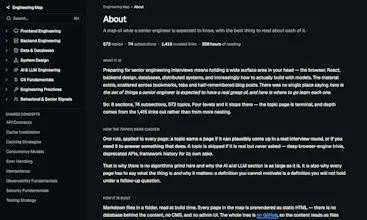
573 topics across the browser, React, backend, data, distributed systems and building with models. Every page says what a thing is, why it matters, and points at the best three to five things to read next — 1,415 links, hand-picked and re-checked on a schedule so they don't rot. No account, no ads, no upsell. Open source: MIT code, CC-licensed writing.



Hey Product Hunt! 🚀
I am Prateek, and I built this for myself first.
I kept losing the same explanations in bookmarks and half-remembered blog posts. There was no single place saying: here is the set of things a senior engineer is expected to have a real grasp of, and here is the best thing to read about each one.
So I wrote one. 573 topics across 8 sections — the browser, React, backend, data, system design, AI and LLM engineering, practices, and behavioural.
One rule decided what made it in: a topic earns a page if it can plausibly come up in a real interview round, or if you need it to answer something that does. Things that are real but never asked got cut. That is why there is no algorithms grind, and why the AI section is 70 topics — tool use, agents, MCP, retrieval, evals, cost, prompt injection. That part I could not find collected anywhere else.
Every page has the same shape: what it is in one line, what it is, why it matters, key points, then the links out. You learn where things are once and can skim any page after that.
The 1,415 outbound links took the longest. Three to five per topic, exactly one marked "start here", and a script re-checks every URL on a schedule — link rot is what actually kills a resource like this.
Free, no account, nothing to sign up for. MIT code, CC-licensed writing, all on GitHub.
I would love to know what is missing — especially from anyone who has run these loops from the other side of the table.
I will be around all day, so ask me anything.