
CreateOS Sandbox
Instant, hardware Isolated Sandboxes for AI agents
266 followers
Instant, hardware Isolated Sandboxes for AI agents
266 followers
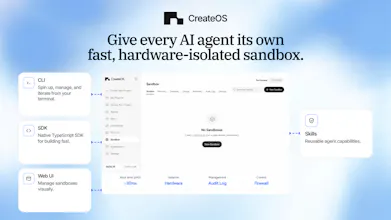
CreateOS Sandbox gives AI agent builders their own fast, secure, hardware isolated, sandbox in ~30ms (p90). We have suit of CLI, SDK, 50+ SDK real world examples, claude plugins, computeSDK integration, and more

30ms startup is great, but for agent workloads I'd also want a teardown receipt: which egress rules fired, what credentials were present, and whether the writable layer was actually destroyed. Is that available per sandbox today?
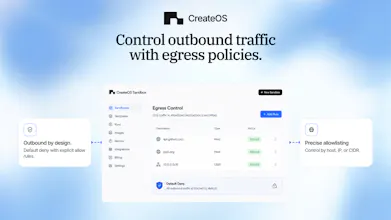
@new_user___2672025cf1bc18102609b53 Good question, and honestly the answer is "partially" today. Every destroy emits an audit event (`sandbox.destroy`, with cause user/admin/TTL/drain) and egress rules are logged when configured (`sandbox.egress.set`, allowlist only, no raw secrets). Credentials never round-trip through logs, disk creds are ECDH+ChaCha20-encrypted at rest and SSH keys are audited by fingerprint only, never raw.
If we want the application layer to take care of the forensics part, else you can always visit audit logs
@pratikbin A per-sandbox teardown receipt would still be useful: destroy cause, policy version/hash, egress decisions summary, and writable-layer disposal result. Audit logs help investigation; a receipt gives callers one artifact they can gate cleanup on.
Super useful for a whole host of scenarios!
Curious if you plan to give more integration options for the plug-n-play style agents? Looks like currently we just would connect / control with Telegram?
@inferhaven Today the real integration surface is the SDK (Go/Python/TS), the CLI, and a Claude Code plugin — Telegram's just been the flashiest demo, not the ceiling. More triggers/connectors are on the list. What would unlock the most for your setup — a specific chat platform, webhooks, something else?
@pratikbin I would personally be into more customizeable stuff like webhooks, mostly just curious cause being able to click a button and have it setup exactly how you need automatically is pretty powerful, also more agents, but I am sure you have a todo list of those too ;)
@inferhaven We support Claude Code, Claude Desktop, Claude.ai, OpenAI Codex, Cursor, VS Code Copilot, Windsurf, Gemini CLI, and OpenCode through the MCP server and SDK. Telegram is one channel, not the only one. What integration would make the biggest difference for your workflow?
A built-in cost dashboard would be super helpful, especially showing compute time per sandbox session and monthly burn. With cold starts at 30ms there's a real risk of accidentally spinning up thousands of sandboxes during testing, and right now there's no easy way to see what's running or set spend alerts.
@yarenaralp Fair, and honestly a real risk we think about too — 30ms cold starts make it trivially easy to fire off way more sandboxes than you meant to. Today you can list running sandboxes and check `/bandwidth` per sandbox, but there's no aggregated spend view or alerting yet. Logging this as a real gap, not just a nice-to-have.
@yarenaralp Fair request. Right now the API returns credit balances and per-sandbox metrics, and the pricing page shows cost per shape. A dashboard with per-session compute time, monthly burn, and configurable spend alerts is not something we ship in the alpha UI yet. Noted.
Spun up a sandbox in around 30ms like they claim, the CLI felt snappy and the SDK examples actually made sense for once.
@emircansowj Appreciate the backhanded compliment to the rest of the industry's docs. Glad it actually clicked instead of fighting you.
@emircansowj Appreciate that. The SDK was designed to be self-documenting, typed errors, automatic retries, zero dependencies. If the examples made sense, that means we hit the mark.
The ~30ms cold start is genuinely impressive, especially for agent loops where latency compounds. One thing that would save me a lot of time: a local dev mode that spins up a fake sandbox emulator so I can iterate on agent logic and exception handling without burning real compute credits during testing.
@feyzaqk5q Real pain point, makes sense especially for exception-path iteration where you don't want real infra in the loop. 500 free credits take some of the sting out short-term, but a proper local emulator is a different, better answer. Adding it to the list.
@feyzaqk5q That is a good idea. Right now the closest thing is the SDK's error types, you can write and test your exception handling against the typed error hierarchy without spinning up a sandbox.
But a full local emulator that simulates sandbox lifecycle without consuming credits is not something we ship yet. Noted for the roadmap.
The 30ms cold start actually held up in my testing, which is wild for hardware isolated sandboxes. The claude plugin integration made spinning up agents feel almost frictionless.
@azadxpsa That was the point of shipping the plugin day one — agent loops shouldn't need a side quest just to get a sandbox. Glad it landed that way for you.
@azadxpsa Good to hear the Claude integration felt frictionless. That was the goal — the plugin lets Claude treat a sandbox as a tool it can call without knowing the SDK.
The 30ms cold start actually held up when I spun up a few sandboxes back to back, no weird warm-up lag. Loved having the SDK examples handy instead of digging through docs.
@sultanrdm6 That's deliberate — every shape's pre-warmed so there's no "first one's slow" tax. Glad the SDK examples were there instead of you spelunking through docs mid-test.
@sultanrdm6 Glad it held up in your testing. The warm pool means back-to-back creates are consistent, the first one might pay a slight cold-start penalty on the pool, but subsequent ones hit ready kernels. That is by design.