TL;DR Quantum computing won’t scale if every program is a hand-written circuit. Coda lets beginners, domain experts, and engineers describe problems in natural language and run them on real quantum processors, without writing low-level quantum code.
I’m Brandon, co-founder of Conductor Quantum. Today we’re launching Coda, a natural language interface for quantum computers.
Coda lets you design, understand, and run quantum programs in natural language, without writing low-level quantum code. We built it because quantum computing is powerful, but still far too hard to actually use.
Quantum computers offer a new computing paradigm for simulating the world at the atomic level. This opens up new possibilities in chemistry, materials science, and drug discovery that push beyond what the largest classical supercomputers can handle.
The problem is most material scientists or biochemists can't use a quantum computer today - the barrier to entry to learn all the new bespoke tools, and the quantum information science is way too high. This is why we are building Coda.
Our long-term goal is simple: access to a quantum computer from every desk. It’s built for domain experts and technical teams who want to explore real quantum use cases today and prototype faster. Also, it’s built for people new to quantum computing who want a practical, hands-on way to learn.
One of the first quantum computers we’re offering on our platform is Rigetti’s 84-qubit quantum computer, plus IonQ and IQM. We also support qubit simulations via IBM Qiskit and NVIDIA cuQuantum + CUDA-Q.
We’re early and learning fast, and we’d love your feedback.
Happy to answer any questions 👋
Report
@brandonseverin Hi Brandon, Congrats on the launch. What are you seeing as the most popular/valuable use case right now?
@zolani_matebese Right now it's split in two - 1. people who want to learn about quantum mechanics/computing and want to experiment hands on. 2. Quantum algorithm experts who are tired of llm hallucinations and want to iterate quickly between building code and running it on a real machine.
Report
Natural-language to quantum is awesome, but at scale the pain is correctness: LLMs can emit circuits that compile yet violate backend constraints or produce meaningless results under noise.
Best practice is to compile into a stable IR (OpenQASM 3 or QIR), run deterministic validation passes (type checks, qubit mapping, depth/cost bounds) plus simulator cross-checks and optional error mitigation (Mitiq) before hitting hardware.
What IR do you standardize on across Rigetti, IonQ, and IQM, and can users export the exact compiled circuit plus metadata so runs are reproducible across backends?
@ryan_thill Hi Ryan thanks for the comment and question. We do a lot of code validation on our end to make sure things run smoothly. Agreed - one of the worst things is to send a circuit off to a QPU and it doesn't work. We offer users a range of frameworks to export including: CUDA-Q, Qiskit, PennyLane, PyQuil and OpenQASM3
Report
@brandonseverin That makes sense, and the export surface you listed is a strong way to keep things portable across backends.
One thing that tends to matter in practice is reproducibility: pinning compiler versions, transpilation passes, and backend calibration metadata so a “working” result can be re-run later and compared apples-to-apples.
If you’re open to it, I’m happy to share a couple patterns we’ve seen for circuit provenance plus idempotent job submission to avoid wasted QPU cycles.
@daniele_packard Hey Daniele - thanks for the comment, and great question. One that people love to talk about is breaking encryption e.g. RSA using Shor's algorithm. But the most interesting use cases are the simulation of molecules and how they interact with each other, for example ground state energy simulations. Or in the recent case from Google - looking at molecular structure. Being able to understand how molecules interact with each other, atom by atom, electron by electron has huge implications for future drug design and materials science.
Vibe-code quantum programs! Very cool to see this on ProductHunt. I don't pretend to have a deep understanding of quantum computing, but it seems like letting people actually play with it and build with it is the best way to help people learn.
This looks insane and like an obvious no brainer, talk about problem/solution fit! Will circulate around my PHD network who are in the space!
Bullish on Brandon and Quantum 🙌💎


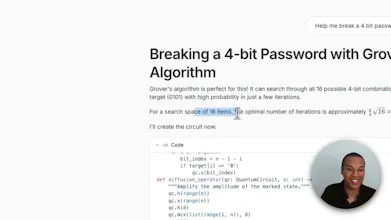


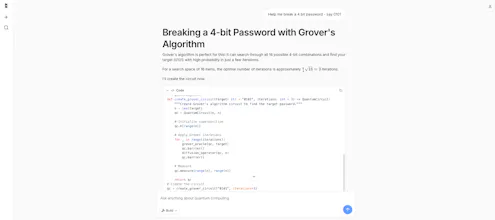


Coda by Conductor Quantum
👋 Hi Product Hunters!
I’m Brandon, co-founder of Conductor Quantum. Today we’re launching Coda, a natural language interface for quantum computers.
Coda lets you design, understand, and run quantum programs in natural language, without writing low-level quantum code. We built it because quantum computing is powerful, but still far too hard to actually use.
Quantum computers offer a new computing paradigm for simulating the world at the atomic level. This opens up new possibilities in chemistry, materials science, and drug discovery that push beyond what the largest classical supercomputers can handle.
The problem is most material scientists or biochemists can't use a quantum computer today - the barrier to entry to learn all the new bespoke tools, and the quantum information science is way too high. This is why we are building Coda.
Our long-term goal is simple: access to a quantum computer from every desk.
It’s built for domain experts and technical teams who want to explore real quantum use cases today and prototype faster. Also, it’s built for people new to quantum computing who want a practical, hands-on way to learn.
One of the first quantum computers we’re offering on our platform is Rigetti’s 84-qubit quantum computer, plus IonQ and IQM. We also support qubit simulations via IBM Qiskit and NVIDIA cuQuantum + CUDA-Q.
We’re early and learning fast, and we’d love your feedback.
Happy to answer any questions 👋
@brandonseverin Hi Brandon, Congrats on the launch. What are you seeing as the most popular/valuable use case right now?
Coda by Conductor Quantum
@zolani_matebese Right now it's split in two - 1. people who want to learn about quantum mechanics/computing and want to experiment hands on. 2. Quantum algorithm experts who are tired of llm hallucinations and want to iterate quickly between building code and running it on a real machine.
Natural-language to quantum is awesome, but at scale the pain is correctness: LLMs can emit circuits that compile yet violate backend constraints or produce meaningless results under noise.
Best practice is to compile into a stable IR (OpenQASM 3 or QIR), run deterministic validation passes (type checks, qubit mapping, depth/cost bounds) plus simulator cross-checks and optional error mitigation (Mitiq) before hitting hardware.
What IR do you standardize on across Rigetti, IonQ, and IQM, and can users export the exact compiled circuit plus metadata so runs are reproducible across backends?
Coda by Conductor Quantum
@ryan_thill Hi Ryan thanks for the comment and question. We do a lot of code validation on our end to make sure things run smoothly. Agreed - one of the worst things is to send a circuit off to a QPU and it doesn't work. We offer users a range of frameworks to export including: CUDA-Q, Qiskit, PennyLane, PyQuil and OpenQASM3
@brandonseverin That makes sense, and the export surface you listed is a strong way to keep things portable across backends.
One thing that tends to matter in practice is reproducibility: pinning compiler versions, transpilation passes, and backend calibration metadata so a “working” result can be re-run later and compared apples-to-apples.
If you’re open to it, I’m happy to share a couple patterns we’ve seen for circuit provenance plus idempotent job submission to avoid wasted QPU cycles.
Coda by Conductor Quantum
@ryan_thill Sure - would be great to chat - email us at: founders at conductorquantum d com
ChatPal
Congrats! Looks cool - what are strong use cases for quantum computers that LLM from laptop wouldn't be comparable?
Coda by Conductor Quantum
@daniele_packard Hey Daniele - thanks for the comment, and great question. One that people love to talk about is breaking encryption e.g. RSA using Shor's algorithm. But the most interesting use cases are the simulation of molecules and how they interact with each other, for example ground state energy simulations. Or in the recent case from Google - looking at molecular structure. Being able to understand how molecules interact with each other, atom by atom, electron by electron has huge implications for future drug design and materials science.
ChatPal
@brandonseverin very cool! I know some folks int he biotech space - I'll share with them
Coda by Conductor Quantum
@daniele_packard Thank you!
Product Hunt
Vibe-code quantum programs! Very cool to see this on ProductHunt. I don't pretend to have a deep understanding of quantum computing, but it seems like letting people actually play with it and build with it is the best way to help people learn.
Coda by Conductor Quantum
@rajiv_ayyangar Thanks and agreed. We want more people to get access to this new paradigm of computation - let us know if you have any feedback!
Congrats on the launch! Love how Coda turns natural language into real quantum programs and removes low-level circuit pain.
Coda by Conductor Quantum
@zeiki_yu Thanks - agreed! Let us know if you have any feedback!
@zeiki_yu Glad you like it! Let us know if there are any pain points you've experienced with building quantum circuits and if Coda can help with that.
Sounds great! Congratulations on the launch 🙂
@mykyta_semenov_ Thank you Mykyta!
Trace
Coda by Conductor Quantum
@timcha_cherkasov Thanks Tim