
Clears
Move beyond AI coding to Agentic Software Delivery
646 followers
Move beyond AI coding to Agentic Software Delivery
646 followers
Clears is an agentic execution platform for autonomous software delivery, helping R&D organizations move beyond individual AI tools to agentic execution across the entire SDLC.




Free Options
Launch Team

Customer.ioAutomate Messaging Everywhere — Startups Get 12 Months Free
Promoted
@danielnakash @tehreem_fatima5 Clears both integrates with CI to automatically fix issues in case it doesn't pass, but also writes and runs its own tests. it also leverages an agent with wider context that is not biased to the implementation of the task, to review and post fixes directly on the PR, which triggers an automatic fix. so the whole loop ends with a well reviewed and tested PR.
@tehreem_fatima5 Thanks! Clears context layer indexes all the repos it works with as well as past runs, the discussion with the AI about each, and the decisions made, so as time goes by, Clears is better aligned with the organization and nuances of the codebase. Clears writes unit tests for each story, and gets feedback on CI failures, so it can fix its own mistakes. Clears also runs a build to ensure it works. All of this leads to well formed PRs ready for review.
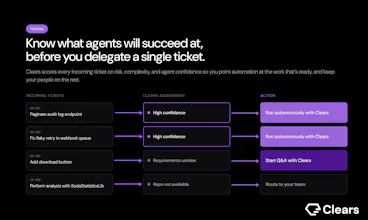
Congrats on the launch! The risk/confidence scoring before autonomous execution is the part I want to understand better, is that scoring done statically from the ticket description, or does Clears actually inspect the codebase to calibrate complexity before spinning up the agent session?
@rnagulapalle Thanks! And a great question - Clears creates and maintain a context layer that enables agents to retrieve relevant context efficiently, with lower token consumption. Clears context layer indexed data includes repositories, Confluence and Notion pages, and info from previous runs such as AI sessions, code reviews, CI results, Q&A, and previous decisions.
All of this enable the AI to better understand the task in context, without flooding it with the entire codebase and irrelevant data, while keeping token utilization at bay.
With all that context, the AI can give a reliable score accounting for expected risk and complexity in implementing the task.
Interesting launch! What was the original “aha” moment that made you decide this problem was worth building a dedicated product for? Would love to hear the story behind Clears.
@tanjum Thanks! We've been in Engineering leadership roles for long time, and when LLMs started to accelerate, we saw how it affects writing code, but still from a perspective of delivery it didn't move the needle as we would expect, then we decided to build exactly that - Leverage AI to actually move the org's delivery throughput
@tanjum We saw coding getting dramatically faster with AI, but the overall delivery process wasn’t speeding up at the same pace. Teams were still spending huge amounts of time on context gathering, clarifications, coordination, validation, and follow-ups.
That’s when it clicked for us: the bottleneck had moved! It was no longer just writing code.. it was everything required to take a task from an idea to production.
@odeth_negapatan1 Thanks!!
I think the biggest shift is that engineering leads can spend less time chasing execution and more time making higher-level decisions. The goal isn’t to remove engineering leads from the loop but to move them up a level.
@odeth_negapatan1 Thanks! We see engineering leads stop being the human context layer, meaning less explaining the background to the machine, less status-chasing on one hand, while on the other hand giving them more agency in steering the product where they want it to be. Today, a lot of work that is important but not urgent gets pushed to the backlog and many times stay there. Now it can be pulled and acted on, while the urgent things are already running in parallel.
One thing I always look for with products like this is how quickly they fit into an existing workflow without adding another layer of complexity. Would love to hear what early users think.
@angelaaa Hi Angela, thanks for asking - that’s exactly one of the things we designed Clears around.
The goal is not to introduce a new workflow, but to plug into the one teams already use like Jira, Git, CI, internal tools, etc. We keep the existing systems as the source of truth and add the agentic execution layer on top.
In practice, teams can connect Clears in about 30 minutes and start getting value the same day, with real tasks moving from requirement all the way to production.