Anthropic’s AI coding assistant, designed for deep context understanding and capable of handling complex software tasks with a massive context window (up to 200K tokens).
This is the 3rd launch from Claude Code. View more
Claude Code Security
Launching today
Find and fix security vulnerabilities with Claude
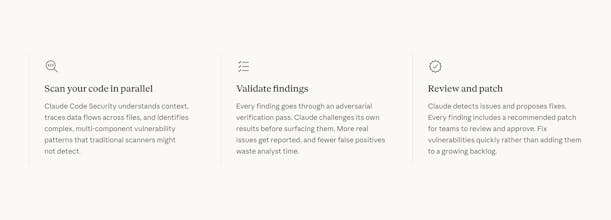
Claude scans your entire codebase for vulnerabilities, validates each finding to minimize false positives, and suggests patches you can review and approve. Available in research preview for Claude Code.

Figr AI: UX Agent for Product Teams — Learns your product. Thinks through UX
Learns your product. Thinks through UX
Promoted
Hunter
📌
Security tools have gotten good at spotting patterns. But attackers don’t think in patterns, they think in systems.
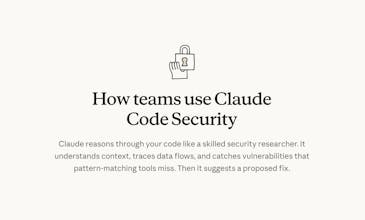
Claude Code Security reasons through your entire codebase like a human security researcher. It traces data flows, understands business logic, challenges its own findings, and then proposes targeted patches for human approval.
Not just “here’s a vulnerability.” But “here’s why it matters and here’s a fix.”
The adversarial self-verification step is especially interesting. Fewer false positives. More signal. Less wasted analyst time. Released in limited research preview, this feels like a shift from static scanning → contextual reasoning.
Hot question: does this make AI code review tools obsolete?
Short answer: not immediately.
Long answer: tools focused on PR reviews and developer productivity operate earlier in the lifecycle. Claude Code Security feels deeper, more like an AI security researcher auditing entire systems.
If it continues improving at finding novel, logic-level flaws (not just surface bugs), it could compress a huge amount of specialized security review work.
Obsolete? Probably not overnight.
Pressure on them to evolve? Absolutely.
What do you think... augmentation layer or category killer?
Report
I lova Claude Code, but it's not so easy to optimize it for a beginner, so it seams I have to spend a high amount of hours to really understand, what is possible with this tool. But its great in total.
Report
5.0
Based on 195 reviews
Review Claude Code?
Reviews praise Claude Code for strong reasoning, long-context handling, and clean, style-aware patches that speed up refactors, tests, and frontend work. Makers of
credit it with faster iteration, day-to-day development, and even powering core systems. Other makers highlight reliable pair-programming, context across files, and reduced manual work. Users echo intuitive UX and reliable output, though a minority expected more agentic autonomy. Overall, sentiment centers on productivity, coherence on large codebases, and dependable, senior-like guidance.
Claude Code is an exceptional AI coding agent that excels across the full spectrum—from rapid startup SaaS builds to enterprise-grade, multi-layered, complex applications. When provided with proper context and guided by fundamental software architecture, engineering principles, and security standards, it consistently delivers high-quality results. Used with common sense and real development experience, there is currently no better AI coding agent in my opinion.
What needs improvement
Claude Code CLI is already seamless and consistently delivers high-quality results. The main area for improvement would be deeper scalability toward a full agentic development environment (ADE), similar to what tools like Warp are evolving toward—bringing more autonomous workflows, richer context management, and tighter developer-environment integration.
I evaluated Warp, OpenAI Codex, and Grok Code Fast1, but Claude Code stood out for its balance of control, context awareness, and consistent output quality. It scales equally well from rapid prototyping to complex, enterprise-grade systems, while remaining predictable and effective when guided by solid engineering and security practices—making it the most reliable choice overall.
Can it run tests and surface failures with clear diffs?
Yes
How controllable are shell commands and file writes?
Safety and control are highly configurable and depend largely on how the user sets rules, permissions, and execution boundaries. The level of control ultimately reflects the user’s proficiency and discipline in configuring and operating the tool, making this a largely subjective assessment rather than a fixed limitation of Cloud Code itself.
Claude is excellent for writing clean code and reasoning through complex logic. It’s especially good at understanding context and improving code quality.
What needs improvement
Better support for very technical edge cases and framework-specific examples would be helpful.
vs Alternatives
I considered other AI coding assistants, but Claude felt more reliable for structured reasoning and reviewing larger code blocks.
How reliable are automated Git commits and push operations?
Claude provides accurate guidance for Git workflows, but automated commits and pushes still benefit from manual review to ensure correctness and prevent unintended changes.
What guardrails prevent destructive commands or data loss?
Claude is cautious with potentially destructive actions and typically asks for clarification before proceeding. This reduces the risk of accidental data loss, though final responsibility still lies with the user.
How well does it manage long-running tasks and cancellations?
Claude handles structured, step-by-step tasks reliably. For longer or complex tasks, breaking work into smaller steps produces more consistent results.
Thanks to the Claude Code team for building such a great product — it really makes a software engineer’s life easier. It is impressive. Once you clearly define the problem, it often delivers an almost perfect solution — sometimes even better — especially if you already have a few unit or integration tests in place. In most cases, with just a bit of debugging and some error context, it gets about an 85% approval rate from senior engineers.
What needs improvement
It still struggles a bit with frontend web code, but that’s mostly because frontend details are harder to describe precisely and harder to verify automatically.
almost perfect if you're clear about the solution. almost hand free once you describe the requirement clear. comparing to other , approve rate is much higher than others.
What guardrails prevent destructive commands or data loss?
should be prompt or popup for some commands, might also need not allow command set in rules.
How well does it maintain coding style and lint rules?
good if with claude.json rulesset
How transparent is cost when using extended reasoning budgets?
Security tools have gotten good at spotting patterns. But attackers don’t think in patterns, they think in systems.
Claude Code Security reasons through your entire codebase like a human security researcher. It traces data flows, understands business logic, challenges its own findings, and then proposes targeted patches for human approval.
Not just “here’s a vulnerability.” But “here’s why it matters and here’s a fix.”
The adversarial self-verification step is especially interesting. Fewer false positives. More signal. Less wasted analyst time. Released in limited research preview, this feels like a shift from static scanning → contextual reasoning.
Hot question: does this make AI code review tools obsolete?
Short answer: not immediately.
Long answer: tools focused on PR reviews and developer productivity operate earlier in the lifecycle. Claude Code Security feels deeper, more like an AI security researcher auditing entire systems.
If it continues improving at finding novel, logic-level flaws (not just surface bugs), it could compress a huge amount of specialized security review work.
Obsolete? Probably not overnight.
Pressure on them to evolve? Absolutely.
What do you think... augmentation layer or category killer?
I lova Claude Code, but it's not so easy to optimize it for a beginner, so it seams I have to spend a high amount of hours to really understand, what is possible with this tool. But its great in total.