
Bugpilot
Turn errors, DOM, + screenshots into an AI-ready Markdown
95 followers
Turn errors, DOM, + screenshots into an AI-ready Markdown
95 followers
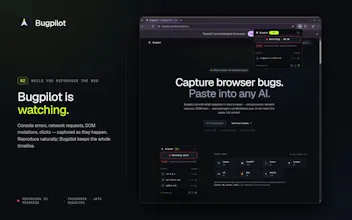
Built for vibe coders using Claude and ChatGPT. Bugpilot captures your whole browser in one click — console errors with stack traces, network requests, DOM state, clicks, and screenshots — then exports it as clean, AI-ready Markdown your assistant can actually read. 100% local: no servers, no accounts, no telemetry, always-on redaction. Pro adds React component state, 5 AI-optimized export formats, and unlimited history. Free forever, $28 one-time, 14-day refund, no subscription.




Free
Launch Team / Built With


Customer.ioAutomate Messaging Everywhere — Startups Get 12 Months Free
Promoted
@malindu_perera great idea! will test it!
Hi @nico ! Did you get to use the extension? I hope you found it useful. What would you like to see in the next version ? love to hear your feedback
The token argument is underrated. Everyone talks about the time wasted re-explaining bugs to the AI, but pasting walls of raw console logs also burns context window for nothing. Clean structured Markdown instead of a screenshot dump is better for me and for the model.
The "DM me and I'll send Pro for free" offer says a lot about how you're building this. Respect.
One thing I'd want to know: how does the always-on redaction decide what's sensitive? Auth tokens in network requests are the obvious one, but what about things like emails in API responses?
Installing the free version today. Good luck with the launch, Malindu.
hi @josedamian Thanks, this genuinely made my day. The token point is exactly the angle I keep coming back to — even when developers have generous context windows, burning them on raw console dumps means less room for the AI to actually reason about the code. Structured beats verbose every time.
On the redaction question — good one, and worth being precise about it.
The always-on layer runs at capture time, before anything hits storage. It targets pattern-detectable values: passwords (input fields with type="password"), email addresses (regex-matched), credit card numbers (Luhn-validated, not just any 16 digits), JWTs, API key patterns, Authorization headers in network requests, and tokens in URLs (query string and path segments). Each match gets replaced with a [REDACTED:type] marker so you and the AI both know something was there but not what.
You hit the harder case though — emails or PII inside API response bodies. Right now that gets caught if the value looks like an email by regex, but it's not field-aware. So {"user": "[REDACTED:email]"} works, but if someone's name is in a "fullName" field, that wouldn't be auto-redacted. Field-aware or schema-aware redaction is something I'm thinking about for V2 — letting users add custom patterns or even a "redact this field" rule per domain.
Which actually leads me to a question, if you don't mind — once you've had a chance to use it on real bugs, I'd genuinely love to hear:
A review on the Chrome Web Store would mean a lot at this stage — early reviews carry disproportionate weight
What would you want most in V2? The agent-export angle (structured for AI to act on, not just read) keeps coming up, but custom redaction rules might be just as important from your question
Either way — thanks for installing and for the thoughtful comment. Good luck back at you.