Launching today

Avarodh
Zero-Trust AI gateway with DSPy routing & semantic caching
1 follower
Zero-Trust AI gateway with DSPy routing & semantic caching
1 follower
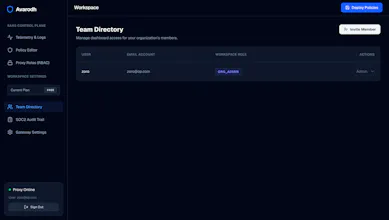
Most engineering teams deploying LLMs to production face two major roadblocks: skyrocketing API bills from redundant queries, and security audits stalled by unmonitored payloads and prompt injections. Avarodh solves this by acting as a transparent, zero-trust reverse proxy between your application backend and external AI providers: 1) Drop-In Integration 2) DSPy-Powered Firewall 3) Tenant-Isolated Semantic Cache 4) Control Plane & Live Telemetry 5) Privacy-First Supports Cache-Control




Hi Product Hunt! 👋
I’m Sanjay, the maker of Avarodh. I built this out of sheer frustration while putting LLM features into production.
Every time an application scaled, two things happened: API costs exploded because users repeatedly asked semantically identical questions, and security teams raised red flags about prompt injections or sensitive data flowing unmonitored to OpenAI.
Hardcoding regex checks, rate limits, and custom caching into app logic turned clean codebases into brittle monoliths. I wanted a transparent layer that sat in front of the LLM provider to handle security and cost optimization automatically.
Enter Avarodh: a Zero-Trust AI Reverse Proxy designed as a seamless drop-in for the standard OpenAI SDK. You just swap your base_url and pass a Workspace ID.
Here is what Avarodh handles at the edge:
🛡️️ DSPy-Powered Intent Routing: Instead of brittle keyword filters, payloads are evaluated against compiled DSPy signatures to block prompt injections and policy violations before they ever reach your expensive target models.
🧠 Tenant-Isolated Semantic Cache: We use Supabase and pgvector with strict composite partitioning to cache semantic matches. If a query shares intent with a previous safe request, it returns instantly—bypassing the upstream LLM entirely to slash latency and costs.
🔒 Enterprise Privacy Controls: Sensitive workloads can simply pass "Cache-Control": "no-store" to bypass cache database writes entirely while retaining full DSPy firewall protection.
🔑 BYOK Architecture: Avarodh passes your Authorization headers unaltered. It works securely with your existing OpenAI quotas or internal deployments without intercepting your keys.
The Tech Stack: Avarodh’s Python Data Plane is hosted on Render to prevent serverless cold starts, while the fully reactive Control Plane is built with Next.js and hosted on Vercel. Everything is backed by Supabase for robust tenant isolation and Row Level Security.
We have a free-forever Developer Tier with 10,000 proxy requests/month so anyone can stress-test the routing latency today.
To see exactly how frictionless the drop-in integration is, I've put together a Quickstart repo here: https://github.com/SanjayManjunath/avarodh-quickstart
I'll be here all day answering questions. I'd love your candid feedback on the onboarding flow, the control plane dashboard, and what guardrail integrations you'd like to see next!