
A search tool for agents, not a search box. AI agents are only as good as the information they receive. When connected to AnySearch, your agent gets filtered, de-duplicated, and structured information from trusted sources searched in parallel, helping it produce more reliable results. Free to start.


Congrats on the launch! What is the source of your search results, and what's the frequency of your updates?
@chilarai AnySearch features self data sources, covering both general and vertical search.
@chilarai Thanks! Short answer: AnySearch isn’t just one static index with a single “updated every X hours” schedule.
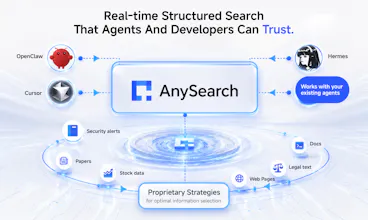
We route each query to the best source mix for the intent: live web, vertical sources like academic/legal/security/finance/code, and direct URL extraction when the agent needs to inspect a page. For freshness, it depends on the source: web and page extraction are queried live, while vertical sources follow the update cadence of the underlying data provider.
We also return source attribution and metadata where available, so agents can cite the source instead of treating the result as a black box.
How does AnySearch decide which sources count as "trusted" for a given query, and can I override that list if I want to pull from a specific site or domain?
@sezerdasekwcwb Great question.
AnySearch does not use one fixed “trusted source” whitelist. Trust is query-dependent.
For each query, we rank sources based on signals like relevance, source authority, freshness, content type, domain fit, and vertical context. A trusted source for financial data may be very different from one for academic papers, legal research, or developer documentation.
Developers can also constrain or bias retrieval toward specific domains, sites, verticals, or source types when those sources are already covered or publicly accessible.
For new sites, private sources, or domains that are not yet covered, tell us the use case and target source. We can evaluate the best way to support it as a custom or approved source.
So the default is query-aware source selection, while developers can still enforce their own provenance policy when needed.
@sezerdasekwcwb Just chiming in here to add—we totally get that 'black box' APIs are a nightmare for agent builders.
That's why, alongside the input controls mentioned above, we focus heavily on output transparency. AnySearch always returns strict citation metadata, giving your system full auditability. You never have to blindly guess where the data came from!
Let us know if you have specific domains in mind for your use case.
I appreciate the focus on developers instead of building another search box. What happens when an agent needs niche information from smaller websites? adding an option to include verified custom sources make the platform much more flexible.
@hana_salazars Thank you for your recognition and suggestions! If you have any specific needs you would like us to solve, please feel free to leave a message on our official website. This will affect the priority of our development efforts.
@hana_salazars Thanks — really appreciate the suggestion.
We agree that niche and smaller websites can be very valuable for agent workflows, especially in vertical use cases where the best source is not always the biggest one.
Verified custom sources are a great idea, and we’ll definitely consider this as we continue improving AnySearch. Thanks again for the thoughtful feedback.
@hana_salazars Thank you~ The real hurdle with niche sites isn't just retrieving them—it's that their HTML is usually unpredictable.
If we enable custom sources, the goal would be to run them through our same extraction layer. That way, your agent still gets perfectly clean Markdown instead of a parsing headache.
Feel free to share the specific niche spaces you're targeting!
@ridhwikvinod Thanks, and totally agree with that distinction — “trusted by the tool” is not always the same as “trusted by your workflow.”
Yes, the goal is to let developers control source policy per query.
For new domains, private sources, or sources that are not yet covered, share the use case and target sources with us. We can evaluate the best way to support them as custom or approved sources.
Default ranking is useful when developers do not want to manage source selection manually, but when you already have your own trusted source list, your policy should take priority.
@ridhwikvinod Thanks so much for the congrats!
Just adding a quick thought to Nic's answer: since messy results are your main headache, the best part of pinning those 15 domains is the output format.
We handle the extraction and just hand your agent clean Markdown. No more wrestling with raw HTML or scraping those specific sites.
Let us know if you want to test it out with your list!
@doaoww If you're curious, the fastest way to see how it compares for Google or Tavily is to use AnySearch for a few complex tasks in your Agent. I think you've seen search layer bottleneck of your Agent, especially multi-step queries. Would love to hear what the difference looks like in your Agent environment!
@doaoww @terence_lou I'm also curious to see some more objective and diverse benchmarking on different problems/tasks that require different kinds/depth of searching. Measuring the effect of AnySearch on the outcome. Time to reach the goal? Tokens? Result quality? The fact that search results were relevant and concise enough in a few test tasks is not convincing enough to me for serious prod adoption.
@doaoww @rezgar Thank you for your feedback again. If you want to get more objective and diverse benchmark test results about AnySearch, you can visit our official website www.anysearch.com to view. As time goes on, our product AnySearch is constantly evolving as the search layer of AI Agent, and more and more benchmark test results will be updated and displayed to the public.
@doaoww And thanks for your question~
the dedup and structuring part is the interesting bit to me, most "search for agents" pitches i've seen just wrap a regular search API. what happens when two trusted sources genuinely disagree on a fact, does anysearch pick one and present it as ground truth or does it surface both and let the agent reason about it
@omri_ben_shoham1
That's exactly the part that makes this interesting to me. Most "search for agents" pitches I've seen are just thin wrappers around a standard search API. The hard problem isn't "find relevant pages" — it's packing the most useful information into a limited context window.
So we didn't spend much effort on URL dedup — that's a relatively shallow problem. The real challenge is exactly what you described: different sources telling the same story with different wording, where reading three of them yields near-zero incremental information but burns through thousands of tokens.
The solution is a custom information-density ranking algorithm we built in-house. For multi-intent queries, the objective function isn't pure relevance — it's maximizing the information density of the final result set. Specifically, ranking jointly accounts for:
- Relevance — obviously can't go off-topic
- Cross-passage redundancy — how much a new passage overlaps with what's already in the selected set; high overlap gets down-weighted
- Information entropy — the passage's intrinsic information richness and distinctiveness
- Length penalty — given equal information value, shorter wins
This naturally answers your question — when two trusted sources genuinely disagree, it means each carries independent semantic information that the other lacks. They aren't redundant with each other. The algorithm won't pick one — both get included and surfaced. The agent sees a multifaceted, tension-rich information landscape and gets to reason, compare, and weigh things itself, rather than being fed a sanitized "canonical answer" with the contradictions already smoothed over.
At its core, what we're optimizing for is that every token the agent reads delivers maximum marginal information gain — not the same story rehashed three different ways. Disagreement between sources is actually one of the highest-information-density scenarios you can encounter. Suppressing it would actively degrade the value of the result set.
Makes sense, and I like that you're not trying to force a single "canonical" answer out of the model. My only worry with keeping disagreement in the set is cost - if two sources contradict each other you're now paying for both plus whatever reasoning tokens the agent burns reconciling them. Do you cap how many "genuinely conflicting" passages get surfaced per query, or is that left uncapped and trusted to the length penalty to sort itself out?
@omri_ben_shoham1 There's no specific cap — we keep as much diversity or disagreement as possible without exceeding the num_results the user requested.
got it, so it's whichever comes first - hitting the diversity target or hitting num_results. makes sense for a general default, just wondering if there's ever a case where a user wants strictly ranked results with zero diversity weighting (like a legal or medical search where you want the single best match, not variety)
the bit about agents not being able to skim and decide like humans is exactly the right framing — what does the output structure look like, json schema or more like markdown blocks?
@sabber_ahamed The structured content AnySearch provides is in Markdown format, which can be directly used by Agents. Existing search is designed for human browsing, that's why Agents cannot browse and make decisions like humans. AnySearch is designed to address this issue.