
akta.pro
Private company data and signals API for the agent economy
747 followers
Private company data and signals API for the agent economy
747 followers
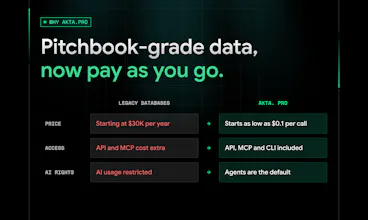
Private company data with 4x the depth and 2x the coverage of PitchBook, plus 100+ event signals and news across companies, industries, and topics. Source and diligence deals or make outreach lists and trigger outbound. Built for financial services and GTM teams, pay-as-you-go.




Cool. Can you set up notifications when a specific signal is triggered? And can you create custom signals?
@natalia_iankovych Custom signals, yes. Filtering happens at the query rather than from a preset list of alert types, so you define what counts as a signal. Filter across a 70+ category news taxonomy, plus IAB and IPTC codes, scoped to whatever set of companies you're tracking. So a watchlist filtered to funding and leadership changes, and a separate one for competitors filtered to product launches, are just two queries against the same endpoint.
On notifications, webhooks for signal alerts are on the roadmap. Until then you poll the news API on whatever frequency suits you, and credits are only charged on news actually returned, so empty polls cost nothing and you can run a tight loop without paying for quiet periods.
@saswat_nanda2 I have a slightly different use case: I have several thousand potential clients and around 10 signals that should trigger me to reach out to them with an offer. I need to track these signals daily/weekly and receive an email notification when one of them appears. Is something like this possible?
@natalia_iankovych Yes, this is exactly what the webhooks I referred above can solve. You define a set of companies, the signals you care about, and a frequency, then get a webhook plus email notification when any of them fires. Several thousand companies against 10 signal types is well within what it's built for.
Until that ships, a scheduled poll on the news API gets you the same outcome. The filtering and company scoping is already there, and credits are only charged on news actually returned, so a daily run over a quiet list costs almost nothing.
For the email step, n8n or Zapier will do it without any code, both can run the API call on a schedule and route hits into an email.
Happy to chat over a quick call. Also, will give you a heads-up once webhooks are live.
This is great. Congrats, Siddhant and team.
Since those are synthesized rather than reported data, would I be able to see what a given moat call was drawn from, or do I take the field as given?
@tmaleh_ Fair question, and and the short answer is you can see what it was drawn from.
Moat isn't returned as a single verdict. competitive_moat comes back as an array of typed entries, each tagged to a category, distribution advantage, switching costs, network effects, cost advantage, ecosystem lock-in, data advantage, with the specific reasoning attached to each. So you can see which dimensions are actually carrying the call and which are thin.
It also sits inside a broader company_assessment section, alongside strengths, weaknesses, key risks and key highlights. Those are fully source-traced, each entry carrying links to what it was drawn from, and the moat read is the analysis layered on that same evidence base. So the reasoning is inspectable by looking at what it was built from.
We built source traceability into the architecture itself. Any output meant for diligence has to be something you can audit back to what produced it.
As a developer, having this available through API, MCP, and CLI makes the product flexible and interesting to use. Congrats on the launch!
@roopreddy Thanks Roop. That was the intent,. We wanted the choice of surface to be about how you work rather than a tradeoff, so API, MCP and CLI all return the same shapes.
20M+ companies with 70+ fields is a serious amount of coverage. Congrats to the team! 🚀
@priyankamandal Thank you! Coverage was the part we spent the longest on, since a private markets API is only as useful as the tail it reaches.
Worth adding that the 20M+ isn't a fixed ceiling either. If you hit a company that isn't in the database yet, there's a company addition endpoint that takes the submission and builds the profile. It's free and asynchronous, so you fire the request and either poll the status endpoint or take a webhook when it lands.
Practically that means a miss on an obscure company becomes a short wait rather than a dead end.
I question how teams measure success after using this API. would the main benefit be saving research time or finding better business opportunities?
@new_user___209202627e87af67bf41b28 It shows up as time first and opportunities later. Week one is usually the boring win, where the cleaning and matching layer that used to sit in front of every agent just goes away, because the company data comes back structured and the news comes back already filtered instead of as pages to read through. That is also where the cost drops, since retrieval stops coming out of token spend. The better part comes later, when the signals start doing the work for you and a funding round or an exec change surfaces without anyone going to look for it. GTM teams count that in meetings booked, investment teams in deals they saw before the round was announced.
Happy to go deep on the technical side.
Reasoning models changed the economics of proprietary data. For years the winning move was a large team of analysts manually cleaning, normalizing and QAing structured datasets. That model is going obsolete.
Demand growth is in agents now, and agents do not want a handful of structured fields in a subscription model. They want a large, reliable corpus of structured qualitative knowledge they can reason over and scale consumption as needed. That changes how you architect the platform.
So we made entity resolution the foundation everything else sits on. Every company gets a canonical identity connecting parents, subsidiaries, products, executives, investors, news and hiring signals.
Once identity is solved, coverage stops being a fixed list you either have or lack and becomes an extensible graph, where anything new resolves against identities that already exist, including data you bring in yourself.
The real-time news pipeline runs on those same identities, with no batch refresh window. Every article goes through:
Deduplication and entity resolution back to company IDs
Classification against an 100+ event taxonomy
Mapping to NAICS, SIC, IAB and IPTC codes
Scoring for impact, sentiment and story centrality
Each of 20M+ companies are tagged to 30k+ industry codes and qualitative source-traceable data across 70+ fields.
The noise gets filtered along the way, and whatever survives is queryable the moment it lands.
The schema is built for reasoning over a corpus rather than browsing rows in a dashboard, which changes the interface too. Everything is API-first, with MCP and CLI as first-class surfaces built for token efficiency and composability inside agent workflows.
The goal is simple: make private markets data programmable for anyone building with AI.
Try for free. Code PH50 gets you 50 credits, no card required: playground.akta.pro/signup/?coupon_code=PH50 — If anything in the docs at https://docs.akta.pro/ is wrong or hard to follow, tell me and it usually gets fixed the same day
Interesting Concept. Congratulations on the Launch. @saswat_nanda2 @siddhant_masson @bharat_garg6
@dhanrajchoudhary Thanks a lot Dhanraj, appreciate the support