
AI Test Engineer by BlinqIO
Playwright code + self-healing tests w/ no vendor lock-in
441 followers
Playwright code + self-healing tests w/ no vendor lock-in
441 followers
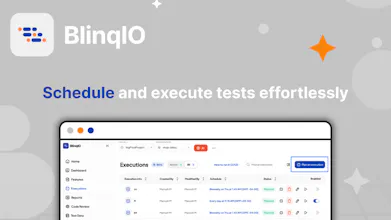
BlinqIO’s AI Test Engineer builds and maintains Playwright automation in minutes - generating real code in your repo, integrating with CI/CD, and self-healing when your app changes. No lock-in, just faster, stable, zero-touch testing.




How do you see AI-led testing evolving – is it going to replace scripting entirely or act more like a co-pilot?
@john_spradling_ We see AI-led testing evolving more as a co-pilot than a full replacement. There will always be edge cases, domain knowledge, and architectural context that humans understand best, while AI can accelerate the heavy lifting around creation, maintenance, and analysis. In practice, the most value comes from combining both strengths: intent and oversight from humans with speed and automation from AI. Over time, the split may shift as models get better, but we expect collaboration, not “no more scripting,” to be the durable pattern.
@dafinka_madjunkova Today BlinqIO focuses on generating and maintaining real Playwright tests, and the product and docs are centered around that ecosystem. Supporting other frameworks is a reasonable future direction, but we have not announced anything specific around Cypress, Selenium, or others. For now, we are investing in making the Playwright experience fast, maintainable, and production-ready.
This makes sense. E2E tests usually become a headache because of constant breakage, not writing them once. I like that the tests are real Playwright code and stay in the repo. Congrats on the launch :)
@bpratapp Totally. Writing tests once is easy, keeping them alive is what hurts. That is why we made sure the output is plain Playwright in your repo so nothing gets locked away. Really appreciate the encouragement!
Tests that write themselves? Hold my coffee
Hey everyone
I am Liat, Head of Marketing at BlinqIO. For the last year our team has been building something called the AI Test Engineer. It started as a small idea and turned into months of talking with testers, breaking things, fixing things, and trying to figure out what actually creates value in real QA teams.
The main challenge was finding the right product market fit in a space that moves fast and has strong opinions. We did not want to add another shiny tool that creates more work. We wanted something that feels useful on day one, respects QA as a profession, and removes some of the pain around automation, coverage, and maintenance.
Along the way we learned what matters most to the people using the product. Speed without chaos. Ownership without lock in. Accuracy without extra complexity. Those values ended up steering the entire roadmap.
Today we are bringing the AI Test Engineer to Product Hunt to get honest feedback from a community that cares about building real products. If you test, ship, or break software for a living, I would love to hear what you think and what you would improve.
Thanks for reading and for being such a supportive community
Hi all!
I’m Sapnesh, Solutions Architect at BlinqIO, and I’ve spent most of my career in the test automation space, thinking on how best to tackle the gap between “tests we want” vs “tests we can actually maintain.”
UI test automation breaks not because teams don’t know how to write tests, but because keeping them running over time is expensive, fragile, and mentally draining.
So we built the AI Test Engineer to work the way real engineering teams work.
From a technical standpoint:
BlinqIO generates real Playwright code using the AI Recorder
The code lives in your Git repo, runs in your CI, and can be edited in VS Code like any other test.
AI Recovery fixes your failed tests: understanding intent, mapping UI changes, recovering broken selectors, and analyzing failures
No vendor lock-in. You can export the code and run it on its own without BlinqIO
Full freedom to edit/change code - you edit/modify the code if you want to. In fact, you can chat with our AI Test Engineer to implement custom code changes!
We also provide our own BlinqIO execution cloud where you can run tests in parallel, with AI Recovery, retry failed tests, get failed test videos, Playwright traces, and more! - You don't need a third-party cloud service to run your tests.
We call this Vibe Testing, starting from intent and letting AI handle the repetitive, failure-prone parts of automation while engineers keep ownership and control.
Please share your questions and opinions here, and I’d be happy to answer them!
- Sapnesh
This is a strong take on a very real problem.
E2E tests usually fail not because the logic is wrong, but because maintaining them becomes a full-time job as the UI evolves.
Generating real Playwright code in the user’s own repo + no vendor lock-in is a big trust signal — that alone removes a lot of friction for adoption.
Curious about the self-healing part: when selectors change, how much is rule-based vs model-driven, and how do you avoid masking real regressions?
API testing support sounds like a natural next step. Congrats on the launch 👏
Finally a tool that treats flaky E2E tests as a code-gen problem, not a human debugging marathon! Love that the generated Playwright lives in my repo—no black-box lock-in and I can still npx playwright test on CI. Two quick questions:
Does the AI auto-heal only selectors, or can it also patch waits/assertions when latency spikes?
If I run tests on a private staging env behind VPN, will the BlinqIO cloud agent tunnel back to my network, or do I have to run everything locally?
Looking forward to stress-testing it against our most chaotic sprint. Congrats on shipping true vibe testing!