Launched this week

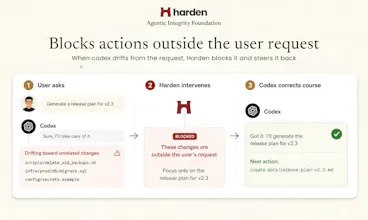
Harden AIF is a free, local security tool for AI coding agents. Its post-trained model checks tool calls before they run, using your request and session context. It beat frontier models on key agent-security benchmarks, while keeping your repo and tool output on your machine.




Merlin 2.0
Congratulations on the launch @pushpak_pujari1 ! Excited to try out Harden finally.
Harden
@siddhartha_saxena2 Thank you! Would love your feedback. Once click install from https://harden.run/
Serand
Harden
@rukhsar_amjad Yes, definitely do try it. It is completely free, installs in seconds, and watches your agents 24/7 so that you don't have to.
Netlify
Congrats on the launch!
Harden
@thisiskp_ Thanks a lot, KP! Really appreciate the support. Coming from someone who’s built so much in public and around developer communities, it means a lot 🙌
Harden
@thisiskp_ Thank you, KP. Your support means a lot.
Congratulations 🎉
DocsAlot
this is actually really great.
HTTPDump
the intent-boundary check is the part i'd stress test hardest — real tasks drift too, agent finds it needs to touch a file you never mentioned but that's still correct. curious what your false-positive rate looks like on normal work vs the obvious stuff (rm -rf, exfil). that gap is usually where security layers get disabled by day 3, not where they fail the demo.
Harden
@pushpendraw You are absolutely right on this one! However, this is where we have spent the most time designing our product, our post trained model is trained in a way to clearly draw the contrast between dangerous/misaligned and "dangerous looking" but legitimate actions. Therefore, our model is trained to understand drift and block or steer the agent back into the right direction. That being said, this pipeline will keep getting even better quickly!
Premarket Bell
I’m curious how much context Harden looks at before making a security decision. Does it consider the whole session or mainly the current request?
Harden
@daniel_henry4 Hi Daniel, thank you for the question. Harden AIF looks beyond just the current request. It evaluates the pending tool call against the developer's intent and the relevant session history, especially earlier events that can change what the action really means. Hope that answers your question. I'm happy to answer any other question as well.