
ACME.BOT
No-slop AI SEO agent that interviews you first
258 followers
No-slop AI SEO agent that interviews you first
258 followers
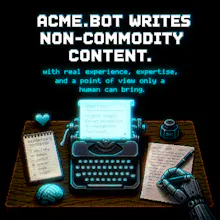
ACME.BOT turns your expertise into no slop SEO articles. Answer a few questions on a topic (from your phone) and your first-hand experience shapes your blog post. AI handles the boring stuff. Like keyword research, illustrations, references, internal linking, and publishing cadence. Create helpful non-commodity content that also satisfies Google's EEAT requirements.



The interview-first approach is actually clever. Most SEO tools just take a brief and run with it, ends up generic. Does the interview data get reused for future content or each piece starts fresh?
@abdurrahman_fakhrul Yes. All interviews go verbatim in a knowledge base. So not only does the content get reused.
Even the interview builds on top of the previous interviews so that you're not asked similar set of questions again and again. Instead you get to go deeper into the topic with every interview.
@abhishek_iyer Nice, that’s exactly what I was hoping for.
Using previous interviews as a living knowledge base makes the whole thing feel more human over time instead of one‑off Q&A.
Keen to see how this behaves with bigger teams and multiple stakeholders jumping in.
@abdurrahman_fakhrul We do have multi-player support, though at the moment is nascent. We're working on making it seamless with things like slack / discord / teams integration etc.
One thing I'm curious about is how you stop the content from sounding repetitive after a few months. Does the knowledge base help with that?
@reda_roqai_chaoui Yes, the Knowledge Base helps - every time we do an interview we end up going one level deeper. So the knowledge from the interviews builds up being a rich and deep repository of your opinions and takes over time. Based on that the later posts will end up going deeper into the takes as opposed to the initial ones.
The interview-first step is the interesting bit — most SEO tools skip straight to generating commodity content. Once I answer the questions for a topic, does it persist that expertise as reusable context for future posts, or is each article a fresh interview? And for the publishing cadence, which CMSs can it actually push to versus just draft?
@noctis06
re. Storing interviews: Yes, all your interviews go inside a knowledge base. So any future documents can reference it and cite it.
re. Publishing: Right now we support Wordpress, Shopify and GitHub.
The "interviews you first" approach is smart. We built an AI layer into our SaaS and the biggest lesson was that generic AI output is worthless — context is everything. Curious: how deep does the interview go before it starts generating? Do you find users drop off during the questioning phase, or does it actually increase trust in the output?
Hi @rachid_abadli -- actually users are quite happy to answer. Think about someone asking questions to you about the field you're very knowledgeable and passionate about. That's the exact effect we're seeing.
We also try to keep the interview super light-weight and preserve contexts over various interviews. So the knowledge actually compounds over time while still being lightweight.
Congrats on the launch. The thread is deep on interview quality, so I will ask at the other end: publishing. Connecting WordPress or Shopify hands the agent something that can write to a live store. Is that scoped to creating drafts and posts, or does the same connection let a run edit or take down what is already published? Curious how you drew that line, since it changes what a wrong turn can reach.
@vollos Good question - for now we only manage what was created by us. For eg we create a post, we are able to edit it ourselves.
The ability to update existing posts as well (or maybe take down bad content that is not ranking) is our roadmap.
@abhishek_iyer Makes sense as a boundary. Where does it get enforced though, on the connection or in your code? A WordPress application password comes with whatever that account can already do, so "only our own posts" can be a rule ACME.BOT follows rather than a limit the site puts on you. Curious which way you set it up.
In code@vollos .
That way the same connectors will automatically gain more capabilities once the new functionality of maintaining existing posts goes live!
@abhishek_iyer Makes sense, that is the normal shape for these things: the credential already carries the wider access, so shipping take-down later is not a new grant, it is the same code path choosing to use more of what it always had. I have built connectors that way before too, credential scope and what the app decides to do with it end up living pretty far apart. Appreciate you walking through it, good luck today.
The interview-as-the-one-input-competitors-can't-copy framing is the right wedge. I care as much about getting cited in AI answers now — ChatGPT, Perplexity, Google's AI overviews — as I do about ranking in classic search, and first-hand expertise seems like exactly what those engines reward. Does ACME.BOT optimize the output for LLM citation specifically, or is that just a downstream effect of writing genuinely useful EEAT content?
Hi Christoper - AI answers are also powered by search engines, so in that sense doing good SEO also helps LLM citations. In addition to that there are two things that LLMs like to cite:
Quotes from people (which we do automatically thanks to the interview mode)
Content diversity (the content reflects your stance as a human - so its bound to be unique)
We try to create self-contained chunks that can be easily parsed by systems like RAGs
Beyond this, we're also working on other optimizations for LLMs. It's difficult to navigate what exactly helps LLM rankings (most "common knowledge" about the subject out there is mostly just garbage).
We do put in quite a bit of effort to understand inner workings of LLMs and try to incorporate the learnings in our content optimizations (eg. we were one of the first people in the world to conclusilvely prove that ChatGPT used Google search results)
Other co-founder here 👋
@abhishek_iyer covered what it does, so I'll just say why I wanted it to exist.
What worked for my previous product was blog posts targeting the specific things people search right before they buy. It worked better than ads and outbound for us.
We tried to scale that with writers, then with AI. Failed both times.
Took me ages to see why.
The posts that worked had things nobody else could write. Numbers from our own work, opinions from years of doing it. That never made it into a brief. So every draft needed hours of editing before I'd put my name on it, and that time never existed.
I generated a lot. I published almost none.
The interview flow is our answer to that. It does the research, reads your docs, then asks you the few things it couldn't know and your answers anchor the piece.
Basically the tool I wanted when I was doing this by hand.
The feedback I most want: if you've tried AI writing tools and quietly stopped publishing the drafts, tell me why. That's the failure mode we are builting against.
@abhishek_iyer @dyuti We did not abandon ours, we changed what the model was allowed to do. Ours used to handle the mechanical parts too - quotes and dashes, stage tracking, SEO fields - and the quality was uneven. Once that moved into scripts and it was left with only the writing, the drafts got better and cost less. The generic tone was not the model. It was how much non-writing work we had given it.
@alieksia Partly agree. Pulling the mechanical work out of the prompt does make the prose better.But if you just limit the model's job it fixes the tone but not the actual substance of a response.
A model that only writes is still writing the same research anyone else could.
That's why the human stays in the loop. Interviews extract your first-hand knowledge prior to drafting, and approval gates keep you at the exact points where you are irreplaceable.
We're all for having scripts for the mechanics. But what has often been missing is not the division of labor. Rather, it's been the material only the human has.