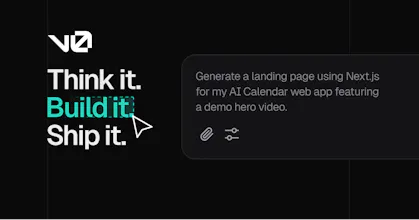
Reviewers mostly see v0 as a strong UI prototyping and design-to-code tool: fast for generating clean React, Tailwind, and Next.js starting points, useful for mockups, demos, and frontend ideation. Several users say it produces production-grade code, but the broader pattern is more cautious: it often needs edits, can miss requirements, break styles, struggle with state, data wiring, and multi-step flows, and feels pricey when retries pile up. The makers of Tusk and Basement Browser also praise its design taste and workable output for shipping sites quickly.
One of two options I use for frontend design and sites that don't require much backend. Can't wait for them to connect Convex then v0 will solidify my first stop.
I still use Lovable sometimes and probably more since they connected Supabase, this just make setting up my database way too easy. That's the feature that keeps me split.
Vercel v0 is great for spinning up clean Tailwind/Next.js UI scaffolds from a prompt or screenshot. You get fast iterations and decent component structure. Where it struggles is multi-step flows, state management, data wiring, and design fidelity. It often misses requirements, so you still refactor and rewrite. The latest model pricing feels steep given the miss rate and retries, which makes ROI shaky for daily use. Compared to general coding tools like Cursor or Claude Code, v0 shines mainly as a design-to-UI starter, not an end-to-end builder. Wish list: lower-cost tier for heavy iteration, better memory of prior feedback, spec-aware generation, and fewer regressions between runs. Verdict: useful for quick UI drafts; hard to justify at current price-to-accuracy.
What's great
prototyping (8)clean code output (3)fast UI generation (4)React and Tailwind support (3)AI-powered UI generation (3)
We use v0 as our frontend companion to generate .tsx files, and then we use SmythOS agents to integrate those designs with our existing code & APIs. In some cases we instead use Cursor to do the integration, and SmythOS to provide the API functionality.
In 2025, our goal is to not have any front-end developers anymore, and stop designing product UX in Figma all together. Instead, the product person who has both user data and product experience, is able to imagine the user interfaces, while our AI agents put everything together.