Launched this week

Scholé
Turn everyday work into personalized AI learning
584 followers
Turn everyday work into personalized AI learning
584 followers
Most AI learning is disconnected from the work people actually need to do. Scholé changes that by giving professionals and teams personalized, task-based learning in real time, right in the flow of work. Grounded in learning science and powered by adaptive AI, Scholé helps learners practice, improve, and apply AI skills as they work so learning is more relevant, more effective, and immediately useful.


Scholé
Hi Product Hunt! I'm Vinitra, co-founder of Scholé AI.
Our team goes by a lot of descriptors: educators, engineers, researchers, scientists, designers. But mostly we're a group of lifelong learners that get way too excited about good edtech.
The problem: We’ve been researching AI for education for more than 10 years, and we keep seeing the same gap. One-size-fits-all learning from MOOCs means half the content isn’t relevant to you, and nothing adapts based on how you’re actually progressing. Dropout rates are substantial, now 90% (we're guilty of it too!)
Newer AI learning tools go the other way, lots of open-ended prompting towards socratic-style discussions. Helpful for the quick answer, but where’s the skill progression? Where’s the grounding in real materials? Where’s the curriculum?
The approach: Bring back what works from learning science. Scaffolding, mastery learning, knowledge tracing, zone of proximal development, scenario-based learning, self-regulation, reflection, and so much more, but build it in a way that feels native to AI.
Enter Scholé: agentic personalized learning for the AI era.
We’re currently focused on adult learning, and we personalize every part of the experience across:
your context (job, daily tasks, tools)
your modality (videos, podcasts, interactive tasks, more or less explanation)
your pace and difficulty (your strengths, your misconceptions)
You can ask Scholé “what is this MCP thing I keep hearing about” and it doesn’t generate something generic. It constructs the lesson on demand, remixing trusted materials into explanations, examples, podcasts, video excerpts, visuals and interactive tasks that are all relevant to your role and tools.
Under the hood, it’s a multi-agent system, with different pedagogical agents to teach, illustrate, question, and challenge, coordinating in real time to adapt the lesson to what you understand and what you need next.
We’re using GenUIs, orchestrators, conversational lesson delivery, knowledge tracing, hierarchical memory, multimodal learning, and more. Our first use case is helping people understand how AI is actually useful for them, because that's what we know how to teach. :) But you'll soon see us here teaching anything and everything else.
Who is Scholé for?
✅ The first-timer who’s curious about AI
✅ The enthusiast keeping up with new tools
✅ The expert who wants a 5 minute deep dive
✅ The team who wants to learn from their wiki / slides / pdfs / videos
What does Scholé have?
🧠 Multi-agent lessons (explanations, analogies, tasks, feedback, illustration, reflection working together)
🔄 Adaptive progression based on your performance and misconceptions
🧭 Personalized learning journey tailored to your role, tools, and goals
📚 Grounding in high-quality knowledge graph of data science learning materials from our favorite profs at Harvard, UC Berkeley, EPFL, UCSD, UW, and more
📊 Learning analytics you can query, based on your evolving knowledge
🎧 Lesson DJ to remix your lessons the way you want
We’re beyond excited to put this in front of you as an early public beta and our first ever launch. Feedback is the thing we treasure most, so please drop us a line at hello@schole.ai.
We’re also partnering with teams who want to turn their internal PDFs, slides, and videos into personalized learning experiences (we're already in the hands of 100s of companies!). If that sounds like you, please reach out to enterprise@schole.ai.
Start learning (for free!) with Scholé today: https://app.schole.ai 🎉
PicWish
@vinitra interesting, how does the knowledge tracing and memory handling compare to just using a well prompted custom gpt?
Scholé
@mohsinproduct Hi Mohsin, very good question! You can think of it analogous to a "digital twin" of a learner, which allows to optimize which right material on what right topic in which right modality at what right difficulty level should we show to the user at this exact point in the lesson progression. We're doing some cool stuff with lesson "budgets" for how to teach optimally within certain constraints of how many different tasks we can show to a user. Knowledge tracing, intuitively, is basically estimating that for a problem of a certain topic X, how many attempts would a learner take to get it right? This, probabilistically, can be viewed as a skill aptitude metric. Scholé is different from a custom GPT because it's not one monolithic tutor, but a team of agents orchestrated together deriving the right path from a knowledge graph; one prompt with RAG is not very good at capturing all the different pedagogical roles needed to design a lesson.
On the whole, Scholé is not about having a single lesson, but a broader upskilling journey. Knowledge tracing in this way allows us to actually measure skill mastery with some scientific basis across many different skills. It allows us also to suggest changes to the learning journey based on current lesson progress!
@vinitra Scholé has an interesting product direction, but the public technical evidence is still not strong enough for me to trust it as an enterprise-ready AI platform.
The main issue is that the product describes advanced concepts such as agentic learning, personalized AI tutors, knowledge tracing, hierarchical learner memory, role-based lesson generation, and internal knowledge integration, but the public site does not provide enough technical detail about how these systems are actually implemented.
For example, I would expect to see clearer information about the architecture: how agents are orchestrated, how user context is stored, how knowledge graphs are built, how retrieval is grounded, how hallucinations are reduced, how learning progress is evaluated, and how generated lessons are validated before being shown to users.
Another concern is data handling. If companies upload internal PDFs, slides, videos, or wiki content, the platform needs a very clear technical explanation of tenant isolation, access control, encryption, retention, deletion, audit logging, and model-provider boundaries. Without this, the system may be risky for enterprise usage.
The frontend also appears to have duplicated content in the rendered page output. Repeated sections, repeated testimonials, and duplicated text blocks can negatively affect SEO, accessibility, page performance, and maintainability. For a product selling AI-powered learning quality, the public implementation should be cleaner.
The product also claims compliance-related learning support, but technically there is not enough visible evidence of audit trails, completion records, role-based training mapping, risk-based learning paths, or compliance reporting workflows.
So my technical view is: the idea is strong, but the implementation proof is still weak. I would need to see architecture diagrams, security documentation, evaluation metrics, data-flow details, and real enterprise case studies before considering it technically mature.
Scholé
@suyama thank you so much for the clear and detailed feedback! It means a lot that you took the time to write it out. Indeed, we have some work to do; we’re currently in the process of a ISO and SOC2 audit, and we’re a young company on our first launch (about 10 months old now and we spent all of it building the technical foundations of the tool!). We actually already have prepared all the details you’re asking, but usually we send it to companies that we’re working with directly (on our side it’s a more than 100 page doc about architecture, security procedures, protocols, integrations!) and didn’t want to overcrowd the website. Still, your points are very valid, and would be happy to continue a conversation about all of those things offline, if you’d like!
Scholé
@suyama sorry to hear about any bug on our frontend, we’ll look into resolving it immediately!
Scholé
@suyama super interesting feedback! I second Vini, thank you for taking the time to write this!
Regarding the data protection and security concerns, customers have access to all the documentation under the appropriate procurement and confidentiality processes, including architecture diagrams, data-flow documentation, technical and organizational measures, data processing agreements, sub-processor information, security controls, retention and deletion procedures, and audit-related evidence.
In more detail, customer data is logically separated by organization. Access is role-based, restricted to authorized users, and governed through identity and access management controls. Moreover, data is protected in transit and at rest. The platform is hosted on Azure with security controls around storage, access, monitoring, backup, and recovery. We maintain logging, access records, and operational monitoring so that activity can be reviewed and investigated where required. Customer data is processed only for the agreed purpose. At contract end, data can be returned and deleted according to contractual requirements.
We are very happy to share our security and data protection protocols anytime :)
minimalist phone: creating folders
So is it something like personalised Duolingo? :) Assuming from the dashboard (map) :)
@busmark_w_nika Yes and no for me personally. You could compare a few things to Duolingo but the "pedagogical engine" powering Scholé is much more powerful. Remember that viral conversation about Duolingo that it is a cool, gamified app but some people won't learn that much with it? Scholé is also an intuitive app but it makes sure that learners actually achieve mastery (e.g. on AI upskilling).
Scholé
@busmark_w_nika definitely towards the right idea! With Duo, I might want to learn Korean because I might have a trip coming up, so what would be useful to learn would be how to say good morning, or basic signs on the metro, or how to order at a restaurant. However, regardless of that need, Duolingo would start with the Hangul character symbols.
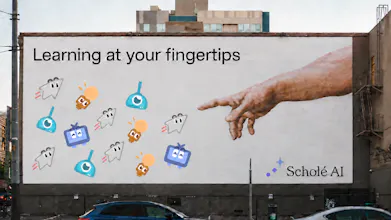
Scholé starts from understanding who you are, and then tailors every bit of learning content on-demand for you. There's many different agents (e.g. the projector, cursor, light bulb, tv characters), all with different pedagogical roles, but we still avoid hallucinations while we're constructing lessons on-the-fly because we're based on an underlying knowledge graph of materials. So... there's a lot going on under the hood that's a bit different than what Duo is doing with spaced repetition and fixed curriculums. :)
Scholé
@busmark_w_nika but, in a simple way, you can think of it as personalized Duolingo to learn AI!
minimalist phone: creating folders
@vinitra So how is it ensured that the person really knows the subject? Any special tests?
Genome
Looks super sleek and polished!
Can we learn something else than AI?
@dodolab First use case is AI, then everything else.
Scholé
@dodolab as Michael said, AI is just the first use case and the materials present in the knowledge graph; however, organizations can enrich the knowledge base with their own internal documents and knowledge bases to cover ANY topic
@dodolab thanks for the support!
Scholé
@ebikere_sonia_ngwobia hi Sonia, thank you so much! Indeed, Scholé is a pedagogical engine, so it can be used to teach anything. We started with teaching AI because we’ve been AI professors before, so we know how to validate whether the curriculum makes sense. You’re totally right about the operations positioning. We have some pilots right now teaching food handling safety, fire safety, customer support, real estate and more, so I think the use case you mentioned is a very good one.
About the learning vs. process problem: I think framing Scholé as a way to deeply understand company procedures or onboard new team members effectively might help there! We could call it “getting everyone on the same page” no matter their experience level or background, which might be more understandable from the business angle. What do you think?
We also have some very interesting scenario-based learning features (interactive AI roleplay scenarios, a bit like a video game) coming up which would be perfect for the area you mentioned, happy to share a preview if you’d like. :)
Really interesting approach — turning work tasks into learning moments rather than forcing people out of their workflow to go learn. We've seen this pattern at our IT services company too: training almost never sticks unless it's tied to something people actually need to do that week. One question: how does the system handle personalization for a small team where roles are very different? Does it differentiate well between, say, an account manager and a solutions engineer?
Scholé
@thekrew Hi Vamshi, thanks for the question and the kind words! Yes, Scholé does personalization on an individual level, so the team size doesn’t matter for having distinct lessons and curriculum for an account manager vs. a solutions engineer! Please feel free to try it out with both personas, and you’ll see the difference: e.g. the Agents lesson will look similar in structure for both roles, but the content will be different because it’ll be tying it to the tools and tasks and analogies / use cases of each role. :)
The "adaptive AI" piece — what's it adapting to exactly? My past mistakes, the topics I keep avoiding, the speed I'm moving through material? Would help to know what signals it's actually reading before trusting it to personalize anything.
Scholé
@sounak_bhattacharya exactly! On a granular level, when you get a question wrong or right or skip it, the next question or chunk of material is conditioned on your earlier response (to choose the right difficulty, topic). We also adapt on modality: if you skip a bunch of videos, we’ll try to show you less and less videos. We’re keeping track of your misconceptions and strengths in memory as well to make sure to address them across different lessons or later in the same lesson.