Most AI learning is disconnected from the work people actually need to do. Scholé changes that by giving professionals and teams personalized, task-based learning in real time, right in the flow of work. Grounded in learning science and powered by adaptive AI, Scholé helps learners practice, improve, and apply skills as they work so learning is more relevant, more effective, and immediately useful.
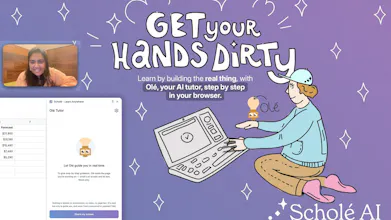
Learn by building, on any website, with Scholé by your side. You can read about a tool, watch someone walk through it on YouTube, or ask ChatGPT to explain it. But you won’t properly learn until you build with it yourself. Learn Anywhere mode guides you through using any real tool directly on your screen, adapting tasks and giving visual hints. Everything you learn updates your Scholé knowledge graph and counts towards your lessons. Our thesis? Learn it well enough to use it.
You can read about building an agent. You can watch someone else build one on YouTube. You can even ask ChatGPT to explain it perfectly.
That’s great. But you won’t properly learn it until you build one yourself. And if AI builds the whole thing for you, you haven’t really solved that problem either.
This is something we atScholéthink about a lot. We’re AI-for-education researchers, and we use AI constantly ourselves. It’s incredibly useful. But getting something done and learning how to do it aren’t the same thing.
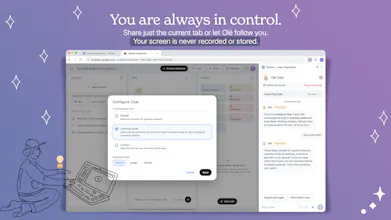
It’s an agentic browser extension that guides you through a real project, in the tools you want to learn. It sees what’s on your screen, checks things off the task list, and gives you visual hints on screen with sparkles when you need them. Youdo the building, andexplain why you made the choices you did.
Build your first agent (try it!), explore gemini notebook features (try it!), finally make your first website with Github (try it!) or any other scenario you can come up with, all for free for today's launch. Notably, what you build counts towards your Scholé lesson progress and updates your knowledge graph. You shouldn’t have to finish "learning" before you get to make something.
This is the help we wish we’d had when we were learning how to build things. Very excited for you to explore it(no credit card or account needed!) and would love to hear your feedback. :)
What would you learn first? 🌟
Lots of love, Vini & Team Scholé
Report
Hunter
@vinitra Many congratulations on the launch, Vinitra and team! :)
How I met the Scholé makers:
I first met the Scholé makers when Vinitra and I collaborated on a YouTube video with the @Unabyss team. From that collaboration, I got a firsthand look at the team’s thoughtfulness, product taste, and genuine commitment to improving how people learn with AI.
What does Scholé do?
Scholé turns everyday work into personalized, task-based learning. Rather than offering generic courses or passive “click next” lessons, it guides users through real tools and projects in the flow of work with adaptive tasks, visual hints, and learning that builds toward practical mastery.
Its Learn Anywhere mode is a great example: you learn by building, while the product helps you understand what you’re doing and why.
Why I endorse it:
When Vinitra reached out about hunting the launch, I was excited because I believe this is exactly the kind of product the Product Hunt community will appreciate: a meaningful problem, a polished experience, and a mission grounded in learning science. What made it even more special was co-hunting it with @byalexai.
I happily endorse Scholé because it makes learning immediately useful instead of disconnected from real work. I’m enjoying watching the team’s continued updates and innovations, and I look forward to cheering them on as they grow. 😊
Report
Idea is cool! How do you make sure a generated lesson is actually correct?
@zaur_bahramov very happy to hear you like it! We are using a knowledge graph of materials with RAG to ground the lessons in the tools' documentation, and AI upskilling lectures from our professor friends at Berkeley, Harvard, and more. :) For the tasks, we're constantly keep them up to date with computer-use agents that actually interpret and click around the UI like a human does.
Report
How do you decide when someone has actually mastered a skill?
@jackthompson68 it's actually super interesting, there's a lot of work on alpha/beta distributions towards mastery tracking (using the knowledge tracing models Paola is mentioning). If you'd like to chat about it more, would love to talk!
In the gemini notebook lesson, for example, it helps you create your first notebook, then add different modalities of sources (pdfs / slides / videos) and figure out what happens to the summary when you remove sources, or how to reference specific citations! It can really be any task that helps you become a better user or deeply understand the functionality of any tool.
Report
How does it decide which skill to teach when someone gets stuck?
@advin_jadis great question! We are tracking the mastery and misconceptions so we know exactly where the user got stuck and we can try alternative explanations or exercises until the user is unstuck
Report
Does it let users control when suggestions appear or choose which skills they want to improve?
@nolanpierce03 yes! We have a big catalogue of skills and users can choose from them or get recommendations based on their profile and previous interests.
It also has suggestions/hints on demand (by asking for them); so in this way, the user can control whe suggestions appear
I’ve had the opportunity to try this product at various stages and it is really changing the way I thinking about professional learning! So excited to continue trying it and watch it become better and better with each update!
What needs improvement
As Scholé collects more user data, I’m confident they will be able to fine tune their existing features and add additional clarity to help augment the user’s experience
vs Alternatives
Scholé has a much stronger approach to tailoring lessons to my needs than other more general options






Scholé
Hi Product Hunt! Vini here 👋
You can read about building an agent. You can watch someone else build one on YouTube. You can even ask ChatGPT to explain it perfectly.
That’s great. But you won’t properly learn it until you build one yourself. And if AI builds the whole thing for you, you haven’t really solved that problem either.
This is something we at Scholé think about a lot. We’re AI-for-education researchers, and we use AI constantly ourselves. It’s incredibly useful. But getting something done and learning how to do it aren’t the same thing.
So we built Scholé’s Learn Anywhere mode. 🚀💻🌎
It’s an agentic browser extension that guides you through a real project, in the tools you want to learn. It sees what’s on your screen, checks things off the task list, and gives you visual hints on screen with sparkles when you need them. You do the building, and explain why you made the choices you did.
Build your first agent (try it!), explore gemini notebook features (try it!), finally make your first website with Github (try it!) or any other scenario you can come up with, all for free for today's launch. Notably, what you build counts towards your Scholé lesson progress and updates your knowledge graph. You shouldn’t have to finish "learning" before you get to make something.
This is the help we wish we’d had when we were learning how to build things. Very excited for you to explore it (no credit card or account needed!) and would love to hear your feedback. :)
What would you learn first? 🌟
Lots of love,
Vini & Team Scholé
@vinitra Many congratulations on the launch, Vinitra and team! :)
How I met the Scholé makers:
I first met the Scholé makers when Vinitra and I collaborated on a YouTube video with the @Unabyss team. From that collaboration, I got a firsthand look at the team’s thoughtfulness, product taste, and genuine commitment to improving how people learn with AI.
What does Scholé do?
Scholé turns everyday work into personalized, task-based learning. Rather than offering generic courses or passive “click next” lessons, it guides users through real tools and projects in the flow of work with adaptive tasks, visual hints, and learning that builds toward practical mastery.
Its Learn Anywhere mode is a great example: you learn by building, while the product helps you understand what you’re doing and why.
Why I endorse it:
When Vinitra reached out about hunting the launch, I was excited because I believe this is exactly the kind of product the Product Hunt community will appreciate: a meaningful problem, a polished experience, and a mission grounded in learning science. What made it even more special was co-hunting it with @byalexai.
I happily endorse Scholé because it makes learning immediately useful instead of disconnected from real work. I’m enjoying watching the team’s continued updates and innovations, and I look forward to cheering them on as they grow. 😊
Idea is cool! How do you make sure a generated lesson is actually correct?
Scholé
@zaur_bahramov very happy to hear you like it! We are using a knowledge graph of materials with RAG to ground the lessons in the tools' documentation, and AI upskilling lectures from our professor friends at Berkeley, Harvard, and more. :) For the tasks, we're constantly keep them up to date with computer-use agents that actually interpret and click around the UI like a human does.
How do you decide when someone has actually mastered a skill?
Scholé
@jackthompson68 we have some knowledge tracing models that track the skill mastery and accounting for guessing and forgetting
Scholé
@jackthompson68 it's actually super interesting, there's a lot of work on alpha/beta distributions towards mastery tracking (using the knowledge tracing models Paola is mentioning). If you'd like to chat about it more, would love to talk!
Scholé
Scholé
Oh, this is very interesting. I really like task-based learning! What kind of tasks does it give you?
Scholé
@heyitsirenechan hi irene! you could check out a few of the tasks here: https://schole.ai/learn-anywhere
In the gemini notebook lesson, for example, it helps you create your first notebook, then add different modalities of sources (pdfs / slides / videos) and figure out what happens to the summary when you remove sources, or how to reference specific citations! It can really be any task that helps you become a better user or deeply understand the functionality of any tool.
How does it decide which skill to teach when someone gets stuck?
Scholé
@advin_jadis great question! We are tracking the mastery and misconceptions so we know exactly where the user got stuck and we can try alternative explanations or exercises until the user is unstuck
Does it let users control when suggestions appear or choose which skills they want to improve?
Scholé
@nolanpierce03 yes! We have a big catalogue of skills and users can choose from them or get recommendations based on their profile and previous interests.
It also has suggestions/hints on demand (by asking for them); so in this way, the user can control whe suggestions appear