Launched this week
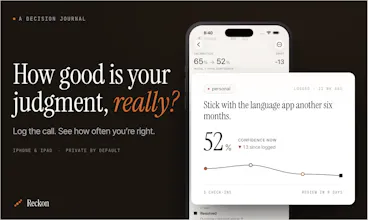
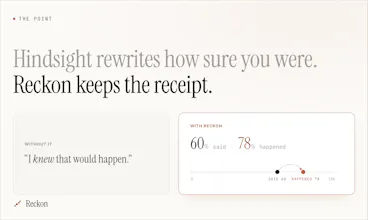
Most decisions feel resolved the moment you make them. Reckon keeps what hindsight erases: the prediction, the confidence, the reasoning. Check-ins capture what changes before the outcome: new info tagged positive or negative, confidence updated. At resolution you log what happened; weeks later it asks if you'd still make the call. A year in, you see where confidence overshoots, where it undershoots, where judgment is sharpest. iPhone and iPad. iCloud sync, no account. One-time purchase.




Continuum
maybe an odd request, but I'd like to see some sample decisions to help jumpstart my activity on the app....the unknown size/shape of an opinion can feel daunting.
Continuum
@kaz I think the App Store screenshots contain a detailed decision that I hoped would help with that and serve as a good example, but I’ll see how I can integrate it and a few more as a “here’s an example” on first install.
to answer your question directly - calibration absolutely makes sense outside forecasting, I just don't think most people would use that word for it. I screen early-stage startups fast, sometimes dozens a day, and the thing I never have is a record of how confident I actually was on a pass or a yes before I knew how it turned out. hindsight rewrites that instantly. the 30-60 day "would you still make this call" check-in is the part that sold me, that's the exact gap between a note app and a real record of judgment. one question - when the new info you tag as "positive" or "negative" mid-decision turns out to be irrelevant to the actual outcome, does that get factored into the calibration score at all, or does it just sit there as a log entry with no scoring consequence
Continuum
@galdayan Thanks for the detailed reply! I'm glad it clicks with you and regarding "calibration" as a word... I always felt it's a bit clunky, even though it made sense to me, so it just stuck. Curious if you have any other alternatives?
Regarding your question, it does not get factored in. Calibration is solely based on your confidence vs outcome (averaged across your decisions). What you log along the way is more like a history for yourself (and positive/negative also helps to easily scan the history).
@rolandleth makes sense, that's a cleaner split than I expected - so the log entries are really just for you to spot patterns later, not part of the score itself. on alternatives to "calibration" - I don't have a better single word honestly, most of the ones I'd reach for (accuracy, judgment) undersell the confidence part. maybe something like "track record" framing could work as a subtitle even if the feature stays named calibration internally
Continuum
@henryslang let me know how it goes!
Hey @rolandleth
Outcomes can be right for the wrong reasons, so tracking the reasoning & confidence feels way more useful than a normal decision journal.
Continuum
@yashekbote exactly what I thought of when I decided to build it.
if i can later provide judgment as context for agents that will dope, the judgment layer should be coined as the new context layer :)