
OpenClix
Agent-driven retention flows for mobile apps.
151 followers
Agent-driven retention flows for mobile apps.
151 followers
OpenClix helps mobile teams run agent-driven local push campaigns without heavy setup. Create campaigns with smart triggers, suppression rules, and scheduling—then let agents analyze results, optimize engagement, and stop ineffective campaigns. Connect outcomes to retention metrics, ship faster, reduce notification fatigue, and iterate from real performance data.
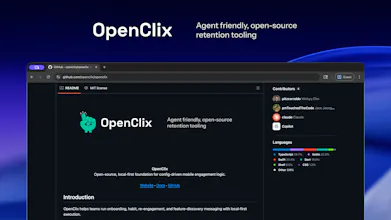
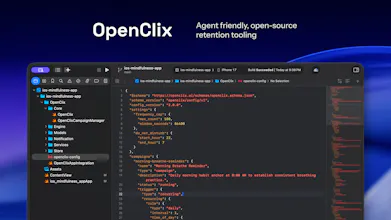


Hey Product Hunt 👋 I’m excited to share OpenClix.
We built OpenClix to make local push campaigns practical for product teams that want better retention but don’t want to stitch together complex tooling. With OpenClix, you can design campaigns, set trigger logic and guardrails, and continuously optimize based on campaign performance.
OpenClix is built for agent-friendly workflows, so you can use it with any agent you want. Your team can create campaigns, tune rules, and iterate using the agent experience that already fits your process.
What we’d love your feedback on:
1. Campaign setup flow (is it intuitive?)
2. The analytics/reporting clarity (what’s missing?)
3. Which integrations you want next
Happy to answer any questions and would love to hear how your team currently handles push campaigns.
Agent-friendly and open source is a really nice combo for push campaigns. Most tools in this space are way too heavy for smaller teams. What agent setups are people using with it so far?
@dparrelli Great question. So far it has mostly been Claude, since many developers already use it for repo level reasoning and code editing.
But the project is not tied to any specific agent. It is designed so that whatever agent you are already using to build your app can work with it.
This is exactly what consumer app teams need - retention is where most apps fail after nailing acquisition.
The agent-driven approach is smart because push notification fatigue is real. Having AI optimize timing and suppress ineffective campaigns automatically could be a huge differentiator vs. the "spray and pray" approach most teams default to.
Question @Jace Yoo: For apps with high-stakes user engagement (like dating or social apps where over-notification can kill trust), how granular can the suppression rules get? Can it learn individual user tolerance thresholds, or is it more segment-based?
Also curious about the open-source aspect - does that mean teams can customize the agent logic for their specific retention playbooks?
Love that this is open source. Notification fatigue is one of the biggest reasons users churn from mobile apps, and most teams just blast push notifications without thinking about suppression rules or timing. The fact that you can connect outcomes directly to retention metrics means teams can finally measure what actually moves the needle instead of guessing. How does the suppression logic work? Is it rule based, or does it learn from user behavior over time?
@handuo Heyy! Thank you for the comment. Right now the suppression logic works based on rules defined in the config file, so teams can control things like timing, frequency limits, and other suppression conditions in a predictable way.
That said, we are thinking about evolving this in the future. The idea is to eventually incorporate user behavior data so the system can learn over time and adjust suppression dynamically. Instead of relying only on static rules, it would be able to adapt based on how users actually interact with notifications and the app.
Interesting approach with the local-first engagement model, @jeong_woo_yoo!
One thing I noticed while reading the homepage. The headline focuses heavily on the technical architecture, ‘open-source local-first engagement’, before the outcome mobile teams care about most: retention lift.
For builders the tech detail is appealing.
But for product teams evaluating quickly, a more outcome-led first line can sometimes pull them deeper into the page.
Something like leading with the retention impact first, then introducing the open-source approach as the mechanism.
Curious if you tested messaging framed around retention growth vs the infrastructure angle.
@taimur_haider1 Thanks for the comment!
That is a great point. Since our ICP is mobile app makers, we definitely agree that outcome focused messaging like retention lift is important, and it is something we can test over time.
For now though, we intentionally chose to lead with the open source and local first engagement angle because we wanted to clearly signal the core idea and philosophy behind the product from the first line. As we learn more from users and experiments, we are open to testing messaging that leads more directly with retention impact as well.
@jace_yoo Appreciate the detailed reply, Jace.
Leading with the open-source and local-first philosophy is a strong signal for builders.
The retention outcome angle might resonate more with growth/product teams evaluating quickly, so it will be interesting to see what the experiments show over time.
Congrats again on the launch.
What I like about OpenClix is that it is as close to normal app development than integrating campaign tools. Everything living in the repo is so much better to me than having to manage campaign logic in some separate dashboard that I have to learn what this UI does and what that does. Also great that it is not a hosted service.
Congrats on the launch! 🎉 The notification fatigue problem is so real in wellness apps — one too many pushes and users are gone forever. The suppression logic and agent-driven optimization are the right primitives to build on. Love that Alan mentioned SPM support — as an iOS dev building OceanMind, an AI-powered breathwork app, the shadcn-style “code lives in your project” approach is exactly how I’d want to integrate something like this. No black box, full control. Retention-tied campaign analytics is the piece I’m most curious about — how granular does it get on the iOS side? Session depth, streak continuity, that kind of thing?