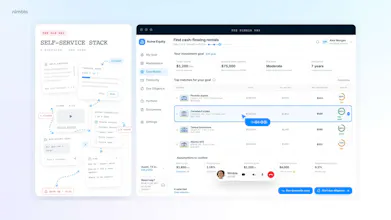
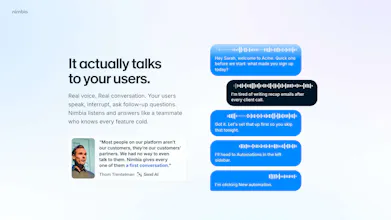
Nimbia is an AI that does screen-sharing calls to onboard and train new users of software products. It speaks, listens, and can actually click on the user's screen, so it can be truly helpful. The very first company using Nimbia is growing 40% faster because of it. When they ran an A/B test against their previous onboarding solution, Nimbia delivered 1.4X higher week-one activation and trial-to-paid conversion rates.
I've given so many product demos over screenshare to small contractors, always walking the customer through it themselves while I explained stuff live. Obviously it converted way better than without, but it ate up a lot of my time.
At the same time, I valued the personal contact. Those calls gave me a ton of feedback on the product itself: hearing what people actually get stuck on, the words they use for their problem, stuff you'd never get from a support ticket.
Nimbia takes that call off your plate, which is great. Curious though how you're handling that feedback loop. When the AI runs the call instead of me, how do I still get that "oh interesting, they always struggle here" insight? Feels like that's the hardest part to replace.
@steuijt Nothing beats live calls with the actual founders! But we mine feedback of course through the transcripts and call recordings.
Report
Congratulations on the launch! It's something that I would like to try. Does it know where the payment wall is? What happens with the call when user gets redirected to the payment provider and back? Does it pause and continue when the user returns or does it loose the thread there?
@alieksia thanks a lot! Our AI explicitly cannot see payment information; only the page context around it. We had to build this product with privacy top of mind, because one of our customers has to be HIPAA compliant, so we're pretty strict about those things.
Report
@machielse That's nice to know :) What I meant is: does the session continue or gets lost in case of redirect to a different site?
@alieksia At the moment, the agent is (only) embedded in the front-end code of the application. So if the user leaves that application, it won't be available at that other app. So for (for example) third-party SSO, Nimbia won't be able to help with that; but at the same time it's better that we're not involved there for security and so forth.
We might add a different mechanism for that in the future. But that depends on what our customers need first.
@alieksia the idea is that the agent will build a relationship with everyone, and will remember context for the next time they chat with someone. so in short: yes the agent should not get lost.
Report
What a cool application of AI. I'm always clicking away launch tours, but this way It can actually help me with what I want to do. Is the idea that it's only there for the onboarding or also for later on in the journey as interactive help functionality
@markijbema Thanks! It can definitely be used for support. But we're focusing on onboarding first because that's the highest-leverage point to start with.
Report
This is going to help a lot to improve new user conversion rates to paid! Can you have complete free-form conversations with the AI? How are you preventing prompt-injections from screen content?
@burpee yes free-form conversations, but grounded of course so it doesn't hallucinate. we've indeed considered prompt injections from screen content, and our guardrails take care of that 😅
Report
Congrats, been waiting to see this ship! The use case I keep comin back to is field teams who barely touch software: site foremen, crop managers, hotel floor staff. What does activation actually look like for someone like that? Does a manager roll it out for the team, or does each user have to set it up themselves?
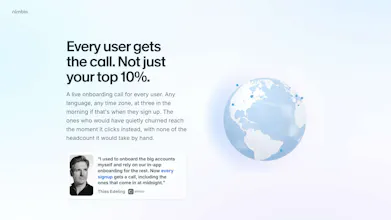
@evelien_hoeben It's indeed built specifically for applications that have a lot of non-tech-savvy users (i.e. "normal people" ;-)) so this should be a huge help to them. The people managing the software platforms decide which of their users get Nimbia's help. Traditionally they would only manually help the "top 10%" of their customers (i.e. the companies paying them the most amount of money). So only those 10% would get human help from Customer Success. Then the majority of their customers would just get sent a link to their self-service docs, even though those people would get the same product as the top 10%. That means the 90% would struggle a lot more with actually getting value out of the product. So they're much more likely to get frustrated and even stop using it (early user churn is generally between 60 and 80%).
We're trying to solve that problem, by giving all users the super patient, empathic help that they deserve!
My first B2B company was a lead gen product, where I personally onboarded every single customer 1-on-1. My next product was in user onboarding itself (demo videos, similar to Supademo). So I’ve spent years inside this problem: those calls work, but they don’t scale, so most users never get one.
About two years ago, right when GPT-4o came out, I ran an experiment. I gave it a goal inside our app plus a screenshot, and asked for the next step. I performed that step myself, sent it the new screenshot, and asked again. It walked through the entire flow on the first attempt. I hadn’t expected that at all, and it took me a while to realize what it meant: someone was going to use this to replicate those 1-on-1 calls, and that would obliterate the legacy approach of product tours, help docs and tooltip overlays. I figured that someone should be me.
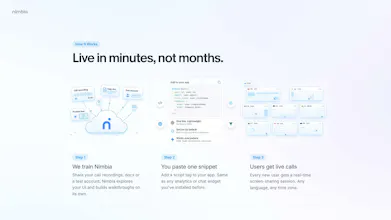
Going from that experiment to an AI that reliably does live screen-sharing calls with real users turned out to be very hard. It took our team 18 months. But it works now: it talks with your users like a human CS agent would, it sees their screen and clicks on things for them, and you add it to your app with a single line of JavaScript. We train it on your product, even on recordings of your past onboarding calls.
The first company running it is growing 40% faster.
Happy to answer anything about how we built this, what broke along the way, or where it's going.
Excellent launch, Nimbia is really super well rounded up. I love that I can just give all my call transcripts from our previous onboarding calls for Nimbia to learn all about my product, that's really good
@rogerio_chaves Thank you! Yeah we often even just train the AI on video recordings of the calls that the founders had with their users in the past. Founders are the gold standard for onboarding because they have the deepest knowledge about their users, and their product. So we're literally trying to replicate that kind of quality with our AI.
I've given so many product demos over screenshare to small contractors, always walking the customer through it themselves while I explained stuff live. Obviously it converted way better than without, but it ate up a lot of my time.
At the same time, I valued the personal contact. Those calls gave me a ton of feedback on the product itself: hearing what people actually get stuck on, the words they use for their problem, stuff you'd never get from a support ticket.
Nimbia takes that call off your plate, which is great. Curious though how you're handling that feedback loop. When the AI runs the call instead of me, how do I still get that "oh interesting, they always struggle here" insight? Feels like that's the hardest part to replace.
Nimbia
@steuijt Nothing beats live calls with the actual founders! But we mine feedback of course through the transcripts and call recordings.
Congratulations on the launch! It's something that I would like to try. Does it know where the payment wall is? What happens with the call when user gets redirected to the payment provider and back? Does it pause and continue when the user returns or does it loose the thread there?
Nimbia
@alieksia thanks a lot! Our AI explicitly cannot see payment information; only the page context around it. We had to build this product with privacy top of mind, because one of our customers has to be HIPAA compliant, so we're pretty strict about those things.
@machielse That's nice to know :) What I meant is: does the session continue or gets lost in case of redirect to a different site?
Nimbia
@alieksia At the moment, the agent is (only) embedded in the front-end code of the application. So if the user leaves that application, it won't be available at that other app. So for (for example) third-party SSO, Nimbia won't be able to help with that; but at the same time it's better that we're not involved there for security and so forth.
We might add a different mechanism for that in the future. But that depends on what our customers need first.
Nimbia
@alieksia the idea is that the agent will build a relationship with everyone, and will remember context for the next time they chat with someone. so in short: yes the agent should not get lost.
What a cool application of AI. I'm always clicking away launch tours, but this way It can actually help me with what I want to do. Is the idea that it's only there for the onboarding or also for later on in the journey as interactive help functionality
Nimbia
@markijbema Thanks! It can definitely be used for support. But we're focusing on onboarding first because that's the highest-leverage point to start with.
This is going to help a lot to improve new user conversion rates to paid! Can you have complete free-form conversations with the AI? How are you preventing prompt-injections from screen content?
Nimbia
@burpee yes free-form conversations, but grounded of course so it doesn't hallucinate. we've indeed considered prompt injections from screen content, and our guardrails take care of that 😅
Congrats, been waiting to see this ship! The use case I keep comin back to is field teams who barely touch software: site foremen, crop managers, hotel floor staff. What does activation actually look like for someone like that? Does a manager roll it out for the team, or does each user have to set it up themselves?
Nimbia
@evelien_hoeben It's indeed built specifically for applications that have a lot of non-tech-savvy users (i.e. "normal people" ;-)) so this should be a huge help to them. The people managing the software platforms decide which of their users get Nimbia's help. Traditionally they would only manually help the "top 10%" of their customers (i.e. the companies paying them the most amount of money). So only those 10% would get human help from Customer Success. Then the majority of their customers would just get sent a link to their self-service docs, even though those people would get the same product as the top 10%. That means the 90% would struggle a lot more with actually getting value out of the product. So they're much more likely to get frustrated and even stop using it (early user churn is generally between 60 and 80%).
We're trying to solve that problem, by giving all users the super patient, empathic help that they deserve!
Nimbia
Hi Product Hunt! 👋
Maker here. Some backstory on why this exists.
My first B2B company was a lead gen product, where I personally onboarded every single customer 1-on-1. My next product was in user onboarding itself (demo videos, similar to Supademo). So I’ve spent years inside this problem: those calls work, but they don’t scale, so most users never get one.
About two years ago, right when GPT-4o came out, I ran an experiment. I gave it a goal inside our app plus a screenshot, and asked for the next step. I performed that step myself, sent it the new screenshot, and asked again. It walked through the entire flow on the first attempt. I hadn’t expected that at all, and it took me a while to realize what it meant: someone was going to use this to replicate those 1-on-1 calls, and that would obliterate the legacy approach of product tours, help docs and tooltip overlays. I figured that someone should be me.
Going from that experiment to an AI that reliably does live screen-sharing calls with real users turned out to be very hard. It took our team 18 months. But it works now: it talks with your users like a human CS agent would, it sees their screen and clicks on things for them, and you add it to your app with a single line of JavaScript. We train it on your product, even on recordings of your past onboarding calls.
The first company running it is growing 40% faster.
Happy to answer anything about how we built this, what broke along the way, or where it's going.
LangWatch
Excellent launch, Nimbia is really super well rounded up. I love that I can just give all my call transcripts from our previous onboarding calls for Nimbia to learn all about my product, that's really good
Nimbia
@rogerio_chaves Thank you! Yeah we often even just train the AI on video recordings of the calls that the founders had with their users in the past. Founders are the gold standard for onboarding because they have the deepest knowledge about their users, and their product. So we're literally trying to replicate that kind of quality with our AI.