
Maestri is a native macOS app with an infinite canvas for coding agents. Each terminal is a visual node you position freely alongside notes and sketches. Connect agents by dragging a line and they collaborate across harnesses through PTY orchestration. Claude Code talks to Codex. Gemini delegates to OpenCode. Ombro, an on-device AI companion via Apple Intelligence, monitors everything and summarizes what happened while you were away. SwiftUI, custom engine, zero cloud, no telemetry.





Hey Product Hunt! I'm Evert, a solo dev from Brazil. I built Maestri because I was drowning in terminal tabs while working with multiple AI coding agents.
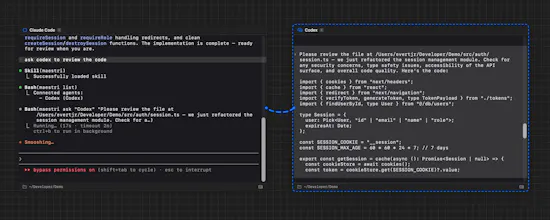
The idea is simple: an infinite canvas where each terminal is a node. But the feature that changes everything is agent-to-agent communication. Drag a line between two terminals and they collaborate. Claude Code asks Codex to review its code. No APIs, no middleware, just PTY orchestration.
Built entirely in Swift with a custom-built canvas engine. A full whiteboard with shapes, arrows, freehand drawing, markdown notes, and terminals, all on an infinite canvas. No Electron, no web views. The AI companion (Ombro) runs on your Mac through Apple Intelligence. No account needed, no telemetry.
1 workspace free. $18 lifetime for Pro.
Would love your feedback, especially from anyone juggling multiple agents daily. What's working? What's missing?
themaestri.app
@curiouskitty I've been working with coding agents for a while now. I've gone from Copilot to Cursor, Antigravity and others. My biggest issue was that I could never reliably parallelize work because the IDE environment adds too much noise. Closing it and opening it the next day feels like starting from scratch. I had no easy way to remember what I was doing other than relying on external tools to manage tasks and notes. With Maestri I can see the big picture at any moment, add notes for things I want to do, and even share them directly with the agents. It's not about replacing IDEs, it's about having a workspace layer on top where you orchestrate the work. You still open your IDE when you need to, but Maestri is where you plan, organize, and keep track of everything across agents and projects.
Hey, I'm a fan of native mac apps and your app look promising, especially for keeping an eye on what your agents are doing and having a visual and organized canvas. Can 2 codex instances can collaborate as well? Congratulations on your launch! 🚀
@louis_mille1 thank you! I hope you give it a try. And yes, 2 codex instances can collaborate, this feature works across all CLIs because it operates at a terminal level, it's like the agent is typing on the other window :)
If you use so many tools for development, won’t it get expensive? Claude Code alone costs $100–200 per license per person if used actively throughout the day.
@natalia_iankovych What drove me to create Maestri was subscribing to Claude Max and realizing I had way more tokens than I could use in a single terminal. I could be working on multiple things in parallel across different projects, but spawning dozens of terminals or VS Code instances made it impossible to manage. Too much noise, too much context switching, no big picture.
With Maestri I can manage dozens of terminals across multiple projects without feeling overwhelmed. Everything has a place on the canvas. My current setup is Claude Code for main development and Codex with an API key strictly for code reviews. It’s a great team and doesn’t get expensive since each model handles what it’s best at.
That’s also why Maestri is designed to be fully harness-agnostic. Every model has different strengths and every dev has their own preferences.
Can I replace the default terminal with Ghostty?
@zuozh11 Initially I was going to use Ghostty as the terminal emulation, but since the libghostty API is still not finalized I decided to go with SwiftTerm, a terminal emulation written in Swift. I'm even contributing upstream with improvements. It works extremely smooth it's just as good as Ghostty. If you feel like theres any terminal feature missing or rendering problems you can report to me!
Stringing multiple coding agents together usually turns into a tangled mess of terminal logs, so mapping them out on a spatial canvas makes total sense. I can see this being incredibly useful for having one agent draft a database schema while another concurrently builds the API routes. I am curious how you handle state sharing and context window limits when several agents are interacting at the same time.
@y_taka One of my favorite features in Maestri is connecting an agent to a sticky note on the canvas (which is saved as an actual markdown file on disk), so the agent can read and write to it freely. I use this constantly to have agents document important decisions, processes, and context as they work. Connect multiple agents to the same note and it becomes shared memory across sessions, even across different harnesses. Claude Code writes something down, Codex picks it up later. Context that actually persists.
Hey there! I have been using maestri for a couple of days, I love what you did there as I was looking for a solution like this for a long time.
I am thinking about building a test orchestration with agents for my team with maestri. I ran into some issues while doing so, and thought about informing this.
I am using a mac device. While working on Maestri I saw that after sometime the workspace gets stuck, terminals are doing there work, but i cant drag them and buttons become unresponsive. Also, delegating tasks to agent sometimes work, and sometimes the agent which should delegate the work creates his own sub agents and does the work in its workflow.
And this is another query, I can bridge agents and notepad but if I connect an agent with a terminal (shell), If i tell the agent to run commands on the connected shell it does not do it. Is it how its supposed to do?