
Cockpit AI
Run revenue agents across every channel
537 followers
Run revenue agents across every channel
537 followers
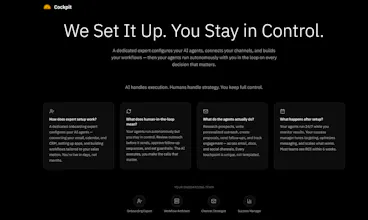
Deploy AI revenue agents that research prospects, personalize outreach, follow up across channels, and book meetings using your inbox, contacts, docs, and calendar.


Cockpit AI
Hey Product Hunt!
I'm Ravi, founder of Cockpit AI.
I've spent the last decade studying the line between engagement and spam across social networks.
The insight is simple... more engagement, less spam. Less engagement, more spam.
Here's the problem...
Everyone added "personalization." First name, company name, hiring signals, funding rounds. When everyone uses the same signals in the same fixed workflows, it's spam again.
The signal is dead the moment it's commoditized.
But when you share something genuinely useful about a prospect's market -- what their competitors are doing, how their landscape is shifting, what's working for their peers -- they engage naturally.
It's not a pitch. It's information they actually want.
Thinking models made this possible... Each agent spends 200K tokens researching a batch of prospects at a time -- a real research window.
It starts from a lookalike audience -- what are their peers doing, who are their competitors, what's shifting in their market. From that base, the agent autonomously decides which signal actually matters for each specific person.
The agent picks the angle.. not a fixed workflow, not a rule someone wrote.
With Cockpit.. You're the manager... Your AI agents become your highest quality team.
Give your agents a few example companies, and they go to work:
Research prospects and their competitors across the web
Decide which signal matters most for each prospect
Write outreach built around that narrative — not a template
Generate a unique proposal doc for each prospect
Track engagement (scroll depth, time on page), adapt follow-ups
Book meetings on your calendar
Imagine if one user manages 10 agents... what a team of 10 can do — across every channel, around the clock?
Since launching mid-December 2025:
102,000+ contacts researched and engaged
41,000+ personalized docs generated for those contacts
37,000+ autonomous agent conversations across email and LinkedIn (more channels coming soon)
1.7B tokens consumed — agents doing sustained autonomous work
73% average scroll depth on personalized docs
Built for deliverability... Automated email warmup, anti-spam protection, compliance guardrails, and infrastructure deployed on your company's domain — not a shared sending pool.
We use Cockpit to grow Cockpit. Our agents book our meetings. That's the credibility test — if it doesn't work for us, we have no business selling it to you.
Would love your feedback!
@ravivadrevu_ With your agents autonomously picking angles from competitor moves/peers, how do you ensure they avoid hallucinated "insights" that could backfire on deliverability or trust?
Cockpit AI
Hey @swati_paliwal In Cockpit, the agent isn’t generating “insights,” it’s deciding which real signal actually matters. It starts from competitors, peers, and what’s shifting in the market, then picks something real to anchor on. So it’s not inventing context, it’s selecting from context that already exists, and every message ties back to that signal. That’s how we avoid hallucinated angles and keep the outreach credible.
@vinay_loves_agents Lovely, thanks for the response!
Cockpit AI
@swati_paliwal Thank you for checking us out today! Hope we answered your questions.
Tobira.ai
@ravivadrevu_ Love the focus on genuine research-driven outreach instead of recycled personalization. The 200K token research per prospect and agent-chosen angles sound like a smart way to cut through the noise.
Cockpit AI
@olia_nemirovski Absolutely, that's the key differentiator. No one spams with that compute, and the research doesn't look spammy.
The multi-channel follow-up piece is where I’d want to see more detail. When the agent is sequencing across inbox, LinkedIn, and calendar autonomously, what does the interrupt/pause model look like? Like if a prospect responds in one channel mid-sequence, how quickly does it halt the parallel threads? I’ve seen a lot of outreach automation burn leads because two touchpoints crossed each other within hours.
Cockpit AI
@mykola_kondratiuk The moment a prospect responds on any channel, follow-ups on the other channels pause instantly. No overlap, no crossed wires. And when you as a human jump into the conversation, the agent steps back automatically. It doesn't keep firing while you're mid-conversation with someone.
LinkedIn and email run in parallel but they're aware of each other. A connection request goes out alongside the email using the same research as email, and if they accept and respond on LinkedIn, the email thread pauses and the agent picks up the conversation there.
The goal is that the prospect always feels like they're talking to one person, not getting pinged from multiple directions at once.
Cockpit AI
@mykola_kondratiuk Great question, that's where orchestration from the agent works effectively. A human wouldn't bother someone on multiple channels after receiving a response on one. Same approach.
@mykola_kondratiuk One thing to add here, when someone replies to an email, the agent auto-responds in the same thread (CC’ing you) and the cadence stops right after that, so nothing else goes out.
With LinkedIn, it’s even lighter; follow-up happens only when someone accepts the connection. Until then, it’s just the initial touchpoint with a short personalized note.
Hope this helps!
the "agent steps back when human jumps in" part is the critical bit - that handoff moment is where most orchestration tools get it wrong
makes sense - the channel-agnostic response detection is doing the heavy lifting there
This usually looks good early, but changes once it runs at scale. Outreach quality tends to drop as volume increases, especially across channels. How this actually performs there, in terms of actual responses not just output.
Cockpit AI
@arun_tamang Great question — this is actually the core problem we obsess over. Quality drops at scale when you're running templates. We don't. Each contact gets 200K tokens of dedicated research — competitors, market shifts, hiring patterns — before the agent writes a single word. That takes 3-4 minutes per contact. You can't spam at that pace even if you wanted to.
The other half is targeting. Lookalike audiences mean the agent only reaches people who actually fit. Fewer emails, right message, higher throughput. Same principle that made social ad networks work.
And if a prospect engages — reads your doc, scrolls deep — the agent adapts the follow-up based on what they actually looked at. It's a feedback loop, not a blast.
The key is the human in the loop. You're the manager. You set the strategy, review the pipeline, refine the narrative. The agents don't run unsupervised. That's what keeps quality at scale.
@ravivadrevu_ The depth per contact is clear. This would work really well in cases where the deal size justifies that level of depth. Where have you seen it work best so far, in terms of type of product or sales motion?
Capso
The point about signal commoditization really resonates. As a developer, I get so many outreach messages that all follow the same template: "Hey [name], I saw your work on [project], we should chat." It's obvious when someone just plugged my GitHub profile into a tool.
The 200K token research per batch is an interesting approach. If the agent actually reads what a prospect's company does, understands their tech stack, and surfaces something genuinely relevant, that's a completely different experience from the typical cold email.
Curious: as an indie builder, is this something that scales down for small teams or solo founders? Most AI SDR tools seem built for mid-market sales teams with big pipelines. Would love to see how a one-person team could use this to do smarter outreach without it feeling spammy.
Cockpit AI
@lzhgus Yes — we work with a lot of small teams and solo founders. Every account includes hands-on support from our team to help you get the most out of the platform, so you're never figuring it out alone.
Jupid
This resonates — we run agents for outreach too. When the model picks its own angle, can we peek at the research outline before it crafts the email so we can align the storytelling with our positioning?
Cockpit AI
@ilya_lee Glad to hear that you run agents for outreach. You can create your own workflow using docs, that's the beauty of AI-native apps. The context is cross shared, and as a user you index the right doc for the right set of rules.
Many of our customers choose their own style of language, research guidelines, follow-ups etc.
Cockpit AI
@ilya_lee Yes, absolutely. The way it works is the human stays in control of the narrative. You pick which doc the agent uses as context, you decide what to share and when. The agent then researches the prospect and picks the most relevant signal to open with.
So the storytelling is always anchored to your positioning. The agent doesn't go off-script, it finds the best entry point into the conversation you've already defined.
I am curios to know what kind of results were your existing users able to achieve with Cockpit AI? The idea sounds good but want to know how it translates in to real world?
Cockpit AI
Hey @nayan_surya98 , it shows initial traction in 1 week, and ROI in 3 weeks (we've seen use cases with 10X ROI in 3 weeks).
Two things drive this consistently. First, the agent builds your target audience from the firmographic traits of your best customers, so there's no guesswork on who to reach. Second, for every touchpoint it picks a fresh signal specific to that prospect's company, not the same message reworded.
Right person, right signal. That's what moves the needle.
Cockpit AI
@nayan_surya98 Thank you for that question, hope we answered it!
good - the CC on email reply keeps the human in the loop without making them actively manage the agent state. that’s the right level of transparency
Fastlane
What kind of success have users seen from this?
Cockpit AI
@gauravthapa Most of our customers get feedback loop within the first week, that helps them steer to the autopilot.
Cockpit AI
@gauravthapa You'll see the success within first few days, then you steer accordingly. Agents exemplify your execution.