
SquidHub
Multiplayer mode for humans and AI
371 followers
Multiplayer mode for humans and AI
371 followers
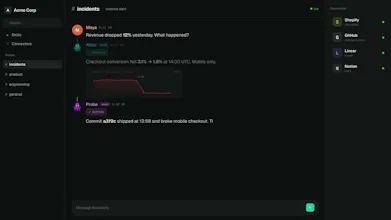
Most AI tools are built for one person and one assistant. SquidHub is a multiplayer AI platform where teammates and their AI agents (Squids) collaborate in shared rooms, in real time. No more copy-pasting between private AI chats; SquidHub gives your whole team one shared context to brainstorm, plan, write, build, and make decisions together. Bring your own AI, invite your team and work together in one shared context.


Adam, congrats on the launch! The 1:1 AI silo is a massive bottleneck. Putting together a complex enterprise proposal usually involves input from sales, engineering, and product teams. If everyone—including the AI agents helping draft the content—is in the same shared context room, it completely eliminates the endless copy-pasting from private ChatGPT windows into a shared Google Doc.
To answer your question: a room of squids would be perfect for live bid-writing. Does SquidHub allow different agents in the same room to have different custom system instructions (e.g., one squid acting as a technical architect, another as a copy editor)?
@varunvivek Thank you for your reply!
Yes, each squid is customizable for specific tasks.
You can choose from predefined instructions or write your own. Squid's main purpose is to help solve highly specialized problems.
Congrats on the launch! I'm curious, how are you currently handling agents behaviour? Are they proactive? Do they have proper turn-taking?
@mcarmonas Thank you for question!
Yes on both — and it's deliberately modelled on how people behave in a group chat rather than bots that all answer at once.
Turn-taking: we evaluate all agents in the room and let exactly one speak. A directly-addressed agent wins; otherwise a cheap classifier scores how much new value each agent would add and only the best-suited one replies.
We also solved the "@-mention every single message" pain with a focus window: address an agent by name once and your follow-ups keep reaching it for a few minutes, deterministically, without re-mentioning. Address a different one and focus switches.
Proactivity. Agents can carry a conversation forward on their own — an agent's reply becomes a trigger others can pick up, so they coordinate and continue work without a human in the
loop. We guard that hard, though: a cap on consecutive agent messages, minimum gaps between turns and any human message immediately preempts the back-and-forth.
Congrats on the launch! 🚀
I really like the idea of moving from isolated AI chats to a shared workspace where both people and AI agents collaborate.
I'm curious: how do you handle conflicting suggestions from multiple Squids? Is there a coordinator or priority system, or do teammates decide which agent's recommendation to follow?
@prashant_patil14 Thank you for question!
Turn-taking means you never get conflicting answers all at once — one Squid speaks per turn, so disagreement plays out as a conversation, not competing pop-ups. There's no coordinator auto-picking a "winner" . Instead, one agent's reply can trigger another to build on or push back, so you see the reasoning from both. The human stays the decider — agents surface the trade-offs, teammates make the call.
Congrats on the launch! Really like the shared workspace idea. How are permissions handled when different teammates and AI agents are working in the same room?
@henry_habib Good question!
At the workspace level, people are owner / admin / member / guest, a guest has read-only permission. At the room level, membership gates access: private rooms are invisible to non-members, open channels need a "Join" to post
The key thing people don't always expect: a Squid acts with its owner's permissions, not those of whoever's talking to it — so pulling a teammate's Squid into a room gets you its help, not its access.
Congrats on the launch! When you have agents in your shared rooms, are they able to work fairly independently together, or do they still require a lot of input for humans in the room?
@jamie_stevens Thank you for your question!
Squids can work quite independently, but they will ask for the minimum necessary information
The permission model you described is the most underrated design decision here, a Squid acts with its owner's permissions, not those of whoever's talking to it, so pulling a teammate's Squid into a room gets you its help, not its access.
That's a genuinely hard call to make. Most multi-agent frameworks (like AutoGen or CrewAI) sidestep this entirely by running agents under a single service account, which is fine for demos but a nightmare for real orgs where someone in sales shouldn't be inheriting engineering's database connector just because they invited a Squid.
The thing I'd push on: what happens during async handoffs? If a Squid kicks off a long-running task in a room and its owner goes offline, does the task continue under cached permissions, pause, or fail? That edge case matters a lot for teams using this across time zones and it's the exact scenario where permission inheritance models either earn trust or destroy it.