
EqualDocs
The legal front door for business
15 followers
The legal front door for business
15 followers
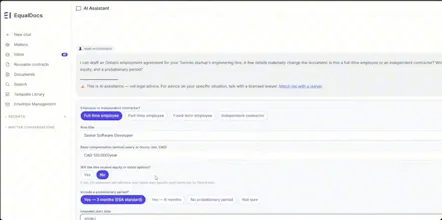
EqualDocs is the legal front door for growing businesses. AI handles routine legal work at software economics, while licensed lawyers step in when professional judgment is required. Draft and review contracts, ask legal questions, send documents for e-signature, and use Legal Firewall™ to check contracts against rules for their type and jurisdiction. Built for growing and cross-border businesses, HR and People teams. Start free, with paid plans for individuals, teams, and enterprises.

Free Options
Launch Team / Built With


Render: Get up to $100K in startup creditsCloud infrastructure for founders who want to move fast and NOT break things
Promoted
@xin_wei_wayne_ As an HR professional, I’ve seen so many managers and small business owners 'sign and pray' because legal fees were too high. It’s a massive hidden risk. I love the mission of democratizing contract clarity, it’s exactly the kind of 'peace of mind' tool leaders need.
Does EqualDocs handle employment-specific contracts, like NDAs or offer letters, as part of the beta?
@chris_payne_emba Absolutely — that’s exactly the use case EqualDocs is built for. Yes, employment‑specific documents like NDAs, offer letters and other employee documents are very much in scope for the beta.
EqualDocs is positioned as an AI contract platform for SMEs, including HR and employment workflows, with specific messaging around employment contracts.
Public materials explicitly mention offer letters, NDAs, and employee documents as ideal document types for the platform, alongside repetitive contracts small businesses sign all the time.
Wow, looks like a very well executed product! I like the strong emphasize on your teams experience in law and software, considering legal work is something you can't afford to be careless on. I'm curious what was your experience transitioning your law expertise to software?
@akhilm6 Thanks so much, really appreciate that 🙏
Honestly, the transition has been a bit of a mindset shift. In law, you’re trained to be super precise and careful — every word matters, and you try to cover every edge case. In software, especially early on, it’s more about shipping, learning, and improving as you go.
One of the harder (but interesting) parts was figuring out how to translate that “legal way of thinking” into something a product can actually use — like breaking down how we assess risk in a contract into something more structured.
At the same time, it helped a lot that we’ve lived the problem ourselves. We knew where things are confusing or risky because we’ve been there.
Still figuring things out as we go, but that mix of law + building has been really fun so far 🚀