
Launching today

Roast
Turn review rage into bug tickets in 60 seconds flat
1 follower
Turn review rage into bug tickets in 60 seconds flat
1 follower
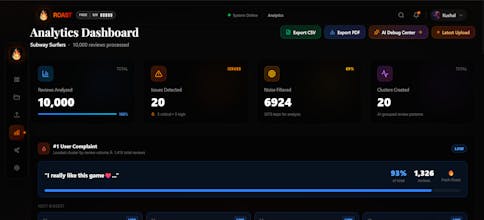
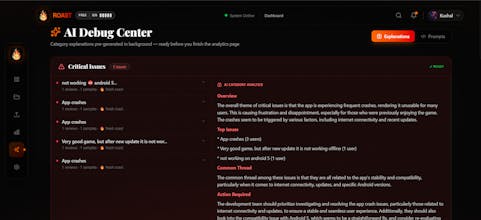
Your app just hit 50k Google Play reviews. 73% are copy-paste spam, 18% are vague rants. Only 9% contain the real problems. Roast uses AI clustering to surface what’s actually hurting ratings: • “App crashes on Pixel 8” (2,847 reports) • “Login broken after v4.2.1 update” • “Battery drain on Android 13+” Upload a CSV → get root-cause clusters in 60s → export to GitHub Issues. Stop reading 10k reviews. Ship fixes that move ratings. Built for indie devs.






The story behind Roast:
I was burnt out researching "portfolio project ideas."
Todo apps. Weather apps. Chat clones. All boring. None would actually test my skills.
Then I downloaded some review datasets from Kaggle just to mess around.
Opened a CSV with 400,000 Spotify reviews.
Spent 4 hours manually reading them, trying to find patterns.
Got through maybe 500 reviews. Wanted to quit.
That's when it hit me: "If THIS is painful for me... imagine actual developers dealing with this every single day."
Something clicked. Sixth sense. Gut feeling. Whatever you call it.
I KNEW I had to build this.
---
The Grind:
First version took 45 minutes to process 10,000 reviews. Pathetic.
Tried different approaches:
- Batch processing
- Parallel workers
- Better clustering algorithms
- Embedding model optimization
Failed. Tried again. Failed. Almost gave up twice.
Then I got it down to 5 minutes.
Then 2 minutes.
Then under 60 seconds for 100,000 reviews.
That's when I realized something:
"If this is just a portfolio project, I'm done. But if this needs to be a PRODUCT... I need WAY more."
That thought changed everything.
---
Project → Product Mindset:
I didn't just need ONE architecture. I needed to prove it WORKS long-term.
So I built:
v1: Production architecture (what users see)
v2: Experimental architecture (testing new approaches)
v3: Shadow monitoring (drift detection, adversarial review detection)
Every upload gets processed by v1 (production).
Behind the scenes, v2 runs in parallel to test improvements.
v3 watches for data drift and review manipulation attacks.
Most "portfolio projects" wouldn't need this.
But a REAL PRODUCT serving real users? Absolutely.
---
The Result:
- Processes 100k reviews in under 60 seconds
- Handles noise filtering (spam, ChatGPT reviews, copy-paste)
- AI clustering finds actual issues (not just keywords)
- Root cause analysis with various LLM system with 5 models fallback!
- Exports to CSV/PDF/GitHub Issues
- Real-time notifications and search
- Plan enforcement (Free → Enterprise tiers)
- Shadow orchestrator that tests every change before rolling out
---
Tech Stack (The Real Stuff)
Backend:
- FastAPI with dual architecture
- Supabase (PostgreSQL) with transaction mode
- Semantic embeddings (paraphrase-MiniLM-L3-v2)
- Shadow orchestrator for A/B testing architectures
- Drift monitor for data quality
Frontend:
- Next.js 14 with Vercel auto-deploy
- Real-time Supabase subscriptions
- Global search with text highlighting
- CSV/PDF exports with AI insights
---
Timeline:
Started 3 months ago as a "portfolio project."
2 months in: realized this could be a real product.
Last month: shipped shadow testing, plan enforcement, notification system.
This week: launching on Product Hunt.
Beta testers keep saying: "Wait, I'd actually pay for this."
So here we are.
---
What I Learned:
Building a portfolio project = solving one problem.
Building a PRODUCT = solving the problem + reliability + monitoring + scaling + edge cases + user experience.
The jump from "this works" to "this works in production for real users" is MASSIVE.
That's what Roast is now.
If you're an app dev drowning in reviews, try it out.
If you have questions about the tech, drop a comment. I'm here all day.
Built by a solo dev in Bangalore who refused to build another just todo app. 🔥
— Kushal Raj G S
— (Founder, The Maker)