

Interactive Digital Magazines for Sports Content: What Makes the Format Worth Considering
If you publish sports content regularly - match recaps, weekly digests, tournament coverage - the format you distribute it in may be worth a closer look.
Static PDFs have been the default for a long time. They are familiar and easy to produce. But there are a few practical limitations that tend to surface when you are publishing on a fast turnaround schedule and trying to reach an audience that reads mostly on mobile.
What an Interactive Digital Magazine Could Offer
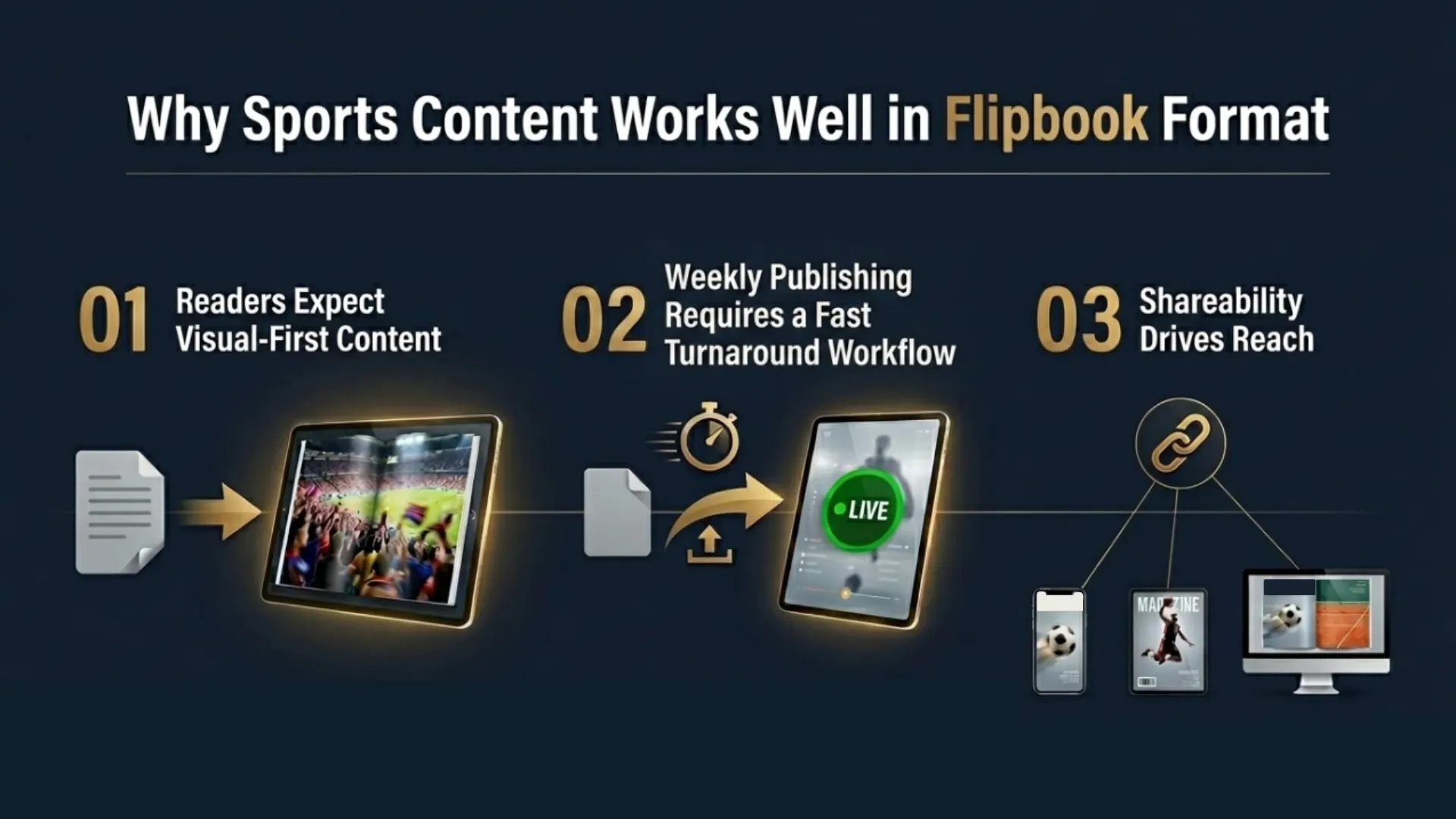
An interactive digital magazine is a publication that opens in a browser without a download. Pages turn, content scales to any screen size, and readers can access it on a phone, tablet, or desktop without installing anything.
The visual experience could be significantly better. Sports content is built around imagery - match photography, player profiles, stat layouts. A format that preserves full-page spreads and smooth page transitions may present that content more effectively than a static file that requires zooming and scrolling on mobile.
Shareability could also improve. A direct link is easier to send than a file attachment, and it opens immediately without asking the reader to do anything extra. For time-sensitive content like match coverage, that ease of access may help more of your audience actually read what you have published.
How the Workflow Could Fit Into What You Already Do
One thing worth knowing is that moving to this format does not necessarily mean changing how you design. If you already work in Canva, Adobe InDesign, PowerPoint, or Google Slides, the process would stay the same. You design your publication, export to PDF, upload it to a platform, and the platform converts it into an interactive flipbook automatically.
For publishers producing content on a weekly or match-by-match schedule, this could help keep turnaround times short without adding production steps.
Accessibility as Part of the Format
If accessibility is a consideration for your publication, an interactive format may help here as well. Platforms that include WCAG 2.2 AA compliance, text-to-speech with word highlighting, and screen reader support by default could make your content reachable by a wider audience without any additional work on your end.
Understanding How Your Audience Engages
Page-level analytics - available on paid plans on most platforms - could give you visibility into which pages your readers spent time on and where they dropped off. For an ongoing sports publication, that kind of data may help you improve each edition based on how the previous one was actually read, rather than just how many times it was downloaded.
What does your sports publishing workflow look like right now, and is there a part of it you wish was simpler?
For more info visit - zenflip.io
Replies
I like it overall. The design is memorable.
@good2know Thank you