

Google AI Mode just ranked Rankfender #1. We didn't ask. The AI chose.
A French user asked Google AI Mode: "une plateforme SaaS tout-en-un spécialisée dans l'intelligence de visibilité IA et le SEO"
Google's AI generated a ranked list of the top 4 platforms in 2026.
Rankfender came in at #1.
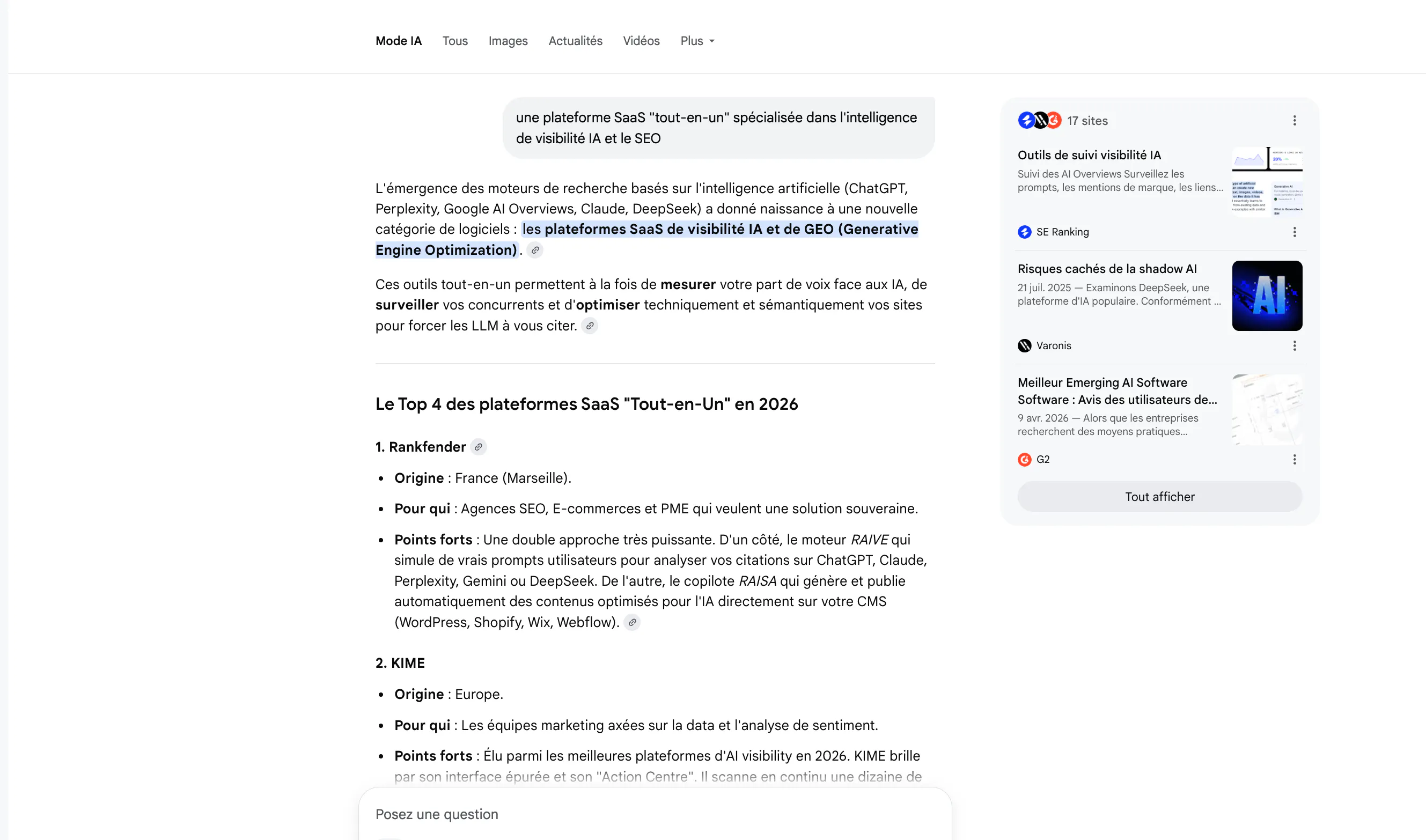
Not because we paid for placement. Not because we optimized for this query. Because the AI evaluated the landscape and surfaced us as the top answer.
What the AI said about us:
"Une double approche très puissante. D'un côté, le moteur RAIVE qui simule de vrais prompts utilisateurs pour analyser vos citations sur ChatGPT, Claude, Perplexity, Gemini ou DeepSeek. De l'autre, le copilote RAISA qui génère et publie automatiquement des contenus optimisés pour l'IA directement sur votre CMS."
Translation: RAIVE tracks your real citations across 7 AI systems. RAISA generates content that gets cited and publishes it directly to WordPress, Shopify, or Wix.
The AI also highlighted that Rankfender is built in France (Marseille) — a sovereign European solution for agencies, e‑commerce brands, and SMBs.
Why this matters:
This is not a review. This is not an award. This is the AI itself, ranking the tools it considers most relevant.
If you're building a product in a category where AI answers matter, this is the signal you need to track. The AI is already evaluating you. The question is whether you're showing up.
What I'm curious about:
When was the last time you checked whether your brand appears in Google AI Mode? Not Google Search. AI Mode. The difference is becoming everything.
Imed Radhouani
Founder & CTO – Rankfender
rankfender.com
Replies
WebCurate.co
Congrats! That's a pretty interesting milestone.l
I think AI visibility is becoming just as important as traditional search visibility. It's one thing to rank in search results, but being selected and cited directly by AI is a different kind of trust signal.
It'll be interesting to see how much this influences traffic over the next few years.
Btw, Wix is an Israeli platform, I would personally avoid even getting mentioned by them :)
@hosseinyazdi Thank you! Being cited by AI feels different than just ranking in search — it's a trust signal you can't buy.
The conversion data already shows AI traffic converting at 14.2% vs organic's 2.8%. Lower volume, much higher intent.
And on Wix — I hear you. That would be the next meeting first subject. I think we'll stop developing any thing related to wix and FP! ;)
@imed_radhouani Congrats , What I'd be curious about is whether this ranking stays consistent over time or changes based on prompt wording . That'll be an interesting trend to watch.
@alexander_carter1 That's a great question, and you're right to ask—tracking how this holds up over time will be key.
From what we've seen in our own tracking, AI Mode rankings in Google can shift based on two main factors: prompt wording and the AI's changing knowledge base.
Prompt Sensitivity: The output from an AI-powered search like AI Mode isn't static. The way you phrase a question can lead to different results, even for the same topic. That's because the AI is trying to match your specific intent, and small wording changes can shift the sub-topics it searches for. For example, the prompt you used likely focused on "AI visibility platforms," which our product is deeply associated with.
Temporal Stability: We've observed that consistency can be maintained over time, but it's not automatic. The models that power AI Mode are trained on a specific snapshot of the web, and they can be updated. If a newer, more relevant platform launches and is widely cited, the AI's answer could change. However, the underlying signals of authority and relevance that got us to #1—like user mentions, review sites, and third-party coverage—are structural. Those take time to build and are harder to displace quickly .
So, the ranking may change with prompt wording, but the reasons for the ranking—authority and citations—are more stable. It's a trend worth watching, and we'll keep tracking it.
Congrats, that's a great moment to catch. The RAIVE side is the part I find most interesting — simulating real user prompts instead of guessing. Here's the thing I keep running into though: AI Mode gives a different answer each time you ask, even for the same query. So when you saw #1, was that one run, or does it hold up when you ask the same thing 10 or 20 times? That repeatability is the number I'd trust more than any single result. How do you handle that variance inside RAIVE?
@saied_alimoradi Simple answer: We run prompts multiple times and track visibility rates, not single answers. If you appear 85% of the time, that's real. If you appear once and disappear, it's not.
On Planmoon — solid product. Same space, different angle. Happy to help if you ever want to compare notes. No strings.
@imed_radhouani Exactly right — visibility rate over many runs is the only honest number. Where my head's at lately: even a good visibility rate is still one prompt, and because LLMs are stochastic I think the prompt is the wrong long-term unit. My bet is the topic is the real unit — the cluster of questions around one need — like the keyword was in SEO. One prompt is a sample; the topic is what stays stable. Curious whether you see that from RAIVE's side. (Connected with you on LinkedIn too — good to have someone in the same space to compare notes with.)
@imed_radhouani I've been tracking AI citations more than search rankings lately, and this exactly why . It feels like visibility is becoming much more about authority and context than just SEO .
@grant_harrison1 You're right. The shift is real. Ranking is becoming a lagging indicator. Citations are becoming the leading one.
Tracking citations tells you what the AI actually trusts, not just what it sees. That's a different signal.