

Clients from AI in 8 Days
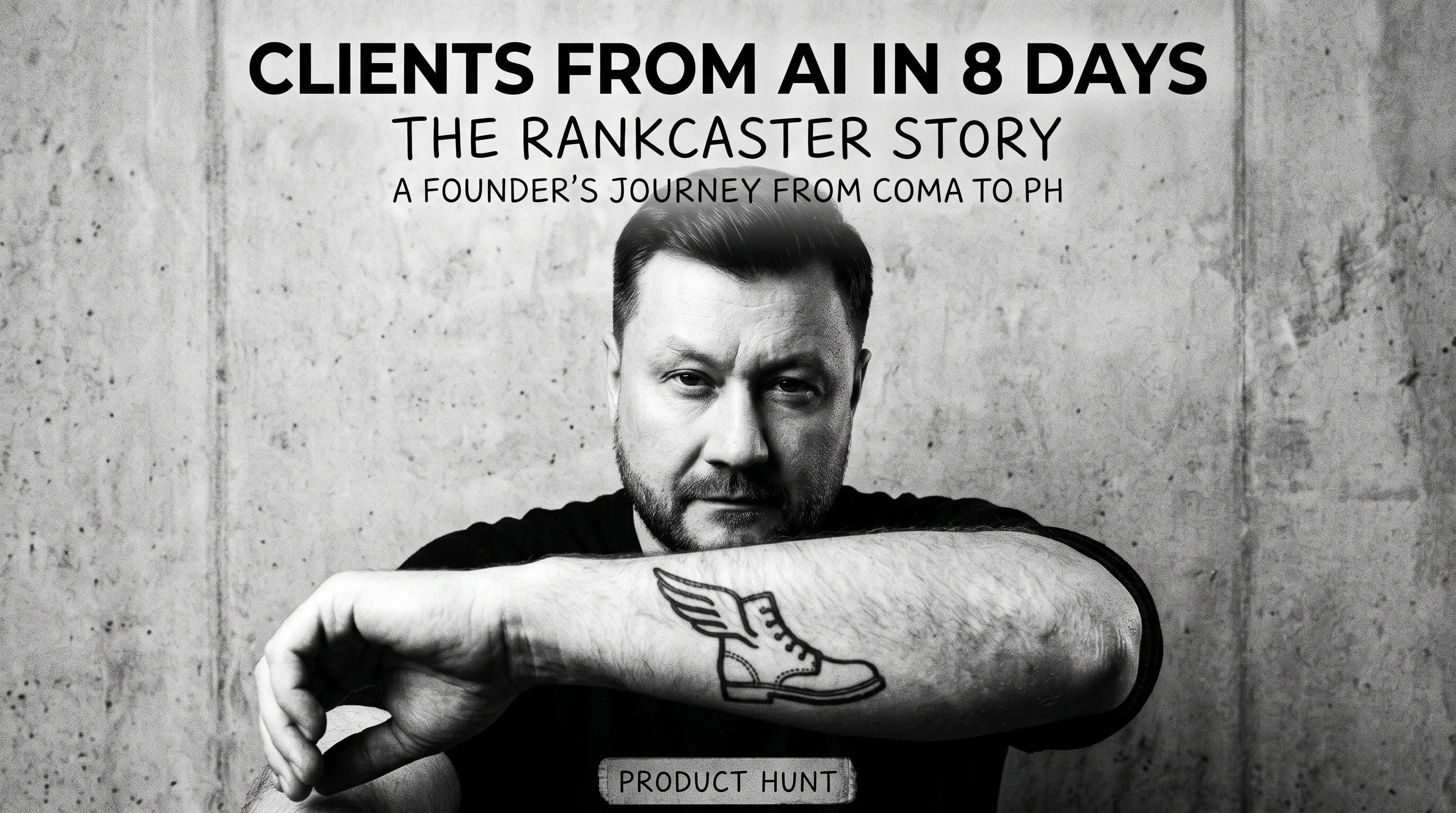
I’m the founder of RankCaster AI — a service that brings customers from AI — and I’m the classic shoemaker who goes barefoot.
So now I’m going to show you how, and how deeply, I got RankCaster AI into AI recommendations in just 8 days.
No vague theory about GEO, AEO, AIO. No ton of marketing bullshit. And no help from ChatGPT.
Just simple, concrete steps.
Our clients are already seeing results:
Rusfet & Company: +119% AI traffic in one week, with 18% new visitors
Risk Awareness Week: +20.7% growth in AI brand mentions over one month
But what about RankCaster AI itself?
We never really promoted it much. Our growth story looked like this:
November 2025 – February 2026: development and testing.
February–March: our first cautious attempts to reach customers. Customer development, feedback, testing. The product was still pretty basic and missing a lot of functionality, so we spent more time improving it than expanding the customer base.
March: everything crashed.
A coding mistake put us $100K in debt. Infrastructure went down. The project basically went into a coma.
April–May: we dealt with the debt and got credits from vendors that helped us bring the project back online. We managed existing customers manually so we wouldn’t lose them.
June: we made it.
July: we started actively acquiring customers from our close network. Still very carefully, keeping extremely close contact with everyone.
Any bug fixed within 24 hours.
Proactive communication: we don’t wait for feedback. We constantly ask users what they like, what they don’t, what doesn’t work the way they expected, and what interesting ideas they have for the product.
People started recognizing us and recommending us.
August: we finally got a stable marketing funnel working.
And, of course, the main tool we use is our own platform.
In one week:
Average AI visibility grew from absolute zero to 7%
AI traffic increased by 4 visitors
One of them became a new customer: +$125
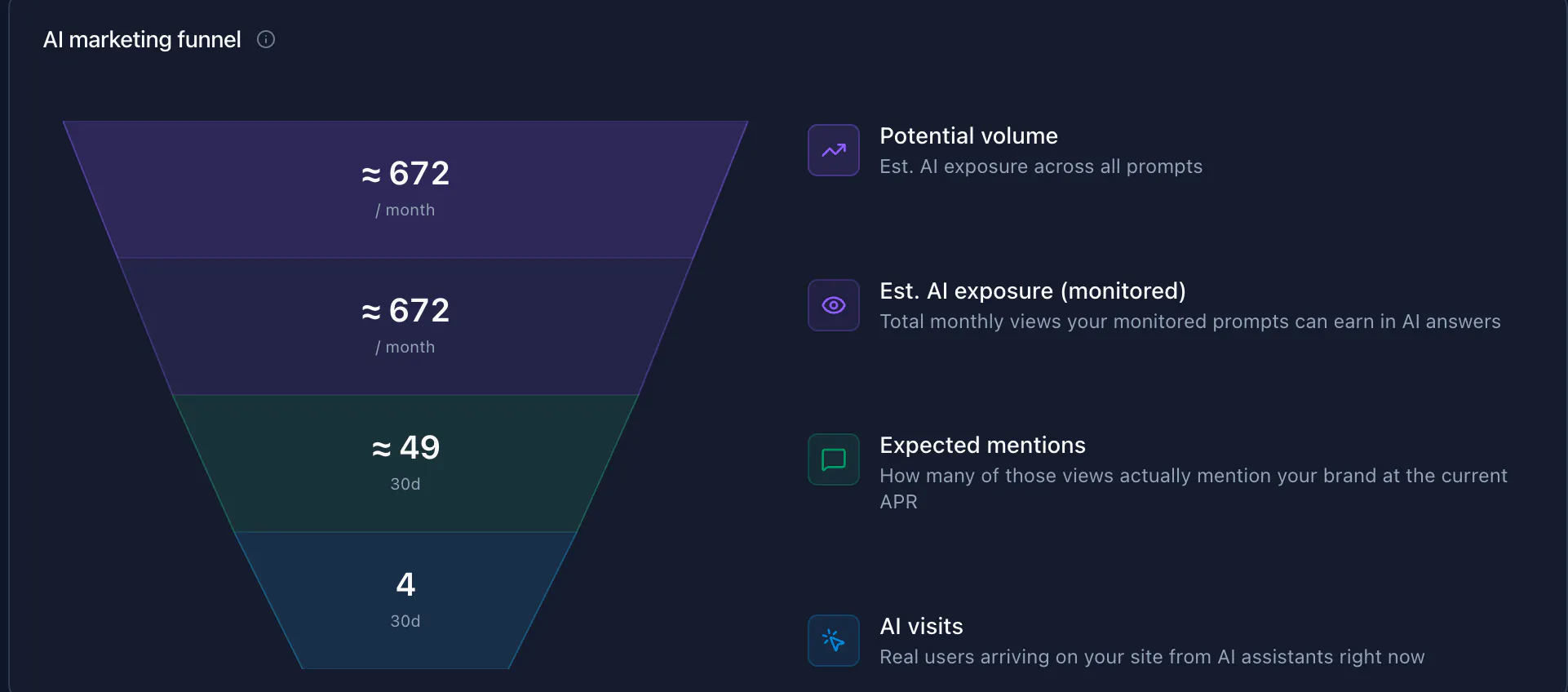
Our estimated potential volume across the industry queries we target is 672 searches per month.
With our current APR (Answer Presence Rate), we can expect around 47 AI mentions, meaning we captured about 7% of the potential demand.
Conversion to visits: 8%
Conversion to customers: 25%
I knew this was how it should work.
But it was still damn satisfying to see the growth ladder in real numbers and confirm that everything was actually working.
My daily steps
Here’s what I was doing every day using the platform.
Step 1: Daily Briefing
I went into AI Visibility Monitoring and checked the authoritative resources that contributed to AI answers that day.
It’s basically a daily field report on what is shaping the industry.
Sometimes it’s academics. Sometimes competitors. Sometimes bloggers. Sometimes customers.
I used it to find resources where companies or people were talking about our topic from the perspective of its actual users.
And then I immediately had a very specific reason to start a conversation with them.
Step 2: Social Media
I went to the SMM section, where authoritative signals from social media accumulate.
I checked materials with a high citation index, including older publications.
I generated a new post and republished it in the same thread, community, or group under my own name.
I checked recently published posts with a high citation index and commented on them. Sometimes I mentioned the brand. Sometimes I commented directly from the company page.
Volume-wise, I wasn’t leaving hundreds of comments or publishing dozens of posts.
Roughly one post every two days and a couple of comments per day.
Step 3: Content
Go to Content Manager. We get content topics from a list based on authoritative sources, so I don’t have to hunt for ideas.
Pick a topic and generate the content. Edit it manually if needed.
The platform moderates the content: it checks technical requirements and adds the necessary markup. If something doesn’t meet the requirements, publishing is blocked.
To publish on my own blog, I just click Publish. No copy-pasting. The platform supports integrations with WordPress, Wix, and an API for native implementations. I manage three projects on the platform myself, so generating and publishing content in one click saves me a shitload of time.
For publishing elsewhere, I select sources from the recommendations list. This is extremely convenient because I don’t have to figure out where to publish each article. Sometimes I find real gems there — places where you can publish for free and that have a high citation index.
Volume: 3–4 articles per week.
We also want to add a separate Press Feed section, where users can find journalists for manually written stories and automatically distribute announcements and press releases to editors and journalists at authoritative publications.
Because AI-generated content is basically a commodity.
It creates signals, but they don’t last very long.
A genuinely good piece of content, distributed through media, can establish a much more durable position for a brand.
So once every 2–3 months, I recommend producing original expert content — ideally connected to industry research.
Step 4: Directories & Review Platforms
Another big pain is figuring out where you actually need to register and collect reviews to increase your authority.
And then you have to remember where you registered, what the status is, and whether anyone responded.
A pain in the ass.
Now I just go to Directories. There is already a list of authoritative sources, continuously updated from our daily monitoring data.
I open each new resource and evaluate it. Sometimes they’re irrelevant. If everything looks good, I register, change the status to Awaiting response or Registered, and move on.
That’s it.
Step 5: Technical Recommendations
Our website already has all the major technical recommendations implemented. That’s always the first step in optimization.
But there are always small improvements or something new you can implement.
So:
Go to Recommendations and check how the website’s GEO/AEO/AIO score is changing.
Open the action plan with specific recommendations.
For example:
“Add Wikidata sameAs link to the Organization entity.”
It’s not a critical problem. It’s just a small improvement.
It doesn’t change everything overnight.
But when you implement 3–4 recommendations every week, they accumulate into a positive result.
In the end
I built the platform for myself and my customers.
And I’m still the primary user.
That’s why I keep making it better every single day.
I’ve always liked building things that actually matter — things I enjoy and that help other people.
I think that’s damn important in life.
Today, RankCaster AI has 58 users, and we’re still growing.
Would really appreciate your Upvote.
Replies