

DroiClaw: From App-Driven Phones to Intent-Driven AI Terminals
For almost two decades, smartphones have been organized around apps.
Every task begins the same way: unlock the phone, find the right icon, learn the interface, move through several screens, and repeat the process in the next app. Even when AI is added, it often remains another destination inside that system - another place to visit before the real work begins.
DroiClaw proposes a different starting point:
Do not begin with the app. Begin with the intention.
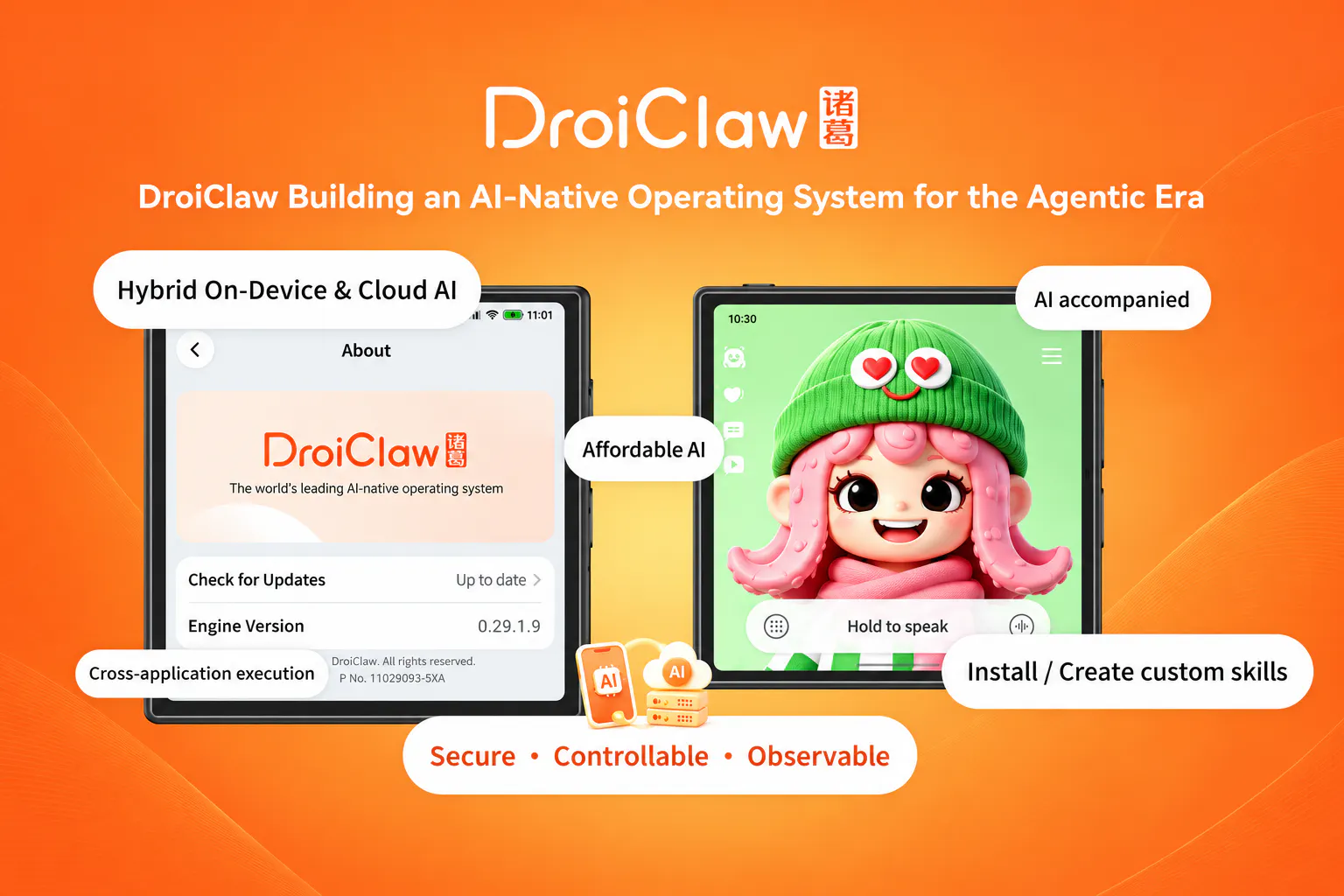
DroiClaw is presented as an AI-native operating system for the agentic era. Image source: Phoenix New Media. The reference terminal shown in these images is not the final industrial design of Meydo C1.
What Is DroiClaw?
DroiClaw is an AI-native Agent system designed to bring understanding, planning, and execution into the operating-system layer.
According to a Phoenix New Media article published on August 4, 2026, DroiClaw Zhuge has launched for the Chinese market and completed an initial terminal deployment. The same report positions it as a system-level platform for carriers, device manufacturers, and enterprise customers. For Meydo C1, our product specification currently describes DroiClaw as the planned AI Agent system that will connect conversation, visual perception, memory, skills, model routing, and supported app actions.
That distinction matters. DroiClaw is not simply a large language model with a character on top. It is intended to coordinate several layers of the device:
An interaction layer for voice, text, vision, and an AI character.
An understanding layer for intent, context, and the situation in front of the user.
An Agent planning layer that breaks a goal into executable steps.
A capability layer that calls models, skills, system tools, and supported apps.
A memory layer for the current task, user-approved preferences, and longer-term context.
A safety layer for permissions, confirmation, logs, interruption, and recovery.
The result is a shift from an AI that produces answers to a system that can help move work forward.
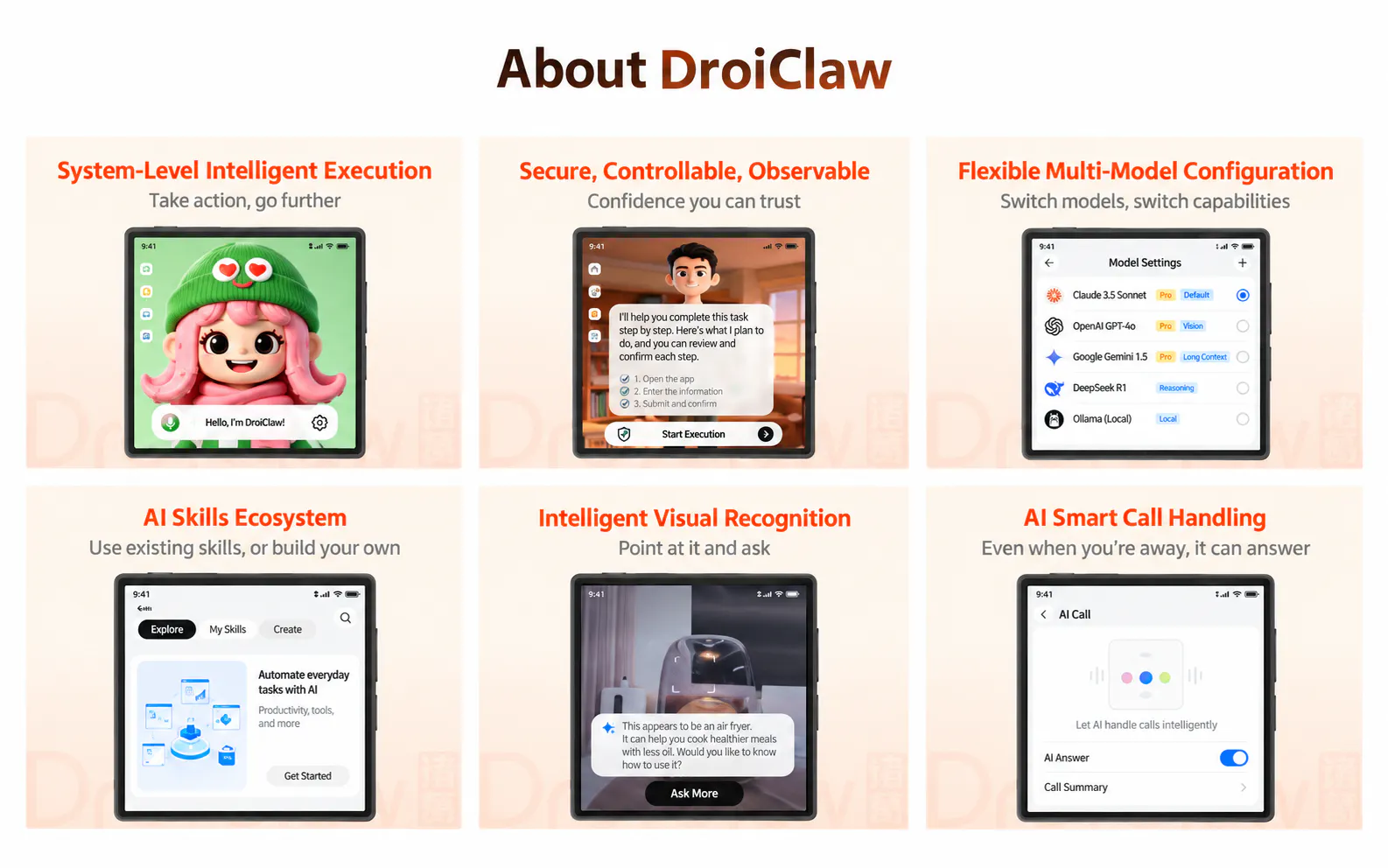
The source material highlights system-level execution, visible control, multi-model configuration, a skills ecosystem, visual understanding, and voice interaction. Image source: Phoenix New Media.
From Opening Apps to Expressing a Goal
In an app-driven phone, the user acts as the coordinator. You decide which service to open, transfer information between interfaces, and keep track of every intermediate step.
In an intent-driven system, the user describes the outcome. The Agent becomes the coordinator.
App-driven interaction
Goal -> choose an app -> navigate -> enter data -> switch apps -> finish

Intent-driven interaction
Goal -> understand context -> plan -> use approved tools -> confirm -> report
Imagine saying, "Book me a ride to Pudong Airport."
A useful Agent must do more than open a ride-hailing app. It needs to understand the destination, identify the pickup location and time, select a supported service, display the route and estimated cost, ask for approval, and report whether the booking succeeded. If login, location permission, a verification code, or network access interrupts the task, it should explain exactly where it stopped.
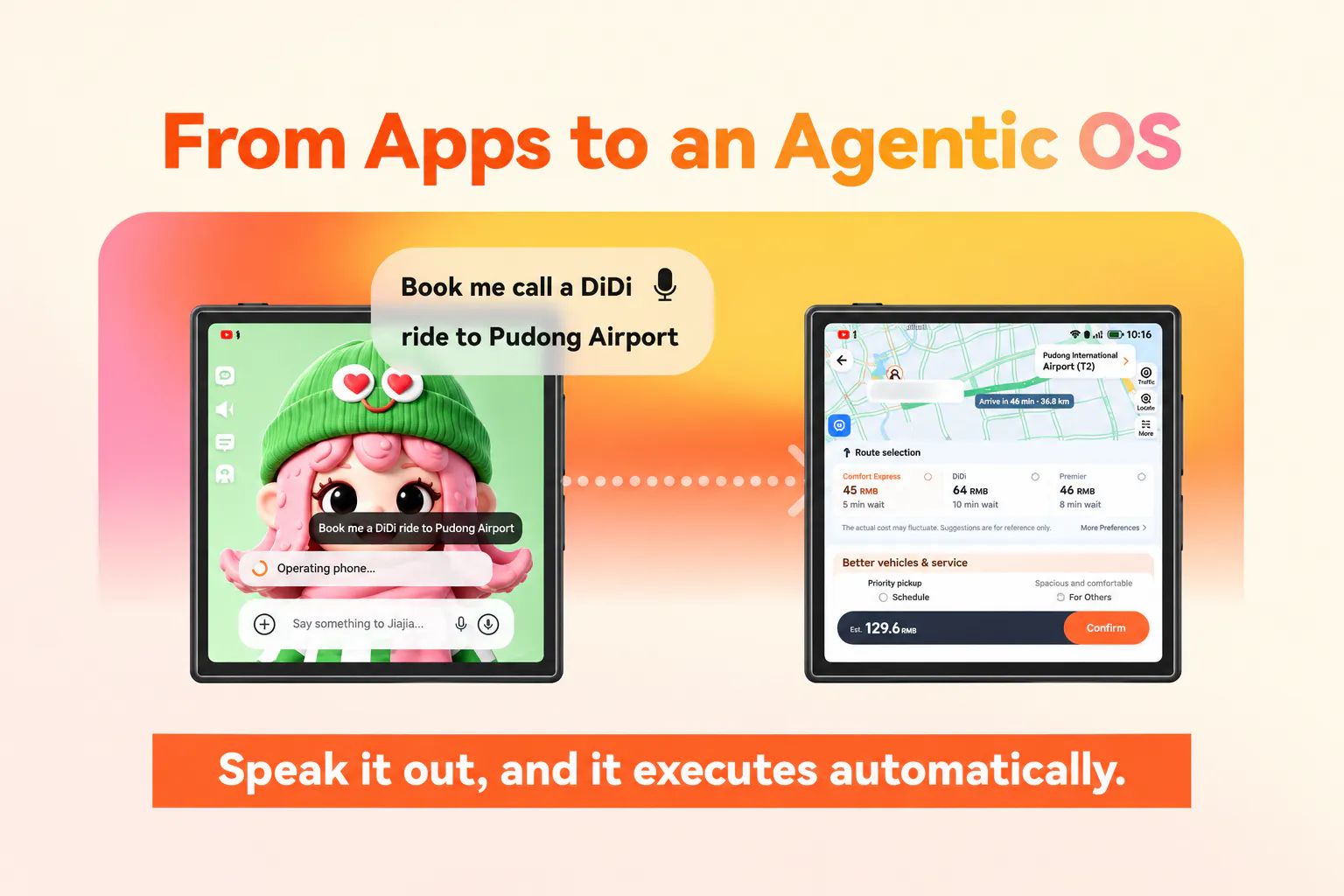
The core interaction moves from choosing an app to stating an intention, with a confirmation step before execution. Image source: Phoenix New Media.
This is why DroiClaw should not be understood as an attempt to make apps disappear overnight. Apps, services, and system tools still provide the underlying capabilities. The change is that they can move behind an orchestration layer. The user thinks about the goal; the Agent determines which verified capability can help.
Multimodal Context: An Agent That Can Hear and See
Intent does not always fit neatly into a text prompt.
Sometimes the fastest way to explain a problem is to point at it. A camera can give an Agent context about a menu, sign, object, document, product, or place. Voice can then add the missing question: "What does this say?", "Is this the right entrance?", or "Save this event to my calendar."
The external DroiClaw material describes support for speech, text, files, images, and video, followed by task execution. In the Meydo C1 concept, the rotating camera is planned as a direct visual entry point: see something, ask naturally, then connect the answer to a useful next step.
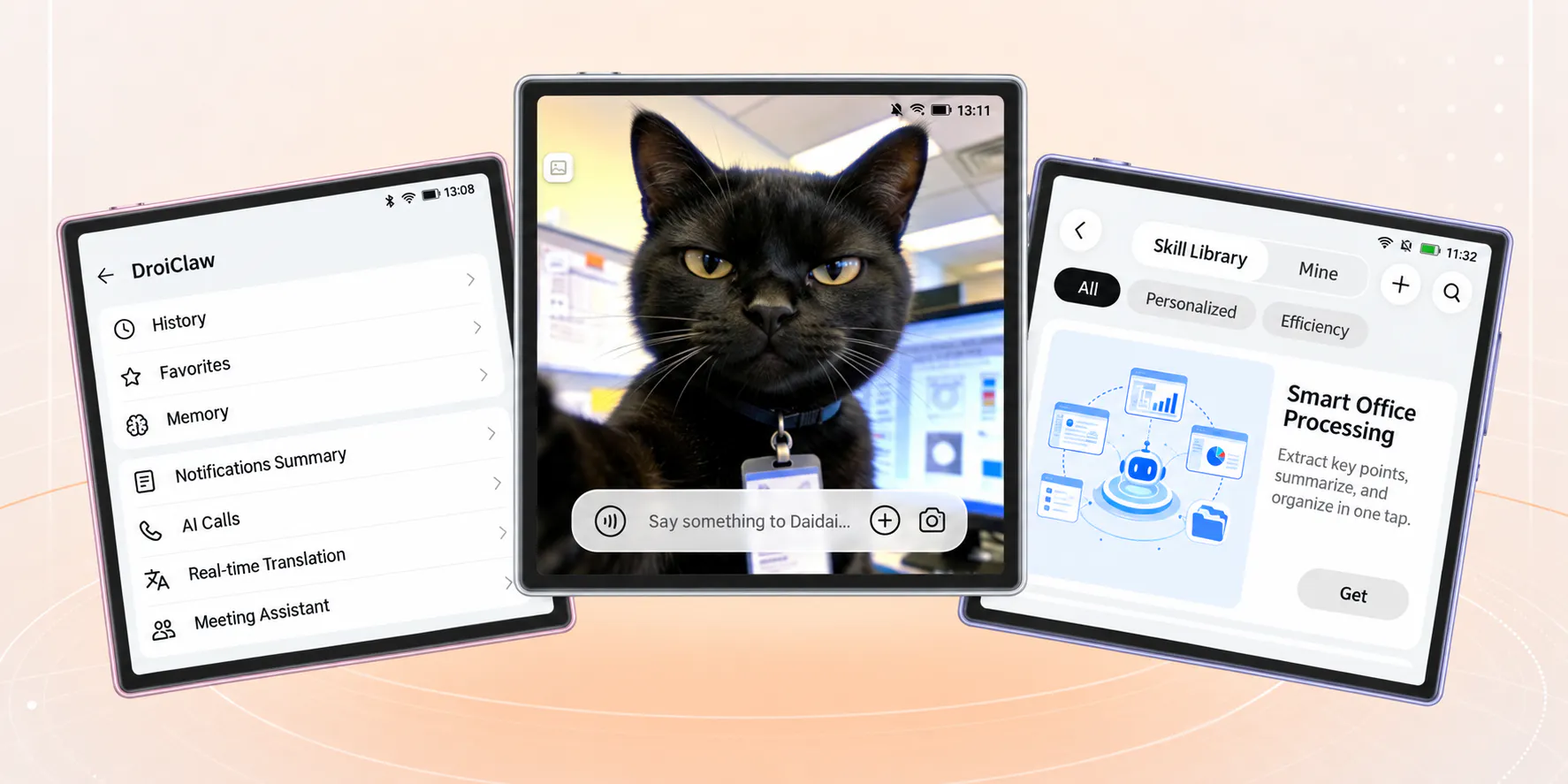
A reference workflow combines visual understanding with an actionable service screen. Image source: Phoenix New Media.
This capability also creates responsibility. Camera use must be obvious and controllable. Results involving medical information, food allergies, traffic signs, legal documents, or financial decisions should be treated as assistance, not professional conclusions. The more context an Agent can perceive, the clearer its boundaries must become.
Skills Turn the System Into a Platform
A general model can answer many questions, but dependable execution usually comes from narrower, testable capabilities.
DroiClaw organizes these capabilities as AI Skills. A skill can combine a model, a tool, and an operation flow for a specific purpose: organizing notes, translating content, planning a schedule, processing an image, or completing a supported service task.
The source interface also shows the direction of a skills library where people can discover existing capabilities or create their own. This changes the system from a fixed assistant into something that can grow with the user's needs.
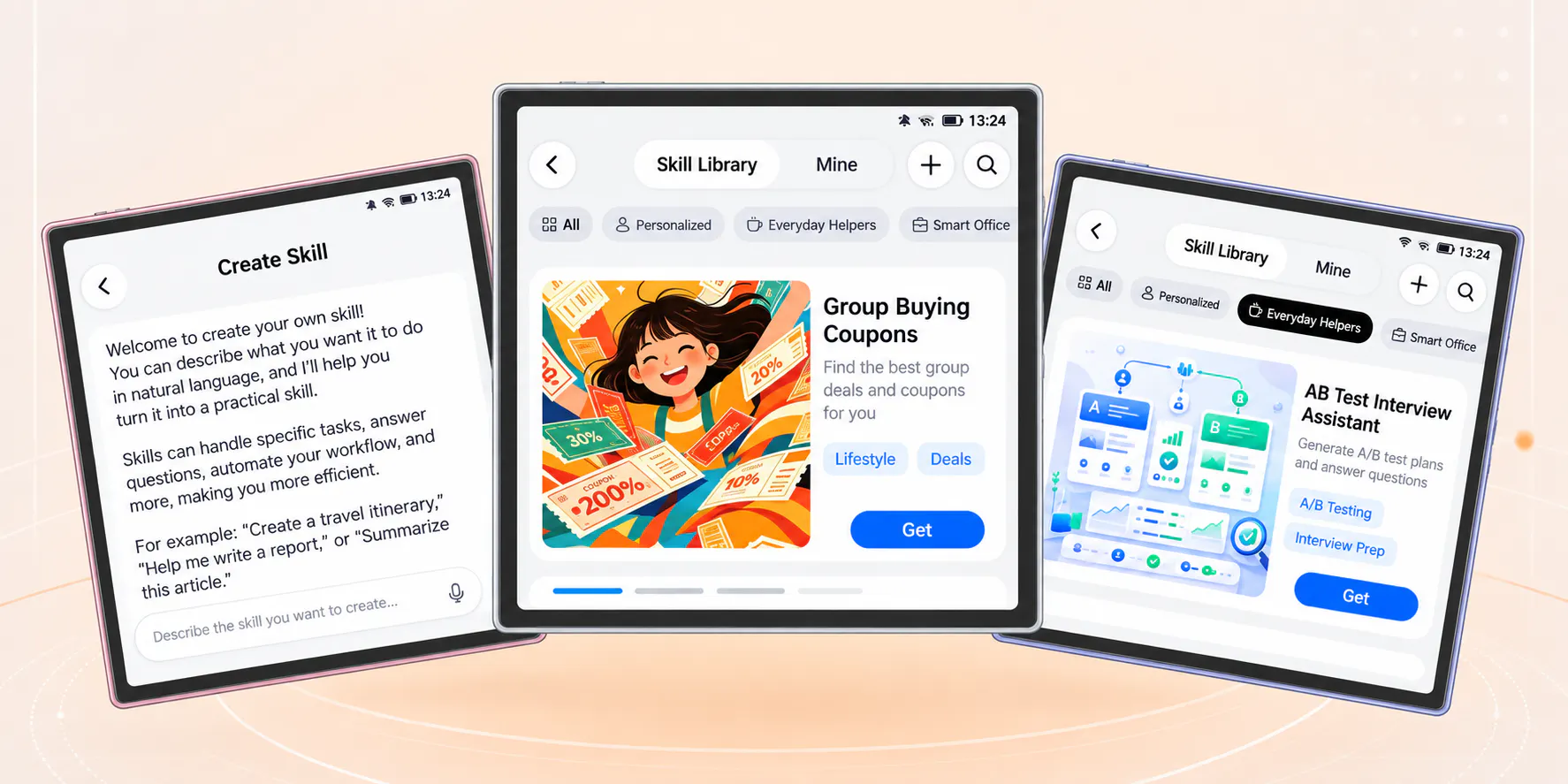
The reference UI shows a skill library alongside a custom skill creation flow. Image source: Phoenix New Media.
But an expandable Agent cannot become a permission free-for-all. Every skill should clearly state:
What information it can read.
What settings, files, or services it can change.
Whether it needs a network connection.
Which model or provider it uses.
Who created and maintains it.
How the user can disable, remove, or revoke it.
The quality of an Agent ecosystem will depend less on the number of skills in a store and more on whether those skills are understandable, reliable, and safe.
One Agent, More Than One Model
Different jobs require different strengths. A fast local model may be enough for a basic device command. Complex reasoning, image understanding, or content generation may benefit from a larger cloud model. A private organization may need its own endpoint and data policy.
DroiClaw uses a hybrid on-device and cloud direction, with an open model architecture. The published interface illustrates automatic selection, several model choices, and the ability to add a custom model endpoint.
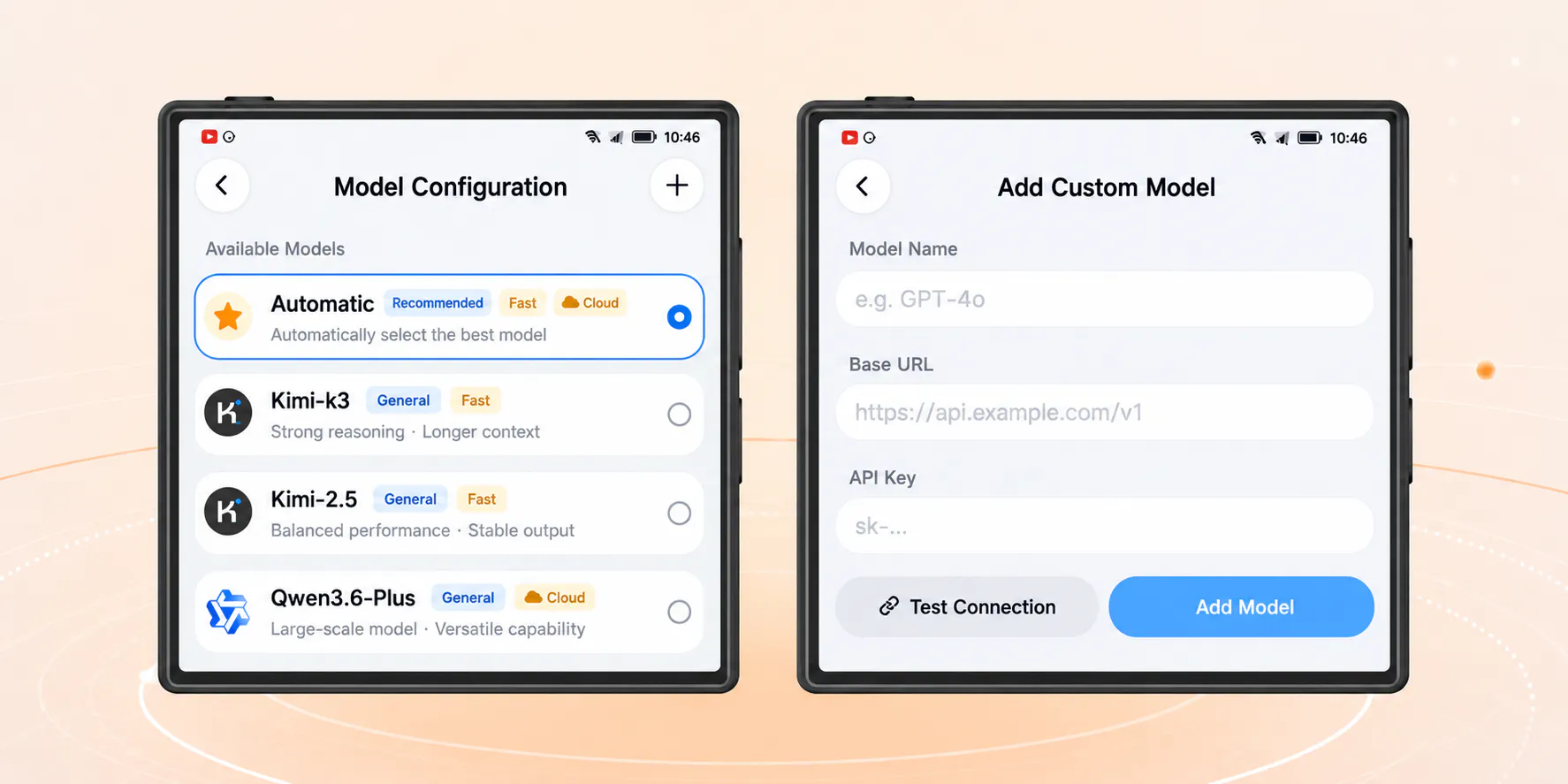
The model configuration interface illustrates automatic routing, selectable models, and a custom endpoint. The actual model list can vary by product, region, licensing, and release. Image source: Phoenix New Media.
The important product decision is not how many model logos appear in a menu. It is whether the system can choose an appropriate path based on five practical constraints:
Quality: which model is best suited to the task?
Speed: can a lightweight request be completed with a lower-latency path?
Privacy: can sensitive work remain on the device?
Cost: is an expensive cloud call necessary?
Availability: what should happen when a model or network is unavailable?
For most users, model routing should feel like infrastructure. They should be able to ask for an outcome without becoming an AI deployment expert.
Hybrid architecture should also be described carefully. "Local-first" does not mean every request stays offline. A trustworthy implementation needs to show when cloud processing is used, what data is involved, and which capabilities remain available without a connection.
Safe, Controllable, and Observable
The moment an AI can act, the product's safety standard changes.
A chatbot can produce a bad suggestion. An Agent can send the wrong message, publish unfinished content, delete a file, expose a location, or place an order. That is why DroiClaw's stated principles - secure, controllable, and observable - are not secondary features. They are part of the core system architecture.
Low-risk and reversible steps may be automated within permissions the user has already granted. High-impact actions should create an explicit checkpoint. Payments, publishing, sending, deletion, location sharing, unlocking, and vehicle control should never be hidden behind an ambiguous animation.
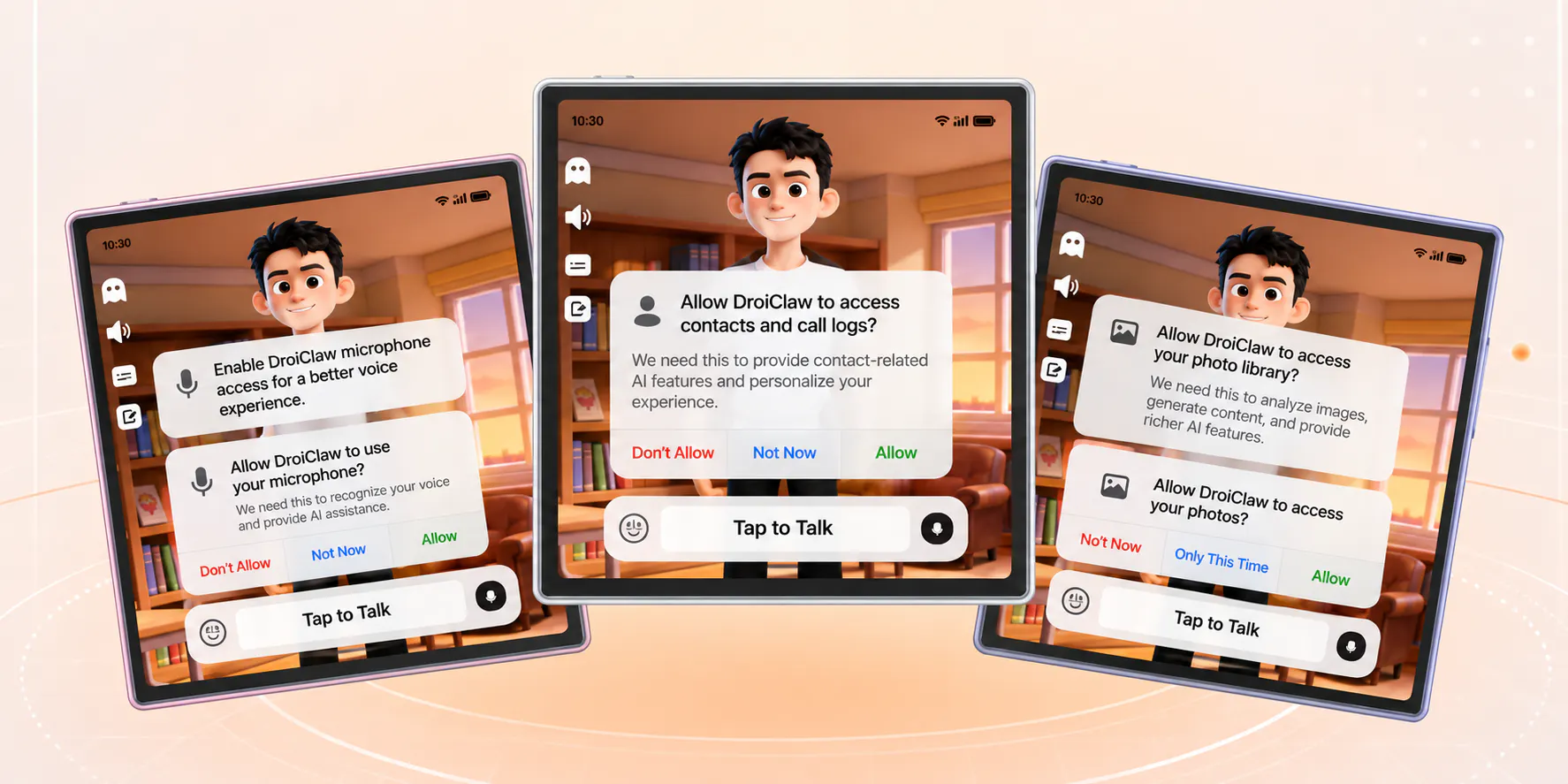
The reference screens show permission requests that explain why camera or microphone access is needed and let the user allow or reject the action. Image source: Phoenix New Media.
The user should be able to answer three questions at any time:
What does the Agent understand me to be asking?
What is it doing right now, and which permission is it using?
What changed, and how can I stop or reverse it?
If a system cannot answer those questions clearly, it is not ready to act on the user's behalf.
What DroiClaw Could Mean for Meydo C1
Meydo C1 is conceived as a pocket AI phone and an independent AI terminal, with DroiClaw planned as its Agent system.
The combination matters because hardware determines how naturally an Agent enters daily life. A physical AI button can create a clear moment of intent. A rotating camera can make visual context immediate. A compact screen can present the Agent's understanding and ask for approval without turning every interaction into a long session. Independent connectivity can allow the device to remain useful away from a primary phone.
On Meydo, the same AI identity is intended to move between pocket, desktop, vehicle, keyboard, and other accessory-based modes. The form may change, but user-approved memory, tone, permissions, and boundaries should stay consistent.
This brings the idea of an AI companion closer to the idea of an operating system. The companion is not only a character that speaks. It becomes the interface through which the user expresses goals, understands system state, reviews actions, and decides what the device may remember.
The intended progression is simple:
It can see. It can understand. It can remember with permission. It can act within boundaries. And it can remain present without constantly interrupting.
The Real Test of an Agentic OS
The promise of an Agentic OS is easy to demonstrate when every app, permission, and network condition behaves perfectly.
The real test comes when the world refuses to follow the demo script.
Can the Agent recover when an app changes? Can it stop safely when a login expires? Can it distinguish a reversible search from an irreversible purchase? Can it explain why it needs the camera? Can the user see, edit, and delete what it remembers? Can useful functions continue when the cloud is unavailable?
DroiClaw points toward a future in which the operating system is no longer only managing apps. It is helping translate human intention into coordinated action.
That future will not be defined by how many taps an Agent can replace. It will be defined by how much useful work it can complete while keeping the user informed, protected, and in control.
From apps to intentions. From answers to actions. From an AI feature to an AI companion.
Sources: "DroiClaw Zhuge: From App-Driven to Intent-Driven", Phoenix New Media, August 4, 2026; Meydo C1 Product Specification V1.1, August 5, 2026. Images were downloaded from the Phoenix article for local editorial reference. Confirm publication and redistribution rights before using them on an external platform.
Replies
Be the first to reply
Have a question or a thought to share? Add a comment above to start the conversation.