

Your AI agent has no idea it's past its "best before" date

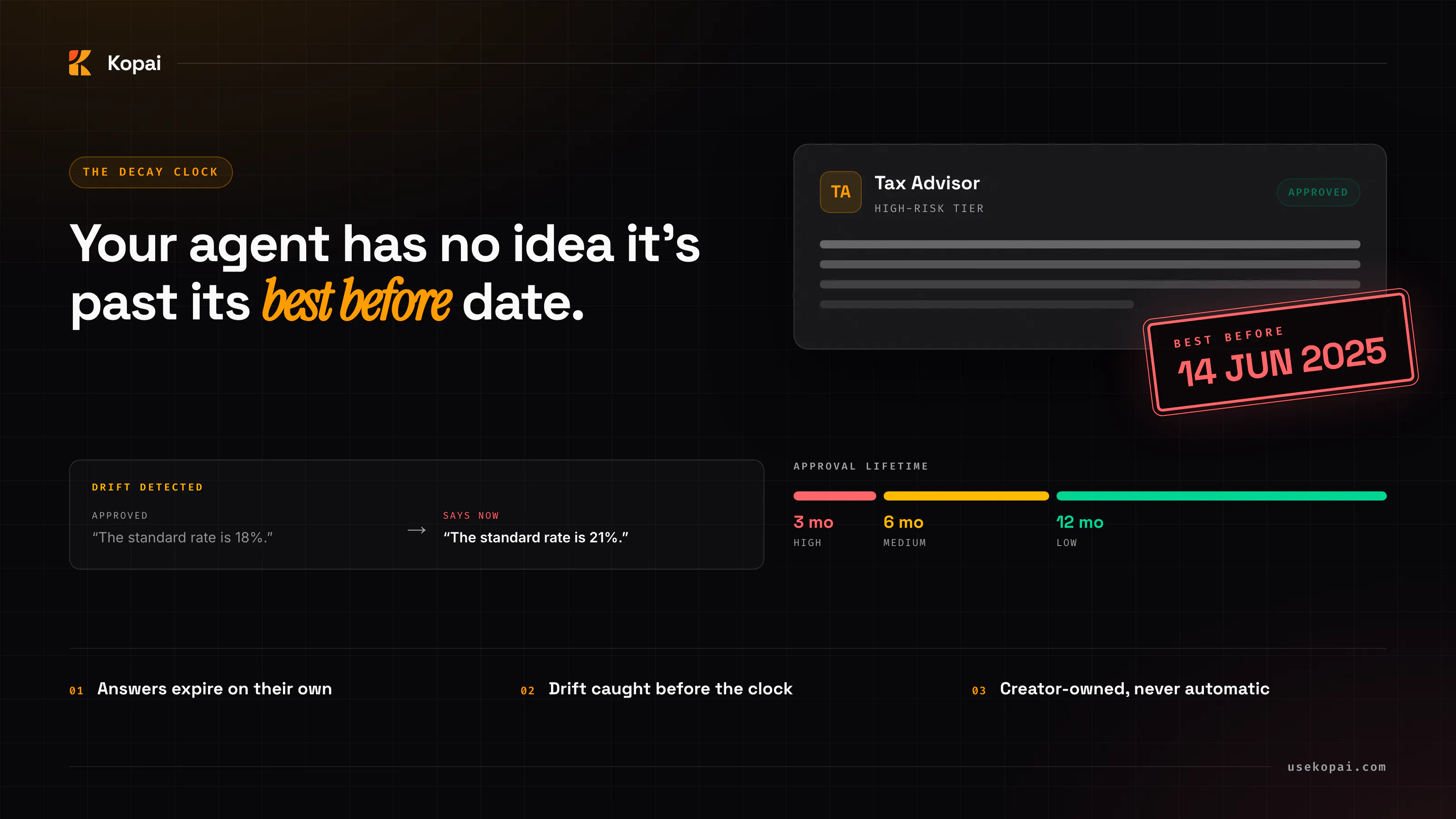
Most AI agent tools treat launch day as the finish line. You upload your knowledge, publish, and the agent just runs. Forever, as far as the system's concerned. Nothing ever checks back in and asks if it still holds up.
That's a real problem once an agent is actually making someone money. Knowledge goes stale, prices change, policies get updated, and an agent keeps answering with the same confidence whether it's right or not. Revenue coming in doesn't tell you anything about whether the knowledge behind it expired. If anything it hides the problem, because nobody goes looking while the money's still showing up.
So today we shipped a decay clock:
Approved answers now expire on their own, somewhere between 3 and 12 months depending on how high-stakes the domain is. Legal and medical decay faster than a trivia agent.
Drift detection for the case where the world moves before the clock even runs out, a rate changes or a policy gets updated. That now shows up as the old approved answer next to what the agent actually says now, instead of a vague "something changed."
It's creator-owned, not automatic. When something expires, the person who built the agent gets told and has to actually look at it again. We didn't want a job quietly re-approving knowledge nobody's checked in a year just because nothing crashed.
This came out of a conversation on our last launch, credit to @galdayan and @rabnoor_s for pushing on it.
Curious what still breaks this. If you've got a decay scenario we haven't thought of, tell us, that's basically how we got here the first time.
Replies
Dial
Glad this actually turned into something, the decay clock is a solid answer to that. One scenario I don't think you covered: what happens when the underlying source document itself gets silently edited rather than replaced? Like someone fixes a typo in a pricing page and the diff looks trivial to a human skimming it, but the agent's approved answer was actually anchored to the old wording in a way that changes the meaning. Drift detection based on the agent's own output might miss that because the agent hasn't said anything wrong yet, it just will the next time someone asks. Might be worth tracking source document hashes separately from output drift.