

AI made me faster at building, but I had to change what “progress” meant
AI has made some parts of building dramatically faster for me.
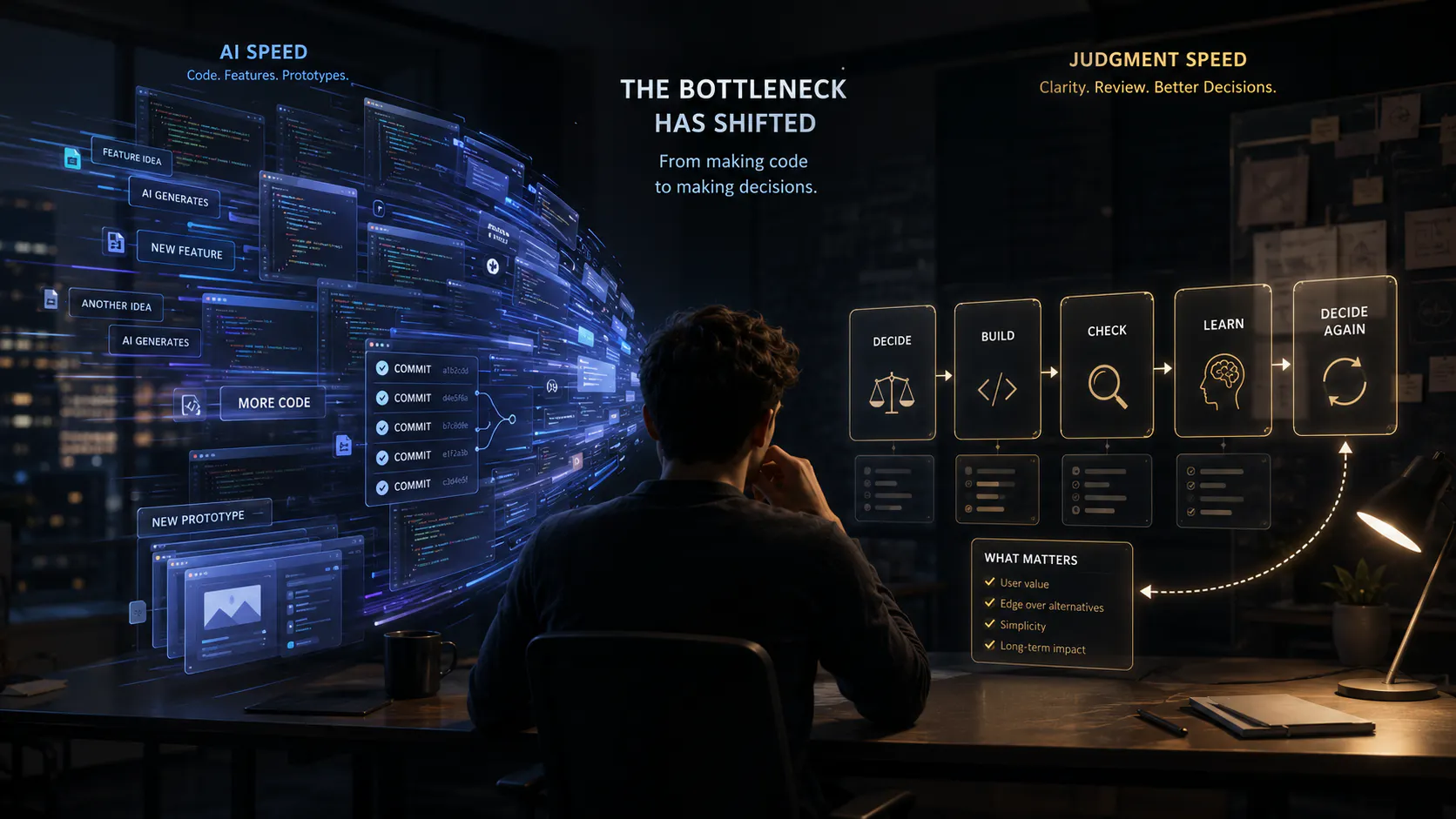
A feature that used to take a long session can sometimes become a much shorter implementation task.
At first, I treated that as straightforward productivity.
More shipped = more progress.
Then I noticed something.
The faster I could generate changes, the more time I needed to spend deciding:
Is this actually the right change?
Did the agent touch anything unrelated?
Does this fit the existing workflow?
What assumptions did it make?
What needs to be tested?
Is this worth keeping?
So I started separating creation time from decision time.
Before:
Build → Build → Build → Review later
Now I try to work more like:
Decide → Build → Check → Learn → Decide again
It feels slightly slower in the moment.
But I think it gives me a better definition of progress.
A line of code being generated isn't progress by itself.
A feature being shipped isn't necessarily progress either.
Reducing uncertainty, solving a real problem, or learning something important is progress.
AI makes creation cheaper.
That makes choosing what deserves your attention even more important.
For people building with AI:
Have you changed how you measure progress since AI made building faster?
Replies
Thank you for this post @evolvix_ai I’ve started treating rework as a better progress signal than output. If AI helps me ship five things but two get reverted and another creates more cleanup, the speed was mostly noise.
Have you started tracking how much AI-generated work survives unchanged after a week?
@alpertayfurr I haven’t been formally tracking that yet, but I think that’s a much more interesting metric than raw output.
“Survival rate” could tell you a lot more about whether AI-assisted work was actually useful — especially if you separate work that survives unchanged from work that needed significant rework or got reverted.
That’s something I’d like to start tracking while building.