

🤔 AI made building easier. It also made saying "no" much harder.
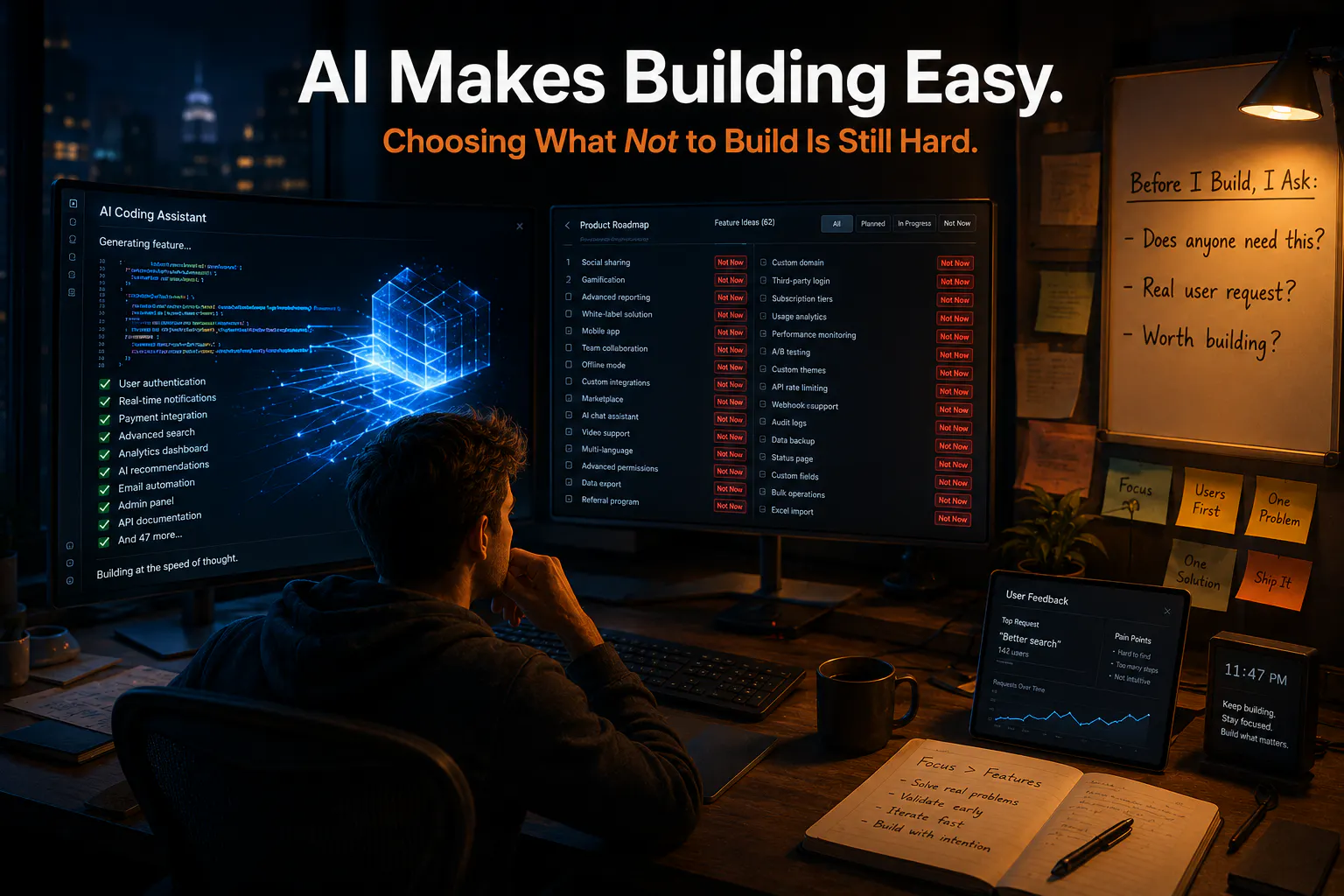
One thing I've noticed over the last year is that AI has changed the cost of experimentation.
A feature that might have taken me a week to prototype can now be built in an afternoon.
At first, that felt like a huge advantage.
But after a while, I ran into a different problem.
Because everything became easier to build, I started building too many things.
Every new idea felt worth trying because the cost was so low.
Ironically, the real challenge stopped being "Can I build this?" and became "Should I build this?"
Now, before opening my editor, I try to answer a few questions:
Does this solve a real problem?
Is this based on actual user feedback?
Am I building this because users asked for it, or because AI made it easy?
I'm still figuring out the right balance between moving fast and staying focused.
I'm curious how other makers have adapted.
Has AI changed the way you decide what not to build?
Or do you think rapid experimentation is always the better approach?
I'd love to hear how others are navigating this trade-off while building products.
Replies
disagree a bit — some of my best features came from stuff nobody asked for. people don't know what they want until it exists
@charlotte_reed1 That's a fair point. Some breakthrough features definitely weren't requested directly. I'm curious—how do you decide which intuition is worth betting on versus which ideas to ignore?
four half-built features on my end right now, zero shipped, because i kept starting new ones instead of finishing
@evelyn_clark1 I can relate. AI made it so easy to start new features that finishing became the real challenge. Have you found anything that helps you stay focused on shipping?