
 •
•3mo ago
The 12 Challenges of Implementing Rebate Software
The hardest part of a rebate software rollout in India isn't the software. It's that the scheme terms only exist in a WhatsApp message.
Twelve things break these implementations. Eleven have nothing to do with the product you bought.
Start with what you're importing. Schemes are announced by circular, email and messaging app never an executed agreement. There is no contract to load. The terms have to be reconstructed first.
The data sits in Tally, Busy, Marg or Zoho, which are built for statutory filing rather than data exchange. File export is the realistic starting point, not an API.
And the master data was never built for matching. Party names typed freely, items described rather than coded, GSTIN discipline that thins out the further back you go. Matching fails here first, and cleanup ends up being the biggest task in the project.
Then the channel. C&F agent, super-stockist, distributor, dealer, sub-dealer, retailer schemes funded at one tier and earned at another. Secondary sales are reported, not observed. Partners are unevenly digitised, so a portal-only design stalls on the least-ready one.
Settlement isn't generic either. GST credit notes carry statutory timing and reporting consequences, and channel payouts raise TDS questions that many tools don't model at all.
Then the two that never make the project plan.
The distributor relationship predates the system, so validation reads as suspicion.
And someone owns the spreadsheet often their standing in the business goes with it. Working around that person is how implementations quietly fail.
All twelve are in the carousel. What a realistic first phase covers, given mid-market budget against enterprise-shaped complexity, is here:
https://claimds.com/blog/challen...
Which of the twelve hit you hardest?
#RebateManagement #Distribution #B2B #ERP #Promotion #trade #dealer #distributor #SaaS #claim
•3mo ago
Expiry and Breakage Returns: Who Collects, Who Pays, and How It Settles
Who collects expired stock, who bears the cost, and whether it is settled by replacement or credit note the operational side of expiry and breakage returns.
Expired, damaged or unsaleable stock moves back up the channel retailer to stockist to company and is settled either by a credit note or by replacement stock. Who arranges collection, who bears the cost and what window applies are all matters the return policy sets; none of them is fixed by a general industry rule
•3mo ago
What Faster Claim Settlement Is Worth: Claims, Cash and Working Capital
An unsettled claim is your money sitting in someone else's system. How settlement speed affects a distributor's working capital, with worked examples in rupees.
An approved but unsettled claim is working capital you have earned and cannot use. Every extra settlement cycle means that money is financed by someone usually the distributor, through borrowing or through stock not bought. Faster settlement does not increase margin; it releases cash you were already owed.
A note on the anchor: this is about the cash tied up in unsettled claims, not about loan or credit products. "Working capital" here means your own money held in the settlement process, not financing you take on.
•3mo ago
what is sales rebate agreement and it works in the B2B world
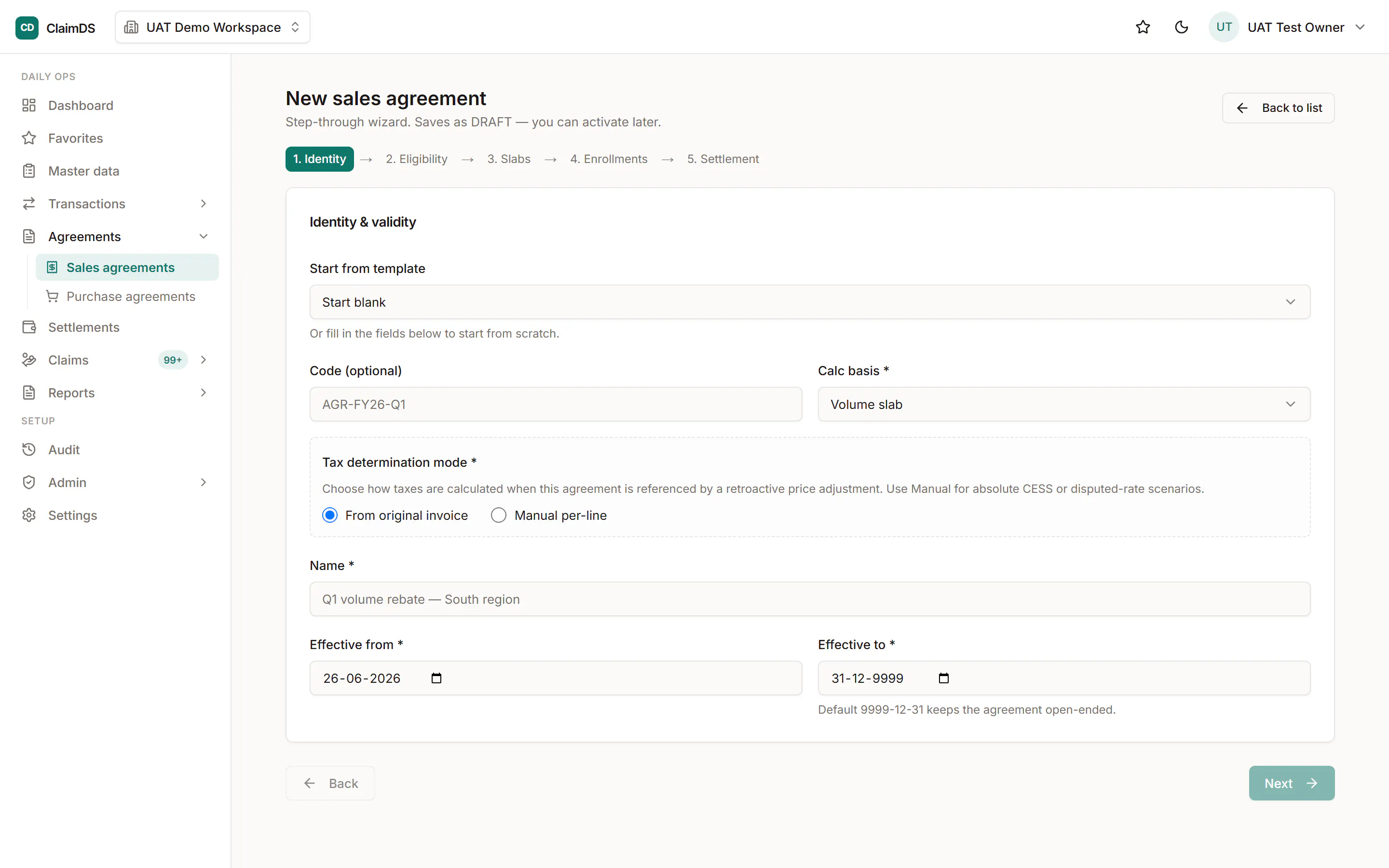
A rebate agreement is the rule that every accrual, claim and settlement is checked against, so it's worth getting right once. A sales rebate agreement defines a rebate you owe a customer its slabs, the products and partners it covers, when it's valid, and which transactions qualify.
 •
•2mo ago