

Hey Product Hunt community! 👋
I'm a 17-year-old student, independent AI researcher, and software developer from Romania. I dream to work as an AI researcher at a frontier lab someday :) Over the past few months, I've been building AI-Atlas entirely on my own, from the initial architecture and API integrations to the AI evaluation system, frontend, backend, and production deployment.
The idea started with a question I kept asking myself:
How can we actually evaluate someone's AI engineering skills beyond their resume, GitHub stars, or number of followers?
Today, GitHub contains an enormous amount of evidence about what developers can actually build. Yet much of that evidence remains difficult to interpret, particularly for recruiters, research teams, and developers looking to understand their own strengths.
That's why I created AI-Atlas.
AI-Atlas is an AI-powered platform that analyzes public GitHub repositories and evaluates demonstrated technical expertise across six domains: Machine Learning, Computer Vision, Data Science, NLP & LLMs, AI Agents, and MLOps.
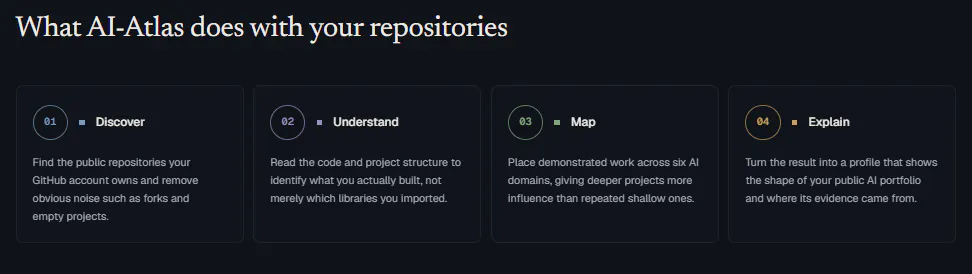
Rather than relying on popularity metrics, it examines project implementations and provides explainable evaluations, project-level assessments, developer rankings, and personalized improvement roadmaps.
My longer-term vision is to help build a more transparent, evidence-driven AI developer community where talented engineers can showcase their work, discover opportunities, and receive recognition based on what they've actually built.
For recruiters and research organizations, I hope AI-Atlas can eventually become a useful tool for discovering promising technical talent beyond traditional credentials.
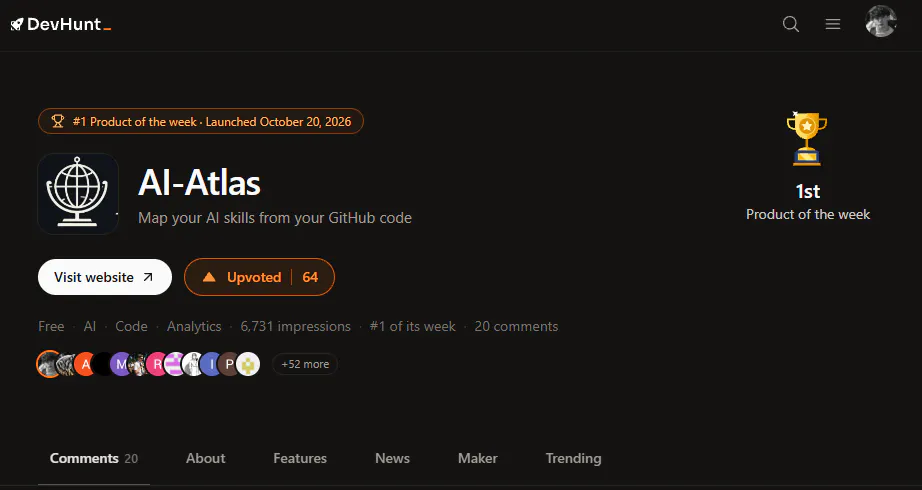
Recently, AI-Atlas finished #1 in DevHunt's Week 42 product rankings, which was an exciting milestone for a project I've developed independently :)
Now, I'm preparing for its Product Hunt launch, and I'd genuinely appreciate your perspectives.
I'd love to hear your thoughts:
🔹 Developers: Would you find an independent evaluation of your GitHub projects useful for showcasing your technical expertise?
🔹 Recruiters and founders: What evidence matters most when evaluating AI engineering candidates?
🔹 Everyone: What would make you trust an AI-powered system that evaluates technical skills?
I'm particularly interested in the limitations, potential biases, and challenges of assessing developers through their public work. AI-Atlas is intended to provide additional evidence, not replace human judgment.
This project has taught me an incredible amount about software engineering, AI research, building production systems, and turning an idea into something people can actually use.
I'm excited to keep improving it alongside the community.
You can explore the platform here: https://getaiatlas.com
Looking forward to your feedback, and hopefully seeing you on launch day! 🚀
— Pop Alexandru, Founder of AI-Atlas | Aspiring AI Researcher
Replies
Congrats on #1 at DevHunt, Pop. That's a big milestone to hit solo at 17. 👏
Here are my answers to your three questions:
Developers: would this be useful? Yes, if it explains its scores. A number like "NLP 72" tells me nothing. "You built a retrieval pipeline with eval harnesses, but there are no tests around prompt regressions" tells me what to fix. I'd also want to be able to dispute or annotate a score, because a lot of good work sits in private repos or in code written for an employer.
Recruiters and founders: what evidence matters? For AI engineering, these matter most to me:
Shipped and running. Did anything get deployed, and does anyone use it?
Evals. Does the project measure whether it works, or just demo well?
Debugging history. Issues, fixes, and commits that show someone diagnosing a failure.
Maintenance over time. One weekend of code reads very differently from a repo that's still maintained months later.
What would make me trust it? I'd look for four things:
Published rubrics, so I can see what is being scored.
Evidence links, so each claim points to the file or commit behind it.
Confidence levels, including "not enough signal" when a repo is thin.
A calibration check against developers whose skills are already well known.
Biases to watch for:
Rewarding large repos over well-scoped small ones.
Favoring popular frameworks, since the LLM judge has seen them more.
Penalizing people who work in private or on teams.
Treating AI-generated boilerplate as skill. This one is getting harder to avoid, and it's probably your biggest challenge.
Positioning it as "additional evidence, not a verdict" is the right call.
Good luck with the launch! 🚀