
happy sunday 🫶
gm friends and welcome back to yet another Sunday! It's time to brew a fresh cup and dive into this week's Roundup. In today's issue: a talk to publish app, a more human LinkedIn, a spotlight for your apps, a dive into OpenAI's next big move, and more.
P.S. Want your launch to be featured in this newsletter? Drop us a line with your pitch at editorial@producthunt.co 🫶
Your agents stopped answering and started doing
Your agents call tools, write to databases and move money, so a wrong answer is now a wrong action, which is a considerably worse meeting. Arcjet runs policy before every LLM call, tool call, query and API request: prompt injection, sensitive data, bots, rate limits, spend quotas, and your own rules in Rego on top. It reads the OpenTelemetry you already emit, so switching it on is one environment variable, no code changes and nothing to deploy. Each check also reads the earlier steps in the same workflow, so an agent's tenth action gets judged against the first nine and not on its own. JavaScript, Python and Go SDKs all at 1.0, agent framework guards included, free tier to start on.
Leaderboard highlights


OpenAI is open again?
OpenAI’s latest move isn’t a shiny new model or viral image drop—it’s a Google Form. But it might be one of the more interesting things they’ve done this year.
They’re working on a new language model with open weights and, for the first time in a while, asking the public what they want from it. The last time OpenAI released anything truly open was GPT-2 back in 2019. Since then, the ecosystem has shifted. Meta’s LLaMA models are everywhere, Mistral’s picking up steam, and open-source AI has gone from niche to normal. Now OpenAI is stepping back in and asking, “What should we build together?”
The questions they’re asking aren’t small. How should the model be licensed? Who should get to use it? What should the boundaries be? It feels less like a product launch and more like a pulse check. A way to show they’re listening, even after a few years of keeping things mostly locked down.
There’s still a lot we don’t know. What the model will be, how open “open” really means, or when it’s actually coming. But the shift in tone is clear. Less “here’s what we made,” more “help us make the right thing.”
Have an original thought, maybe?
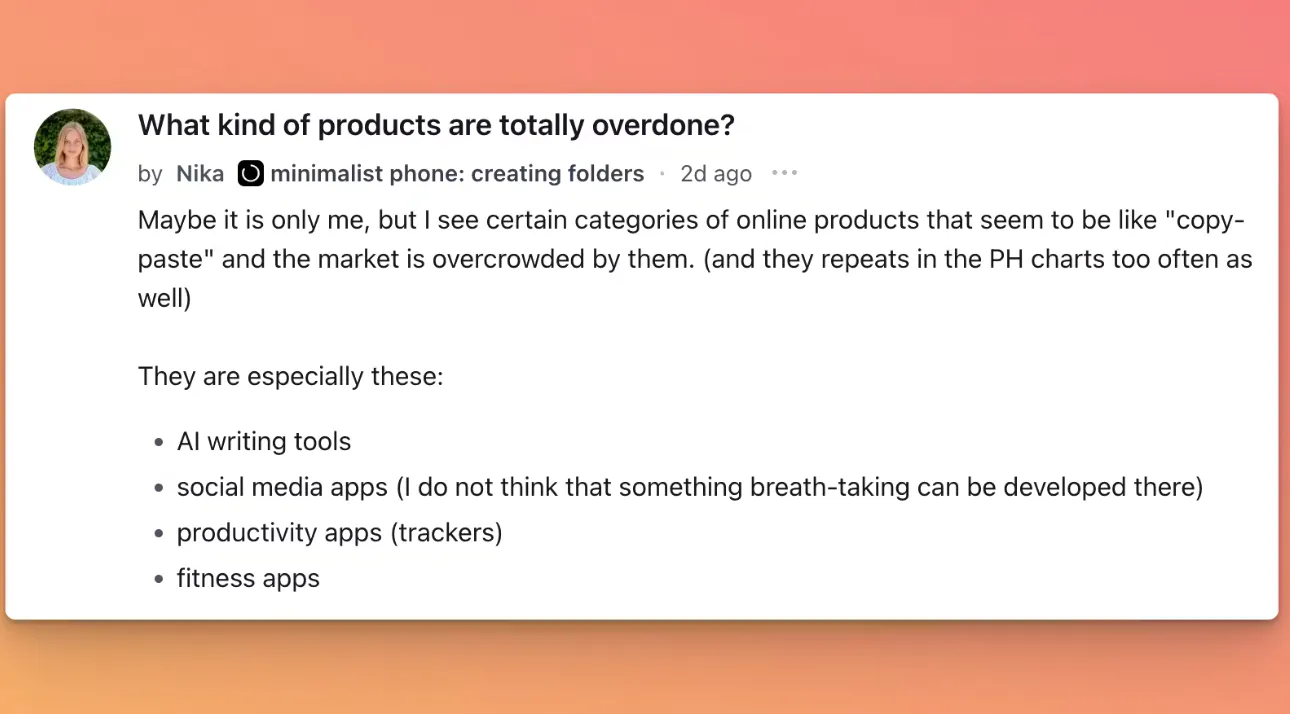
Nika asked which online product categories are officially doing too much—and the replies didn’t hold back.
AI writing tools. Habit trackers. Social apps with no people. Everyone agrees some corners of the internet are just clones stacked on clones.
Still, a few called out overlooked spaces—like tools for kids, or actually useful learning platforms. Maybe the problem isn’t saturation. Maybe it’s originality.
Got your own pick?