Stan Kolotinskiy

Stan Kolotinskiy

Developer for the win

About

I am a software developer truly passionated by what I'm doing and I am driven by the desire to make the world a better place to live

Badges

Tastemaker
Tastemaker
Tastemaker 5
Tastemaker 5
Gone streaking 10
Gone streaking 10
Gone streaking
Gone streaking
View all badges

Forums

octoscope v0.18.0 — insight 🔭

No new tabs this time three small read-only features that answer questions you'd normally leave the terminal for: how a repo's stars are really trending, how much API budget you've actually got left, and which of your repos need attention right now.

Cumulative star history

The hardest question in AI code governance: how confident are you that code was actually AI-written?

Something that keeps coming up when I talk to teams about AI code governance: everyone focuses on capturing records, but almost nobody asks how confident they are in those records.

There are two very different things you can have.
Record A: a file-watcher noticed 47 lines appeared in auth.py and Cursor was probably running.
Record B:a proxy intercepted the Anthropic API call, matched it to the editor insertion via request UUID, measured 1.4 seconds between the API response and thecode appearing, and computed 0.81 trigram similarity between the model output and what landed in the file.

Both produce a row in your audit database. The second is dramatically more defensible but most governance tooling treats them identically.

In LineageLens, every record gets a confidence score from 0.0 to 1.0, broken into five independent evidence signals. Easy Mode captures (VS Code extension, no proxy) score around 0.27 honest about what you know. Power Mode captures (proxy running, full request interception) score up to 1.0. The score is not about whether the record is useful. It is about how much you can defend it when someone asks.

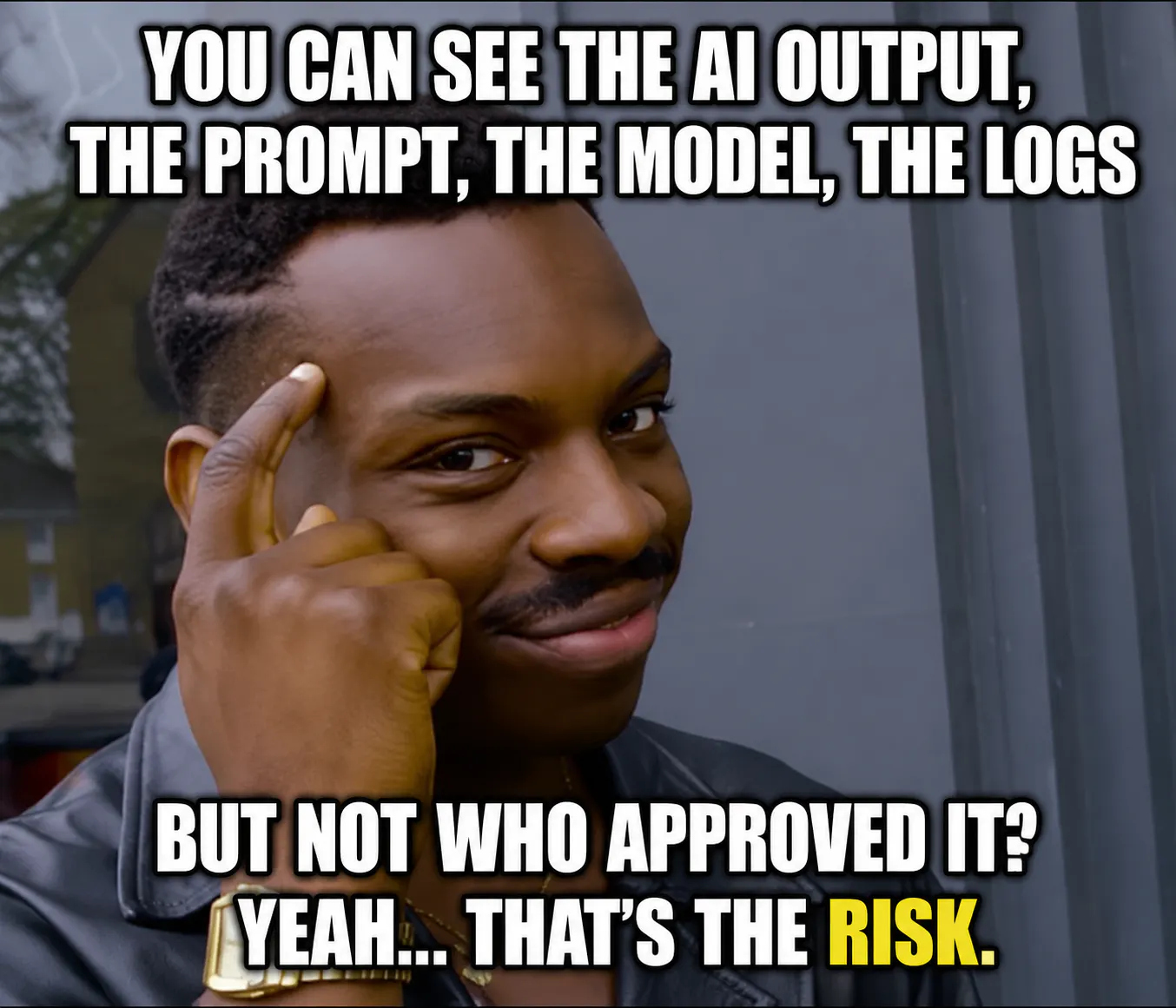
Would you trust an AI output if you could not see who approved it?

Been thinking about this after something that came up recently. Imagine an AI agent makes a recommendation that ends up influencing a customer workflow. The recommendation gets reviewed, approved, and eventually becomes part of how the team operates. Fast forward a few months and someone wants to understand why that decision was made.
The interesting part is that the technical history is usually still available. You can find the output. You can find the prompt. You can usually figure out which model generated it. What can be surprisingly difficult to find is the human context around the decision. Who reviewed the recommendation? Who approved it? What information did they have that made the recommendation seem reasonable at the time?
The more AI becomes part of everyday workflows, the more I find myself paying attention to that layer. Understanding the output matters, but understanding why someone trusted that output often matters just as much. A lot of conversations around AI accountability focus on the model. I suspect a lot of the missing context lives around the people making decisions with it.
Curious how your team is keeping track of that today, lets discuss it below...

View more