

Forums


How many Claude Codes do you run in parallel?
A couple weeks ago, Boris Cherny (the creator of Claude Code) shared a bunch of really useful tips on getting the most out of Claude Code. #1 at the top of the list: do more in parallel. He himself runs 10-15 Claude codes in parallel.
His advice and practice makes sense: coding agents give us the ability scale infinitely. At this point, the only real limiter is our own ability to manage all of these agents.
 •
•6d ago
Why is UX benchmarking still so manual in 2026?
If you re a designer, PM, or growth person, you probably know the drill: You spot a competitor flow you want to study, then you start screenshotting, naming files, pasting everything into Miro/Notion/Figma, trying to recreate the real navigation, and adding notes that end up scattered everywhere.
It works, but it s slow, messy, and hard to share.
 •
•11d ago
We paid $25k for our website. I vibe-coded a new one in 2 days.
Last year we hired a design agency to build our marketing site for @Basedash. They did an incredible job. The headline makes it sound like I'm dunking on them, but I'm not. The site was genuinely great. They built it in Framer so we could manage content ourselves, which was a completely reasonable bet at the time (and something we explicitly asked for).

 •
•20d ago
How much do you trust AI agents?
With the advent of clawdbots, it's as if we've all lost our inhibitions and "put our lives completely in their hands."
I'm all for delegating work, but not giving them too much personal/sensitive stuff to handle.
•22d ago
Anyone else here using Pencil.dev?
I ve been using Pencil.dev for a few days and honestly it s a big paradigm shift for how fast you can explore UI. I'm loving it!!
One thing I bumped into: I still need to move some screens into Figma to polish details, collaborate, and keep everything in the same place as the rest of our design work.

Y Combinator offers 7 startups ideas they want to fund (Spring 2026)
As usual, Y Combinator came up with segments that are worth investing:
1. Cursor for Product Managers
2. AI-Native Hedge Funds
3. AI-Native Agencies
4. Stablecoin Financial Services
5. AI for Government
6. Modern Metal Mills
7. AI Guidance for Physical Work 8. Large Spatial Models 9. Infra for Government Fraud Hunters 10. Make LLMs Easy to Train •
•1mo ago
Is usage-based pricing becoming the norm for AI tools?
Hey everyone,
I've built my product around traditional SaaS pricing (monthly tiers), but I m starting to wonder if that model is getting outdated, especially with more AI-powered and compute-heavy tools entering the market.
That shift requires real architectural changes, instrumentation, metering, billing logic, and UI changes, not just pricing tweaks. It s something I m starting to seriously think about for my own product.
In particular, AI usage has real COGs (every prompt costs money), and I m seeing more platforms experimenting with usage-based models, or hybrids like SaaS base + usage + overage.
For those of you building AI or compute-intensive tools:
•1mo ago
Does founder life feel like an emotional roller coaster?
Hey folks, quick one.
I m exploring a new product to help founders deal with the ups and downs and keep a more objective view of progress. If this resonates, I d really appreciate 1 minute of your time to fill out this short survey:
•7mo ago
I built a generative art studio with GPT-5 in 3 hours (Inspired by Felipe Pantone)
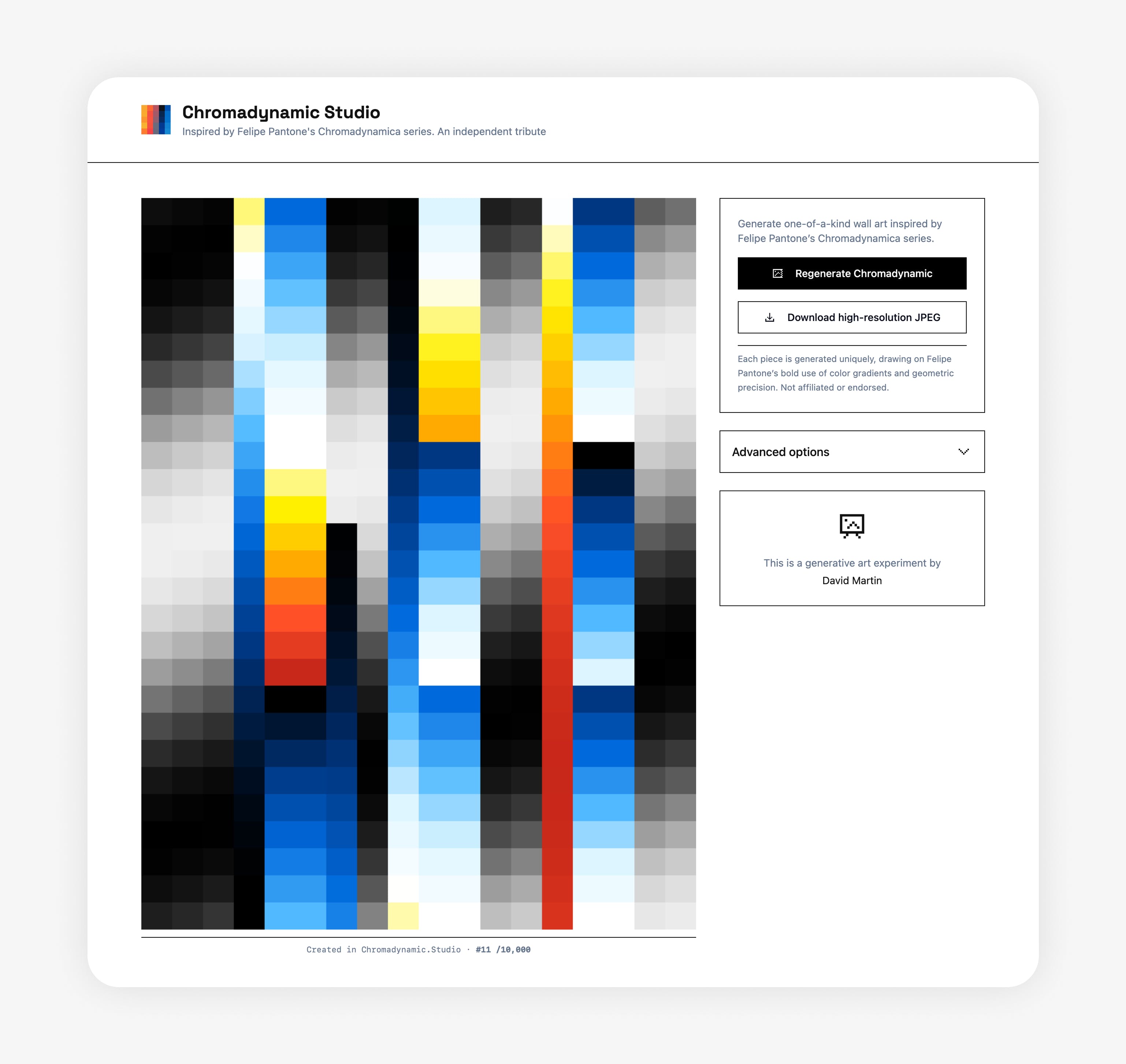
TL;DR
I built a small web studio that generates kinetic color compositions, inspired by Felipe Pantone s Chromadynamica. I used GPT-5 to help shape the algorithm and Lovable to assemble the generator and the UI. It is code based, seeded, and limited to 10,000 outputs.
•7mo ago
Built a tool for fun. Now makers love it… and it’s burning a hole in my wallet. Time to monetize?
Hey everyone
A few months ago I launched lovableprompts.app, a tool that helps makers and designers turn messy product ideas into optimized prompts for Lovable (and other vibe coding tools). It was meant to be just a small experiment to make the blank page problem less painful.
 •
•7mo ago
What's still missing from vibe coding tools?
Vibe coding tools have been making huge improvements, but things can always get better.
What blockers are you still running into? What has no one solved yet? What do you wish you could do, but can't yet?
 •
•7mo ago
What is the best Vibe Coding tool so far? Bonus points if we've never heard of it!
I might be missing some but I've been pretty much in love with @Lovable, @Cursor, @bolt.new and have been trying to use @Replit more and I honestly haven't touched @BASE44 too much but have heard good things. @chrismessina has nudged me to use @Windsurf for whenever I build another Raycast Extension!
Currently I use:
- @bolt.new / @Lovable
- @Cursor
- @Warp
Curious what everyone thinks is the top one so far!
•7mo ago
Sponsorship vs. charging users, what would you do when your side project starts to grow?
A couple of months ago I launched lovableprompts.app, a tool that turns rough product ideas into optimized prompts for Lovable or others vibe coding platforms (Bolt, Cursor, Replit...)
It started as a fun side experiment. Now it s used by 10k+ users, has generated thousands of products, and is slowly becoming a core part of many makers workflows.
•8mo ago
🧠 Your first prompt sets the vibe. Get it right and everything flows
A few months ago, I kept hitting the same wall. Every time I wanted to start a new project in @Lovable, I found myself stuck on the first prompt. I had the idea in my head, but turning it into something structured and usable always felt harder than it should.
So I built a small tool for myself. Something simple to turn messy thoughts into clear prompts that actually worked. I called it Lovableprompts.app, and once I shared it, more people started using it than I ever expected.
Since then, over 5,000 people have given it a try. A few nocode and vibe coding agencies and freelancers have even added it to their workflow, which honestly still blows my mind.
 •
•8mo ago
Anybody know a tool for cursor or other AI ideas to instantly improve your prompts?
•8mo ago
What was the very first project you vibecoded with AI?
On Product Hunt, I can see many people launching their products using "vibe-coding tools" like @Lovable , @bolt.new , or@Replit
I reckon many people who created something with them are usually developers who didn't have enough time for building a side idea before, but with AI, they could make it happen.
•11mo ago
Vibe coding process - do we jump in or plan it out?
I'm super curious how everyone starts to vibe code? In the beginning I would simply jump into @bolt.new or @Cursor and just do a prompt and continue refining with the AI. I quickly realized this created a lot of issues as I didn't think about the structure, tech stack, and how I wanted the features to interact with each other and how the way I was building things would impact the user experience. I now do the following:
Write down a simple problem statement: "what am I trying to solve?"
Write down a simple solution statement: "what does the thing I'm building do (to solve the problem)"
Share the above with @ChatGPT by OpenAI and word vomit my thoughts, ideas, how I want the user to interact with my app, etc and ASK ChatGPT to turn everything I said and want into an easy to understand directive and instructions for an Engineer.
I then take the Engineer instructions and give it to a new chat in ChatGPT and ask it to turn those instructions into a prompt for an AI engineer and to break up the project into sections so that each time we focus on a section the app is shippable and keeps things easy to work on.
I take the output and paste it into my notes. I then give it to Cursor.
Once in Cursor, I create a new project folder and got at it!
Curious what everyone else does and if you've experience any things to avoid or must do
•11mo ago
Vibe coding process - do we jump in or plan it out?
I'm super curious how everyone starts to vibe code? In the beginning I would simply jump into @bolt.new or @Cursor and just do a prompt and continue refining with the AI. I quickly realized this created a lot of issues as I didn't think about the structure, tech stack, and how I wanted the features to interact with each other and how the way I was building things would impact the user experience. I now do the following:
Write down a simple problem statement: "what am I trying to solve?"
Write down a simple solution statement: "what does the thing I'm building do (to solve the problem)"
Share the above with @ChatGPT by OpenAI and word vomit my thoughts, ideas, how I want the user to interact with my app, etc and ASK ChatGPT to turn everything I said and want into an easy to understand directive and instructions for an Engineer.
I then take the Engineer instructions and give it to a new chat in ChatGPT and ask it to turn those instructions into a prompt for an AI engineer and to break up the project into sections so that each time we focus on a section the app is shippable and keeps things easy to work on.
I take the output and paste it into my notes. I then give it to Cursor.
Once in Cursor, I create a new project folder and got at it!
Curious what everyone else does and if you've experience any things to avoid or must do
•12mo ago