
YAGNI
Proactive agent teams you manage like humans
448 followers
Proactive agent teams you manage like humans
448 followers
AI today is reactive: it waits for your next prompt. YAGNI is proactive agent Teams you manage like people. Give a Team responsibilities and guardrails, review its work, and it earns autonomy through a track record you can read, while you keep the calls that matter. Paste your company's URL and YAGNI drafts your first team in seconds. You aren't gonna need more software. You need a team that gets better every week. Become a self-improving company.



Congrats @jackcollinshq👏 on hitting the front page! the choice to run this entirely on open-weight models is a massive selling point for keeping costs scalable, are you guys hosting these models on your own cloud compute nodes or can we host the agent workers inside our own private cloud setup for compliance?
@priya_kushwaha1 Thank you so much! Right now we are hosting our own as well as using US-hosted providers like Fireworks.ai and Together.ai for the open-weight model inference.
We can offer BYOK for those who want to manage their own LLM inference, and happy to support private cloud setup for compliance as well!
Let me know if you have any other questions - and thanks again!
@jackcollinshq that's awesome BYOK and private cloud support are huge pluses for enterprise users.
all the best 👏
I run Claude Code and a couple of agents most of the day, so "manage like humans" resonates. The part I would love to see solved: knowing when an agent is genuinely blocked and waiting versus just thinking. Does the management layer surface that, or is it more about task assignment?
@virko_kask glad to hear it resonates with you!
Yes, work that "Needs You" is flagged very clearly in the app.
The YAGNI Teams work through a loop like this for most of their work:
Map - gather context about the work item)
Plan - YAGNI presents a plan for your review and edits
Execute - Complete the work
Adversarial Review - Specific adversarial agents probe the work for issues, especially with the context of your previous work and corrections
Final Review - your place to review the work before it's sent / pushed / merged
At the Plan and Final Review steps the work has a specific "Needs You" flag that automatically routes it to the top of the list. Additionally, we collate everything that needs you into a simple "Feed" so you can easily and efficiently unblock your YAGNI teams.
I hope that answers your question, but happy to provide more context as well. I appreciate it!
the rule-promotion system (3+ similar edits before it becomes a rule) is the part that stands out to me, most "agent memory" pitches are vague about how corrections actually turn into behavior change, this is the first concrete answer I've seen. one thing I'd want to know: if two different people on the same team review and correct the same kind of work differently, does the Team end up with conflicting rules, or does it pick up whoever's corrections happen to hit the 3-similar-edits threshold first?
@galdayan I totally agree about the vague "agent memory" pitches. That was a big driving force for designing this (hopefully) clearer architecture.
To answer your question:
Similarity is required on both sides of the edit: what the agent drafted AND how it was revised. So two people correcting the same kind of work in different directions don't blend into one averaged rule... they form separate patterns. Whichever pattern reaches three similar edits first gets proposed first, but the other can still reach the threshold and get proposed too. In practice, the second reviewer's corrections become a competing rule proposal.
Which means yes, you can end up with two rules in tension. What we refuse to do is resolve that silently. Every rule is plain language in one shared playbook per Team, every proposal surfaces in the Feed, and members of that Team can dismiss or retire either one. YAGNI also remembers which rules were in play for each piece of work. If work done under a rule keeps getting reversed by a human, that rule gets flagged for retirement with evidence attached.
To take a step back though, the Team has one playbook in the same way a human team has one style guide. If two reviewers genuinely disagree about how the work should be done, that's a management conversation the system should surface and make legible, not hide behind the scenes. That's my opinion at least!
Let me know if you have any other questions!
I like how YAGNI emphasizes proactive agent teams, but I'm curious - how do you envision the 'guardrails' working in practice? Would love to see some examples of what that looks like in a real-world setting.
@aymnart Happy to add some extra context here...
Guardrails in YAGNI aren't a settings page of toggles. Two mechanics combine on every single action.
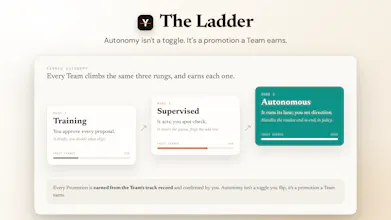
First, every action a Team can take carries a risk profile: is it reversible, how wide is the blast radius, does it touch money, etc. That profile sets a permanent ceiling on how autonomously that action can ever run. In practice:
Internal writes, scheduling, drafting a PR: reversible and contained, so this is the class that can eventually run autonomously. Still logged to the Feed with receipts, never silent.
A 1:1 customer email: contained but not reversible, so it's capped at supervised. It's surfaced per action with an undo window no matter how much trust the Team has earned.
Wiring money, blasting the whole list, deleting data: irreversible and high blast, so draft-only forever. A human approves every single one, and no amount of earned trust lifts that.
A Team changing its own configuration (its rhythms, its sources) is pinned at draft-only too. A Team never rewires itself silently.
Second, within those ceilings autonomy is earned, not granted. Every Team starts in training, where it drafts everything. Clean approvals and edits you shipped build evidence, reversals count against it, and riskier action types require more evidence. When the bar is met, YAGNI suggests the level up and a human confirms it. The system never promotes itself.
So the effective permission on any action is the minimum of what the Team has earned and what that action type can ever be trusted with. Proactive never means unattended.
Let me know if I can provide any more context, and thanks for the question!
Interesting approach. Does a team's autonomy score drop if it makes a costly mistake?
@dhiraj_patel5 Indeed it does! We count "reversals" or substantial edits as mistakes and can even demote the team down in autonomy level.
Congrats on the Launch @jackcollinshq!
Obvious question: is YAGNI running launch day? Curious what you handed a Team and what you kept for yourself.
@eriktaheri Love this question! But my honest answer... less than you'd guess, and I'd argue that's the on-brand answer.
By YAGNI's own rules, launch day is the worst possible thing to delegate. It's first-time work with no track record, it's high blast radius, and it's mostly 1:1 conversations with strangers that I genuinely want to have myself. In our model, a brand-new kind of work starts at the bottom of the ladder: training level, drafts only, human approves everything. That applies to my Teams the same as yours. If I'd handed launch day to an agent Team and called it a win, that would be exactly the unmanaged-agent move we built this product to prevent.
What YAGNI did do today is keep the normal machinery running in the background while I've been heads-down here all day. That's the actual promise of the product: not that an agent runs your launch, but that the routine work doesn't stall while you spend a whole day on something only you can do. Answering you is the part I kept, and the part I wanted!
Really appreciate the question - thanks!
Pasted my site URL and got a surprisingly thoughtful first team draft within seconds, not just a generic org chart. The track record idea for earning autonomy feels like something I'd actually want before handing off real decisions.
@zcanuslusoiuah I'm so happy to hear that!
The "empty room" challenge is one I put a lot of effort into. YAGNI needs context about your business to do its best work, and as a user it's always a pain to give a system a bunch of context just to get started.
So yes, we are building each Teams draft truly custom to your company as you get started, and of course you can edit and tweak their Goals / Responsibilities / Guardrails / etc as you go.
Let me know if you have any other questions!