
Warpforge
Warpforge is a cross-harness Agent IDE
14 followers
Warpforge is a cross-harness Agent IDE
14 followers
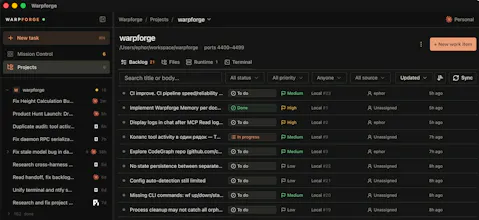
Warpforge is a cross-harness ADE. Eight coding agents (Claude Code, Codex, OpenCode, Qwen Code, Goose, Junie, Cursor, Pi) run in one local workspace on the subscriptions you already pay for. Set a project up once and every task after that starts with its dev services, ports, and logs running. Plan in one agent, implement in another, review in a third, or let a workflow run that sequence, with the live diff next to the running app. Harnesses share one memory. Open source, MIT, fully local.




Free
Launch Team / Built With


LightfieldAI-native CRM that builds itself and does work for you
Promoted
Hi PH. I'm Ihor.
Warpforge started as a runtime manager, not an agent tool. I work across several projects with their own backends, frontends, services, ports, and k8s port-forwards, and I was tired of the terminal-tab archaeology of working out which thing had 3000 today. Then coding agents arrived and multiplied it: three agents, three terminals, three sets of logs, and no clear picture of what any of them had changed.
Agents came later, layered on top of the runtime.
So: register a project once, and every task after that comes up with its services started in dependency order, logs captured, and its own 100-port range starting at 4000. Eight harnesses (Claude Code, Codex, OpenCode, Qwen Code, Goose, Junie, Cursor, Pi) connect over ACP through the CLI you already installed and authenticated, so there's no Warpforge account and no API key. Plan in one, implement in another, review in a third, or configure a workflow pipeline that runs plan → implement → review ⇄ fix and stops for you at the barriers.
The part I use most is the shared memory. Claude Code reads CLAUDE.md, Codex reads AGENTS.md, opencode reads its own, so teaching one taught none of the others. Now it's a single local store with global and per-project scope, plus a pass that checks stored facts against the codebase and proposes corrections for you to approve.
It's young. macOS Apple Silicon and Linux x64 are the validated targets, Windows is an unvalidated preview, and state stays on one machine. MIT.
If you're running more than one agent today: what still sends you back to the terminal?