
Cekura enables Conversational AI teams to automate QA across the entire agent lifecycle—from pre-production simulation and evaluation to monitoring of production calls. We also support seamless integration into CI/CD pipelines, ensuring consistent quality and reliability at every stage of development and deployment.
This is the 4th launch from Cekura. View more

Cekura
Launching today
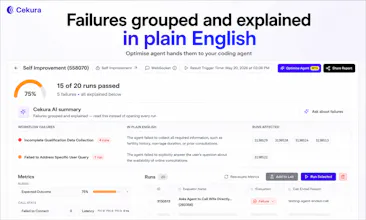
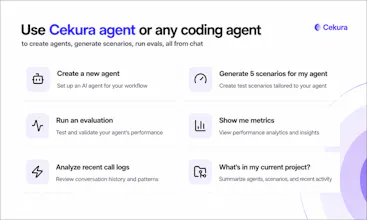
Cekura is the testing, observability, and self-improvement platform for production voice and chat AI agents. It simulates thousands of scenarios, catches failures, diagnoses the root cause, rewrites prompts and config, then re-validates with a full regression sweep. Unlike tools that hand failures back to your team, Cekura closes the loop by fixing the agent itself and proving the fix holds without overfitting.




Free Options
Launch Team


Self-improvement loop is a bold claim but if it actually rewrites config and proves the fix holds, that's a real product, not just a dashboard.
Cekura
@sulemna_ola That's exactly what we're aiming for. Hopefully we're moving the needle from dashboards to fixes that are actually proven before they're trusted.
Voice agents are unforgiving compared to chat, a bad pause or mistimed interruption sticks out immediately. I appreciate that it treats voice and chat as needing the same rigor rather than bolting voice support onto a chat-first tool.
Cekura
@james_will1 Thanks! That's basically what we built Cekura for.
Cekura doesn't answer the calls, it stress tests the agent that does. We generate personas that talk like real users: different accents, interruptions, mumbled order numbers, background noise, code switching mid sentence.
And we score full conversations, not single turns. Did the agent hold state after a topic switch? Did it recover from mishearing something on turn 3?
When it fails, you get the root cause and the fix passed to your coding agent, not just a red flag on a dashboard.
Cekura
@james_will1 This is the exact thing we refused to compromise on. The moment you evaluate a voice agent by reading its transcript, you've deleted the dimension where it actually fails — timing, barge-in, overlapping speech. So voice is tested at the audio layer, not as chat with extra steps. Appreciate you calling it out.
this is squarely the problem we deal with running voice AI. the thread so far is all about logical correctness (did the agent do the right thing), but a huge chunk of our real failures are cases where the words are technically right and the delivery is off - wrong pacing after an interruption, a flat tone on something that should sound apologetic, talking over a caller who paused to think rather than finished. does Cekura's simulation/scoring catch prosody and delivery quality as a distinct failure category, or is it mainly evaluating on transcript content right now
Reading this made me think about how much time my team spends manually reproducing a bad call just to figure out what went wrong. Automating that alone would be huge.
Cekura
@ramish_saje Couldn't agree more. Hunting down logs to replay a bad call takes way too much time. Automating that reproduction and root-cause diagnosis was step one for us. Really appreciate the support!
How does Vocera handle accuracy and context when conversations get more complex or users have different speaking styles? Congrats @kabra_sidhant & team!
Cekura
@hamza_afzal_butt Thank you! Cekura tests agents across varied scenarios, speaking styles, interruptions, and multi-turn context—not just isolated turns. It also preserves conversation history and evaluates whether the agent completed the intended outcome, so accuracy holds up as interactions get more complex.
Cekura
@hamza_afzal_butt Our evaluators are written against intent, not exact wording — conditions like "the agent asks for your name" match semantically regardless of how a specific agent phrases it, and grading runs over the full conversation using LLM/rubric-based judging rather than pattern matching. So the same test generalizes across agents with different tones, styles, or conversational complexity, without needing to be rewritten per agent.
What I like about this is the regression sweep step. I've seen too many "fixes" break something else three calls later because nobody checked the blast radius.
the without overfitting part is doing a lot of heavy lifting in that description, and its the right thing to be worried about. an auto-fixer that cant prove the fix generalized is just prompt roulette.