
VitaminD Explorer
Sun and vitamin D, calculated for your skin type
4 followers
Sun and vitamin D, calculated for your skin type
4 followers
Generic advice says "get 15 minutes of sun". That's right for two of the six skin types and wrong for the rest. This calculates your window from your skin, location, age and live UV — 5 min for type I, 30 for type VI. Free, no account, 6 languages.




Free
Launch Team / Built With


Tines The single, secure environment for agents, apps, and automations.
Promoted
Hey Product Hunt 👋
Every source tells you "get 10 to 15 minutes of sun for vitamin D". I checked what that advice actually means, and it's correct for skin types III and IV — and wrong for the other four.
Same city, same hour, same exposed skin, 1000 IU target:
- Type I (very fair, always burns): 5 minutes
- Type III (medium): 7.5 minutes
- Type VI (dark, never burns): 30 minutes
Six times the difference. Advice that ignores it is wrong for two thirds of the people reading it.
That comparison is a public page now — all six types, with every assumption behind the numbers written on the page itself:
https://getvitamind.app/en/how-l...
It needs no install and no account, so you can check the claim before deciding whether the rest is worth your time.
What it does
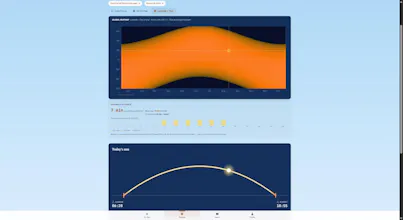
Enter a city — any of 235,000+ — and it computes today's synthesis window from solar geometry, ozone, live UV and cloud cover, adjusted for your skin type, age and how much skin is exposed. It tells you how many minutes you need and when the window opens.
It also tells you when the answer is no. Above ~50°N there are months where synthesis is physically impossible at any duration, because UV never reaches the threshold. Most tools quietly return a number anyway.
The bits I'm proudest of
- The model is auditable. Holick & Dowdy (2010) for synthesis, Madronich for UV, van Heuklon for ozone. The methodology page shows the actual formulas — and the assumptions, including the ones that would make the number wrong for you.
- It's an MCP server too. If you use Claude or another MCP client, you can ask your assistant directly — it connects to the same engine, with your skin type. Fifteen tools, nine of them public.
- Daily notifications, only on days when synthesis is actually possible. Sent at your local morning, not at a fixed UTC hour (that one took an embarrassing while to notice).
- No account needed for any of it. Sign-in exists only to sync across devices.
- Six languages: EN, ES, FR, DE, RU, LT.
What it doesn't do
It's not medical advice, and it doesn't diagnose deficiency — only a blood test does that. When the sun can't do the job it says so and points at the supplement literature, without telling you what to take.
Built solo, free, no ads, no tracking beyond page counts.
I'd love to hear where it's wrong. Especially if you're at a latitude I haven't thought hard enough about.