
Trend-Analytic
AI YouTube Intelligence, Knowledge Engine & Video Studio
2 followers
AI YouTube Intelligence, Knowledge Engine & Video Studio
2 followers
Trend-Analytic is a multimodal AI intelligence platform for YouTube. We analyze video transcripts, comments, and narrative pacing to uncover Brand Safety, manipulation index, and psychological drivers. Features include head-to-head creator battles, B2B media packs with predictive CPM/CPE, an automated knowledge factory converting transcripts into illustrated books, and a programmatic video studio producing multi-speaker vertical videos with studio-grade audio.




Hey Product Hunt community! 👋
I’m Andrey, the solo founder and system architect of Trend-Analytic. I have spent many months engineering, refining, and stress-testing this platform, and it is now operating smoothly in live production.
I built Trend-Analytic to solve two massive problems in creator tech: traditional YouTube tools rely strictly on surface vanity metrics (subscriber counts, view counters) that conceal manipulation, brand safety risks, and factual fraud. Simultaneously, creators and online educators struggle to convert hours of unstructured videos and literature into structured, high-value assets without falling into low-quality "AI slop".
I engineered Trend-Analytic as an end-to-end multimodal intelligence platform built around three comprehensive pillars:
1. Deep YouTube Intelligence & B2B Media Packs:
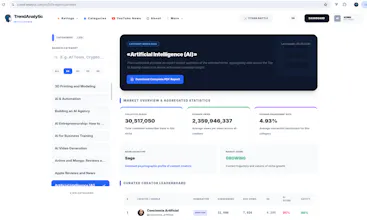
The platform analyzes raw spoken transcripts and community comments to calculate manipulation index, truthfulness score, brand safety, and audience psychological drivers.
Real-time head-to-head Creator Battles with deep cross-niche intersection mapping and qualitative AI verdicts.
Automated 4-page executive B2B Category Media Packs across 90+ industries featuring predictive CPM, estimated CPE, ad load metrics, and top-10 verified creator leaderboards.
2. Modular Knowledge Factory & Anti-AI-Slop Publishing:
Tri-source RAG engine pairing real YouTube video transcripts with academic literature (via Google Scholar) and technical documentation through a high-performance Qdrant vector database.
5 versatile content tiers: from quick analytical insights and in-depth longreads to modular executive summaries (3–4 chapters), standard curriculum courses (5–7 chapters), and deep comprehensive master-books (10–15 chapters).
Features distinct "Theory vs. Practice" reality-check comparison blocks, automated glossary compilation, and persona-driven tone-of-voice controls without generic machine clichés.
3. Programmatic PHP + Python AI Video Studio:
End-to-end vertical video production supporting single monologues, podcast-style dialogues, and multi-speaker debate formats.
Programmatic Puppeteer scene composition across dynamic layouts (Split-Screen, Stream UI, Infographic UI with live chart fetching) and 10 aesthetic visual themes (Cyber Tech, Corporate Gold, Dark Luxury, Neon Dark, etc.).
Cinematic atmosphere and camera dynamics (volumetric bokeh, retro film grain, camera zooms and pans) paired with curated background audio tracks.
Advanced linguistic and phonetic adaptation engine: automated Unicode stress-accent correction, conjunction de-comma-ing to eliminate speech stutter, tech acronym transliteration, and broadcast-standard -16 LUFS loudness normalization.
Launch Offer & Community Access:
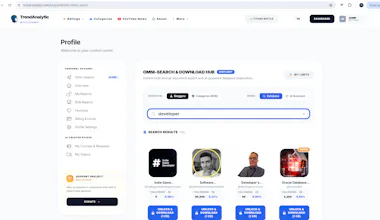
Public creator audits, interactive battles, category media packs, and sample knowledge materials are completely open for free exploration without mandatory registration.
For the Product Hunt community, use promo code PHTRENDSBEST on Whop to get 50% off the first month on all plans.
I will be online all day to answer technical questions about the vector retrieval pipeline, phonetic audio engine, and analytics architecture.
Drop your favorite YouTube channel in the comments, and I’ll run an instant deep teardown for you right in the thread! 🚀
Deep Dive: How we engineered the Anti-AI-Slop Knowledge Engine (RAG + AI Personas + Multimodal Formatting) 📚⚙️
Most AI-generated educational content on the web today is generic "AI slop" — superficial summaries rewritten from Wikipedia without verifiable facts, code validation, or actionable nuance.
When engineering Trend-Analytic’s Knowledge Engine, my goal was to build a rigorous multi-source publishing pipeline that produces production-grade technical articles, executive chapter summaries, and multi-module master-books.
Here is how the architecture works under the hood:
Tri-Source Grounded RAG Pipeline:
Instead of prompting an LLM in a vacuum, the system retrieves and cross-references chunks from three distinct data vectors in Qdrant:
Raw spoken transcripts extracted from verified YouTube practitioner channels (capturing real-world insights and edge cases).
Academic literature and research papers fetched via automated Google Scholar / repository indexing.
Official technical documentation and verified domain articles scraped through anti-bot resilient fetchers with proxy rotation.
Deterministic AI Persona Calibration:
To eliminate robotic phrasing ("In today's fast-paced world..."), the engine employs 12 Jungian Archetypes combined with mathematical behavior scales:
Emotional intensity, metaphor density, entropy level, and slang/jargon indices (from 0.0 to 1.0).
Cultural frameworks (e.g., Asian Collectivist vs. Western Pragmatist) that enforce a consistent, authentic tone-of-voice across multi-chapter courses.
Structured Pedagogical Formatting:
The pipeline doesn't just output raw markdown — it runs through an automated Content Renderer:
Theory vs. Practice Reality Checks: Dedicated visual callout blocks contrasting academic concepts with production edge-cases.
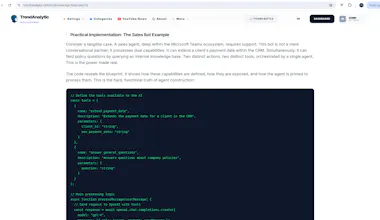
Code & Formula Sanitization: Automatic validation of syntax highlighting (PHP, Python, SQL, JSON) and LaTeX equations with isolated styling.
Graphic Placeholders & Fallback Rendering: Programmatic detection of conceptual descriptions to trigger DALL-E/GPT Image generation with automatic WebP compression.
Multi-Format Export Drivers:
Every generated material compiles into standalone PDF documents, Word DOCX files, and clean HTML books, supporting text-only modes and custom font bin-packing for A4 print optimization.
Drop a topic or technology you want to master, and I'll generate a live curriculum preview!
Behind the Scenes: Programmatic Vertical Video Generation with Puppeteer, OpenAI TTS & Phonetics 🎬🛠️
Creating short-form educational videos typically requires juggling 4 different tools, manually fixing robotic voiceovers, and dealing with static slides. We engineered Trend-Analytic’s AI Video Studio as an automated headless pipeline in PHP & Python.
Here are the key technical problems we solved:
Solving the Robotic TTS Pronunciation Bottleneck:
Off-the-shelf voice synthesizers struggle with conversational speech, acronyms, and natural pauses. We built a dedicated Language Phonetic Service:
Automatic de-comma-ing before conjunctions to eliminate unnatural verbal stuttering.
Unicode stress-accent injection and ё-fication for Slavic locales.
Phonetic transliteration of technical acronyms (e.g., "ROI", "B2B", "SMM", "API") to ensure native pronunciation.
Speech Dynamics Calibration (SDC): Mathematical tempo adjustment based on word count to guarantee video duration fits strict 60-second limits without sounding chipmunked.
-16 LUFS audio normalization via FFmpeg for broadcast-standard loudness on Shorts and Reels.
Programmatic Browser-Rendered Video Layouts:
Instead of static images with text overlays, our pipeline uses headless Puppeteer to render live HTML/Tailwind templates into crisp 1080x1920 WebP video frames:
Split-Screen Dialogue & Debates with dynamic speaker active-state lighting.
Infographic UI: Programmatically queries Google Images / Serper to download real-time charts and financial dashboards directly into the slide layout.
10 Centralized Design Themes: Pre-calibrated palettes (Cyber Tech, Corporate Gold, Dark Luxury, Neon Dark, etc.) ensuring visual consistency across all scenes.
Lock-Free Asynchronous Orchestration:
Video generation runs as an asynchronous pipeline:
Stage 1 generates the conversational script, audio chunks, and visual prompts in background worker queues.
Stage 2 dispatches parallel image generation batches, pre-allocating deterministic file paths on disk to avoid database locks.
Final assembly is handled by a dedicated Python/MoviePy compiler that stitches audio, applies camera pan/zoom dynamics, integrates background music, and exports the final MP4.
Happy to dive deeper into the FFmpeg filters or the prompt strategy if anyone has questions!