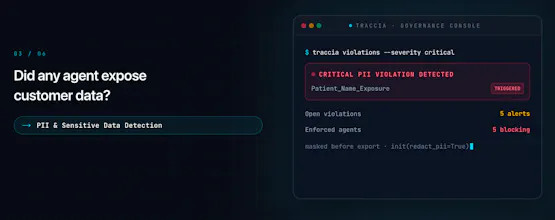
Traccia is a vendor-neutral AI Agent Control Plane built for teams running autonomous agents in production. Observe agent behavior, evaluate performance, govern actions with policies and runtime controls, and maintain an auditable trail of what happened. Built with an open, developer-first SDK and OpenTelemetry, Traccia works across models, frameworks, and existing observability stacks—so teams can control their agents without being locked into a single AI vendor.
We’ve been building Traccia because we kept seeing the same gap with AI agents: once an agent can call tools, make decisions and take actions, a traditional trace can tell you what happened — but not whether that action was acceptable.
With traditional software, an execution usually follows a path defined by the developer. Agents are different. They can reason, choose tools, change their path and take actions we didn’t explicitly define.
That creates a new infrastructure problem for teams deploying agents in production:
What did the agent do? Why did it do it? Was it allowed to? Which policy and permissions applied? And can we prove what happened afterwards?
Traccia is our AI Agent Control Plane — a vendor-neutral layer to observe what agents do, evaluate how they behave, govern what they’re allowed to do, and audit what happened.
We’ve open-sourced the Traccia SDK and built it developer-first, with OpenTelemetry at the foundation. It works across models and agent frameworks, so teams can add observability and governance without being locked into a single AI vendor. We’re still early, and we’re building this alongside developers and teams actually deploying agents.
I’d especially love feedback from people running agents in production:
What are you using today to debug agent behaviour? How are you evaluating agents? And more importantly — how do you control what an agent is allowed to do?
We’re also making it easier to try Traccia during the launch.
I’m one of the makers of Traccia. If you’ve ever watched an agent take a tool call you didn’t expect and then scrolled a 2,000-span trace trying to answer “was that even allowed?” - that’s the pain that started this.
Full-fidelity traces across models/agent frameworks
Eval path: prompts → datasets → scorers → experiments before you promote
Runtime governance: policies + evidence so “observe” isn’t the end of the story
Who this is for Teams putting agents in production - not demos. If your stack already tells you what happened, but not whether it should have happened, you’re our ICP.
One ask If you run agents in prod, comment with your current stack for:
debugging a bad tool call
deciding promote vs rollback
blocking an action at runtime
Even “we use X and it’s fine/it sucks because Y” helps more than a silent upvote.
Trying Traccia today? Platform is open - use coupon TRACCIAPH for 3 months free. I’ll be in the comments all day and will answer everything personally.
Traccia
We’ve been building Traccia because we kept seeing the same gap with AI agents: once an agent can call tools, make decisions and take actions, a traditional trace can tell you what happened — but not whether that action was acceptable.
With traditional software, an execution usually follows a path defined by the developer. Agents are different. They can reason, choose tools, change their path and take actions we didn’t explicitly define.
That creates a new infrastructure problem for teams deploying agents in production:
What did the agent do? Why did it do it? Was it allowed to? Which policy and permissions applied? And can we prove what happened afterwards?
Traccia is our AI Agent Control Plane — a vendor-neutral layer to observe what agents do, evaluate how they behave, govern what they’re allowed to do, and audit what happened.
We’ve open-sourced the Traccia SDK and built it developer-first, with OpenTelemetry at the foundation. It works across models and agent frameworks, so teams can add observability and governance without being locked into a single AI vendor. We’re still early, and we’re building this alongside developers and teams actually deploying agents.
I’d especially love feedback from people running agents in production:
What are you using today to debug agent behaviour?
How are you evaluating agents?
And more importantly — how do you control what an agent is allowed to do?
We’re also making it easier to try Traccia during the launch.
3 months free with coupon code: TRACCIAPH
Traccia
Hey Product Hunt 👋 We’re live.
I’m one of the makers of Traccia. If you’ve ever watched an agent take a tool call you didn’t expect and then scrolled a 2,000-span trace trying to answer “was that even allowed?” - that’s the pain that started this.
What ships today
Open-source SDK (Python + Node), OpenTelemetry-native
Full-fidelity traces across models/agent frameworks
Eval path: prompts → datasets → scorers → experiments before you promote
Runtime governance: policies + evidence so “observe” isn’t the end of the story
Who this is for
Teams putting agents in production - not demos. If your stack already tells you what happened, but not whether it should have happened, you’re our ICP.
One ask
If you run agents in prod, comment with your current stack for:
debugging a bad tool call
deciding promote vs rollback
blocking an action at runtime
Even “we use X and it’s fine/it sucks because Y” helps more than a silent upvote.
Trying Traccia today? Platform is open - use coupon TRACCIAPH for 3 months free. I’ll be in the comments all day and will answer everything personally.
https://traccia.ai
- Aditya (and the Traccia team)