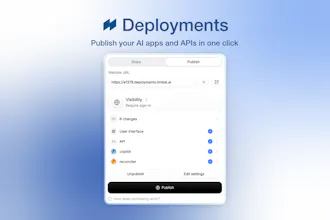
Timbal helps teams turn AI prototypes into production systems. Build agents and workflows, connect them to your data, design interfaces, deploy, monitor, evaluate, and govern everything from one platform. Instead of assembling separate tools for retrieval, orchestration, UI, observability, and evals, Timbal gives you one core for shipping reliable AI applications.
No reviews yetBe the first to leave a review for Timbal AI
Congrats on the launch! I build AI agents internally for a 40-person company and my current stack is duct tape: prompts in one place, tools in another, deployment somewhere else. One stack for all of it is exactly the pitch that gets me. Question: how do you handle testing before an agent hits production? Rolling back a bad prompt change has burned me more than once, so versioning and evals are what I’d look at first.
@ridhwikvinod On your specific pain point, rollback. Every workflow is a real git repo, commits, diffs, branches. A bad prompt change is just a commit you revert, same as reverting any other code change, no separate rollback UI to figure out under pressure.
On testing before production:,you define evals per step, so you're not just checking "did the final output get worse," you can pinpoint which exact node degraded. Composer can also scaffold a starting eval set for you if writing them from scratch isn't where you want to spend time.
For a 40-person team running this internally without a big platform team behind it, that combination (git-native rollback + step-level evals) is probably what saves you the most time day to day, not because either piece is fancy, but because you already know how to use them.
Report
how do you manage version control across workflows. a simple visual history could help teams track every important change.
@darly_selby Great question! Every workflow in Timbal is a git repo under the hood full commits, diffs, branches, the works. You can clone it, review it on GitHub, and roll back exactly like any other codebase. Environments map to branches too, so promoting dev → prod is a merge, not a copy-paste.
Love the visual history idea though!
Report
Congrats on the launch!! That's a really cool project, I tried to create a simple agent and it really satisfied my expectations.
@yernururu Thanks, glad the agent held up! Fair question, and actually it tends to go the other way. ACE stops agents from wandering into extra tool calls, so token usage often drops instead of climbing, and overall ends up more economical 🙂
Report
The "one stack" pitch is appealing — the amount of time spent stitching together separate tools for
retrieval, orchestration and observability adds up quickly. How does it handle model switching mid-workflow?
Curious whether you can swap between providers without rebuilding the whole pipeline.
@charles_mondal_phd Great question! And yes, that's genuinely just swapping a string, models are referenced as "provider/model" throughout, so switching Anthropic to OpenAI to Gemini mid-pipeline doesn't touch the rest of the logic. You can also chain providers as an automatic fallback (if one fails or times out, it tries the next) instead of hardcoding just one. No rebuild, no separate integration per provider.
Report
Bringing tracing and evaluation into the runtime is a strong choice. One thing I’m curious about: how do evaluations handle long-running agents whose context changes over time? A workflow can pass step-level checks while gradually acting on stale or contradictory context. Do you evaluate the assembled context itself, or mainly the agent’s resulting actions?
@amir_mehrabi Sharpest question in this thread, Amir. You're describing a real failure mode: step checks pass locally while the trajectory drifts because the context feeding those steps went stale or contradictory.
We evaluate both, deliberately. Evals can run against any point in the assembled state, including the context itself, not just the resulting action, so you can catch a contradiction before it produces a bad output. And since the full run is traced, evals can also run retroactively across the whole trajectory, which is what actually surfaces slow drift: nothing looks wrong at any single step, but the context now contradicts the context from a few steps back.
Action-only evals catch the wrong output. Context evals catch it before it gets there. Most teams only build the first one until they get burned once.
Report
Love how you're baking governance and step-level tracing into the runtime itself, turning the usual after-the-fact scramble into something you can just replay and inspect.
@ilko_kacharov Hey Ilko! The alternative most teams end up building is logs scattered across five different tools, and by the time something breaks you're reconstructing what happened from fragments. Baking tracing into the runtime means every step, model calls, tool calls, retries, fallbacks, is already captured as it happens. You're not debugging from memory, you're replaying the exact decision chain.
@ilko_kacharov Also just checked out Juma AI, the marketing focus is really interesting, that's actually my world day to day. Would love to compare notes sometime 🙌
Report
congrats on the launch!
I am curious, why a company would prefer to use Timbal vs Claude or Devin?
@0xpili Thanks for your support! The reality is that they're not really direct competitors, more different layers. Claude is a model, you'd actually still use Claude models inside Timbal if you want, we're provider-agnostic, not locked to one. Devin is a specific agent built for one job, writing code autonomously. Timbal is the platform underneath, for a company building multiple different agents across the business (support, ops, internal tools, whatever), each one needs deployment, monitoring, governance, and a place to actually run in production.
So it's less "pick Timbal instead of Claude" and more "Timbal is what you'd use to actually ship and run agents reliably, whichever model or use case you're building for."



Timbal AI
@ridhwikvinod On your specific pain point, rollback. Every workflow is a real git repo, commits, diffs, branches. A bad prompt change is just a commit you revert, same as reverting any other code change, no separate rollback UI to figure out under pressure.
On testing before production:,you define evals per step, so you're not just checking "did the final output get worse," you can pinpoint which exact node degraded. Composer can also scaffold a starting eval set for you if writing them from scratch isn't where you want to spend time.
For a 40-person team running this internally without a big platform team behind it, that combination (git-native rollback + step-level evals) is probably what saves you the most time day to day, not because either piece is fancy, but because you already know how to use them.
how do you manage version control across workflows. a simple visual history could help teams track every important change.
Timbal AI
@darly_selby Great question! Every workflow in Timbal is a git repo under the hood full commits, diffs, branches, the works. You can clone it, review it on GitHub, and roll back exactly like any other codebase. Environments map to branches too, so promoting dev → prod is a merge, not a copy-paste.
Love the visual history idea though!
Congrats on the launch!!
That's a really cool project, I tried to create a simple agent and it really satisfied my expectations.
But what about token usage? isn't it expensive?
Timbal AI
@yernururu Thanks, glad the agent held up! Fair question, and actually it tends to go the other way. ACE stops agents from wandering into extra tool calls, so token usage often drops instead of climbing, and overall ends up more economical 🙂
The "one stack" pitch is appealing — the amount of time spent stitching together separate tools for
retrieval, orchestration and observability adds up quickly. How does it handle model switching mid-workflow?
Curious whether you can swap between providers without rebuilding the whole pipeline.
Timbal AI
@charles_mondal_phd Great question! And yes, that's genuinely just swapping a string, models are referenced as "provider/model" throughout, so switching Anthropic to OpenAI to Gemini mid-pipeline doesn't touch the rest of the logic. You can also chain providers as an automatic fallback (if one fails or times out, it tries the next) instead of hardcoding just one. No rebuild, no separate integration per provider.
Bringing tracing and evaluation into the runtime is a strong choice. One thing I’m curious about: how do evaluations handle long-running agents whose context changes over time? A workflow can pass step-level checks while gradually acting on stale or contradictory context. Do you evaluate the assembled context itself, or mainly the agent’s resulting actions?
Timbal AI
@amir_mehrabi Sharpest question in this thread, Amir. You're describing a real failure mode: step checks pass locally while the trajectory drifts because the context feeding those steps went stale or contradictory.
We evaluate both, deliberately. Evals can run against any point in the assembled state, including the context itself, not just the resulting action, so you can catch a contradiction before it produces a bad output. And since the full run is traced, evals can also run retroactively across the whole trajectory, which is what actually surfaces slow drift: nothing looks wrong at any single step, but the context now contradicts the context from a few steps back.
Action-only evals catch the wrong output. Context evals catch it before it gets there. Most teams only build the first one until they get burned once.
Love how you're baking governance and step-level tracing into the runtime itself, turning the usual after-the-fact scramble into something you can just replay and inspect.
Timbal AI
@ilko_kacharov Hey Ilko! The alternative most teams end up building is logs scattered across five different tools, and by the time something breaks you're reconstructing what happened from fragments. Baking tracing into the runtime means every step, model calls, tool calls, retries, fallbacks, is already captured as it happens. You're not debugging from memory, you're replaying the exact decision chain.
Timbal AI
@ilko_kacharov Also just checked out Juma AI, the marketing focus is really interesting, that's actually my world day to day. Would love to compare notes sometime 🙌
congrats on the launch!
I am curious, why a company would prefer to use Timbal vs Claude or Devin?
Timbal AI
@0xpili Thanks for your support! The reality is that they're not really direct competitors, more different layers. Claude is a model, you'd actually still use Claude models inside Timbal if you want, we're provider-agnostic, not locked to one. Devin is a specific agent built for one job, writing code autonomously. Timbal is the platform underneath, for a company building multiple different agents across the business (support, ops, internal tools, whatever), each one needs deployment, monitoring, governance, and a place to actually run in production.
So it's less "pick Timbal instead of Claude" and more "Timbal is what you'd use to actually ship and run agents reliably, whichever model or use case you're building for."